
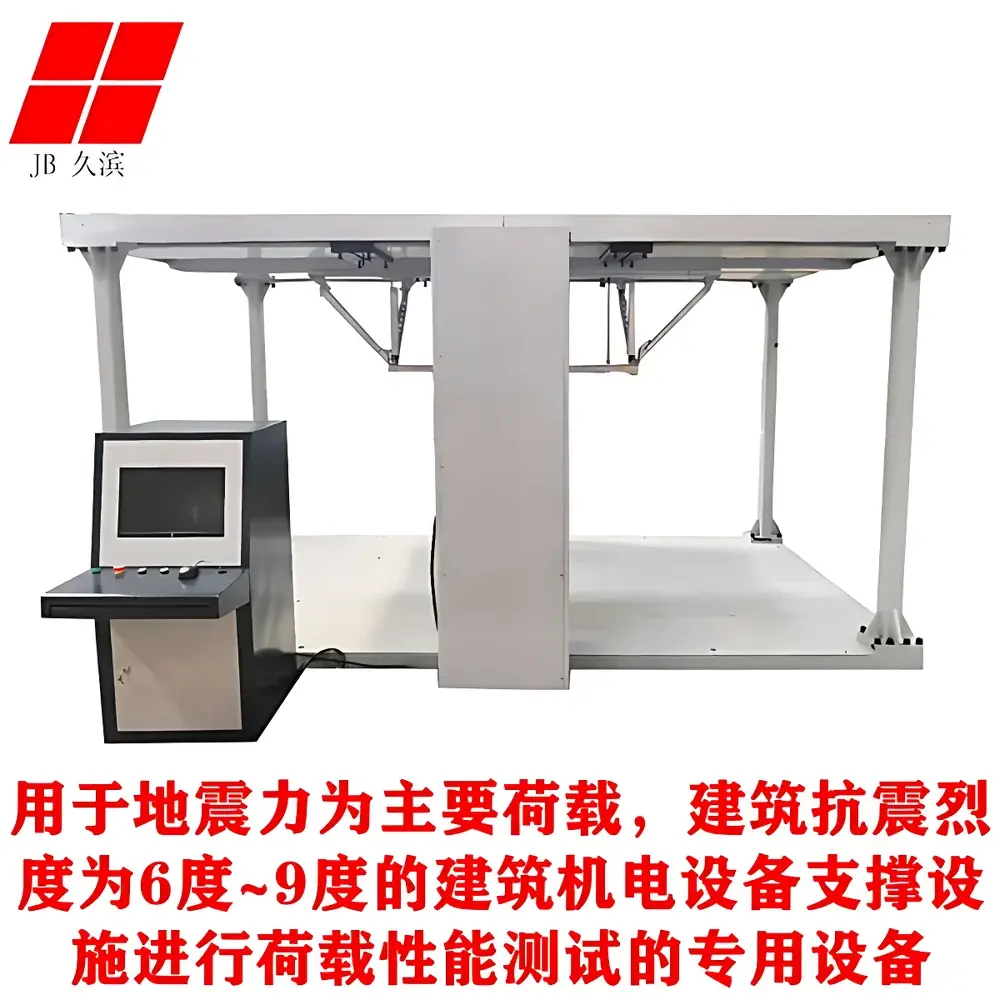
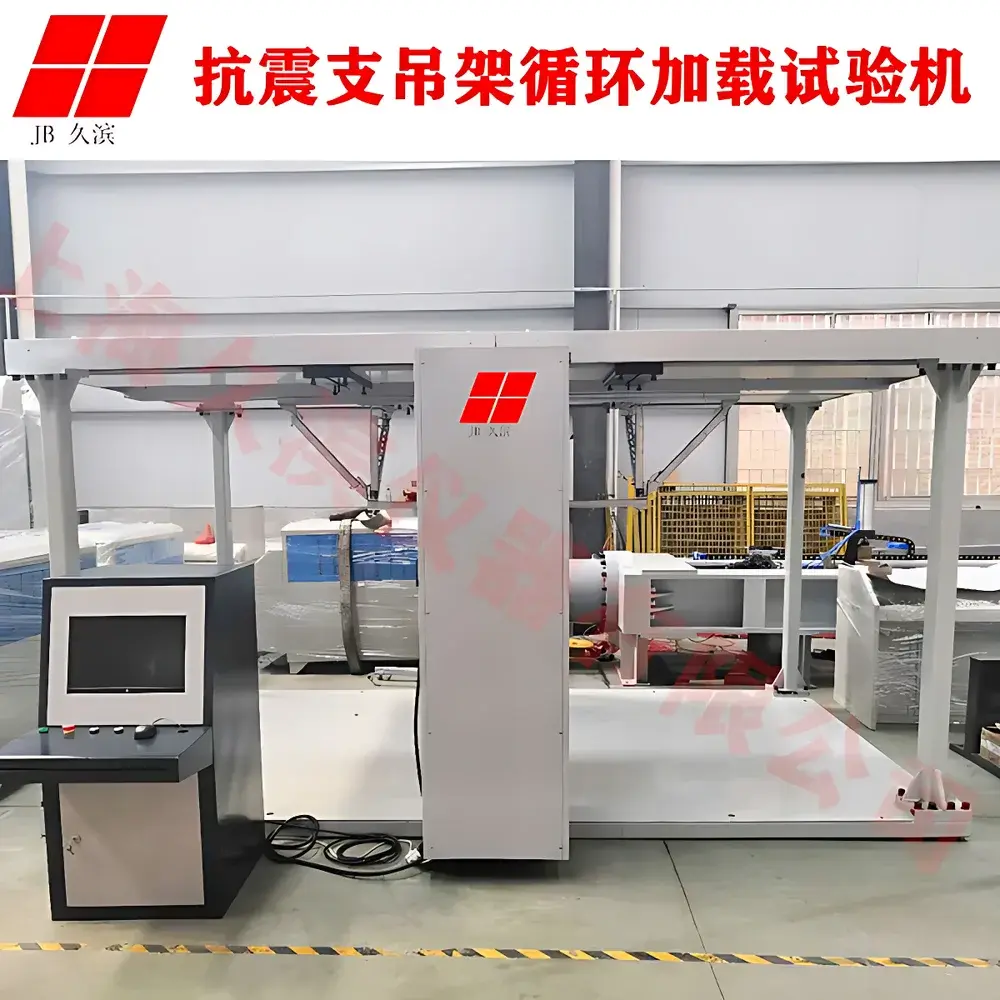
Jiubin JB-JPL Seismic Bracing Cyclic Loading Test Machine
| Brand | Jiubin Instruments |
|---|---|
| Origin | Shanghai, China |
| Manufacturer Type | Authorized Distributor |
| Origin Category | Domestic (China) |
| Model | JB-JPL |
| Pricing | Available Upon Request |
| Power Supply | 6 kW, 380 V AC |
| Control System | PC-based Closed-loop Servo Control |
| Display & Programming | Dedicated Windows-based HMI Software |
| Cyclic Loading Frequency | 0.1 Hz (Compliance Mode) |
| Maximum Static Load Capacity | 40 kN |
| Load Cell Capacity | 50 kN |
| Load Resolution | 2 N |
| Fatigue Sinusoidal Test Profile | ±20.4 kg mass equivalent at 3 Hz |
| Vertical Specimen Height Range | 500–1000 mm |
| Footprint | 4000 mm × 3000 mm × 2200 mm (L×W×H) |
Overview
The Jiubin JB-JPL Seismic Bracing Cyclic Loading Test Machine is an engineered electromechanical testing system designed to evaluate the structural integrity, fatigue resistance, and load-bearing reliability of seismic bracing and hanger assemblies used in building mechanical and electrical (MEP) systems. It operates on the principle of controlled servo-hydraulic or servo-electromechanical actuation to apply precisely defined cyclic displacement or force waveforms—primarily sinusoidal and trapezoidal profiles—according to standardized test protocols. The system is purpose-built for simulating seismic excitation conditions corresponding to design intensities of 6–9 degrees on the China Seismic Intensity Scale (CSIS), aligning with static and dynamic loading requirements specified in JG/T 476–2015 and GB/T 37267–2018. Unlike general-purpose universal testers, the JB-JPL integrates dedicated fixture kinematics, dual-axis symmetric loading capability, and real-time load-displacement synchronization to replicate the multi-directional restraint behavior of installed seismic supports under repeated lateral and vertical inertial loads.
Key Features
- Compliance-driven test architecture calibrated for JG/T 476–2015 Section 6.3 (Component Load Performance) and GB/T 37267–2018 Sections 5.4.1 (Cyclic Loading Performance) and 6.4 (Pipe Connection Component Load Testing)
- Dual-specimen symmetric mounting configuration enables simultaneous evaluation of left/right assemblies under identical boundary conditions, improving inter-test reproducibility
- High-resolution 50 kN load cell with 2 N resolution ensures traceable force measurement across the full 0–40 kN operational range
- Programmable low-frequency cyclic loading at 0.1 Hz—optimized for long-duration endurance validation per seismic service life expectations
- Separate high-frequency fatigue mode (3 Hz, ±20.4 kg equivalent inertial mass) for accelerated component-level durability screening
- Vertical specimen height adjustment range (500–1000 mm) accommodates standard pipe clamp, rod hanger, and sway brace configurations without retooling
- Integrated safety interlocks including emergency stop, over-travel limit switches, and load cell overload protection compliant with IEC 61508 SIL 2 functional safety principles
Sample Compatibility & Compliance
The JB-JPL accepts a wide range of commercially available seismic bracing components—including channel-based lateral braces, rod hangers with seismic clevises, pipe clamps, beam attachments, and U-bolt assemblies—provided they conform to nominal pipe sizes DN15–DN300 and standard mounting hole patterns per GB/T 700 and GB/T 1591. Fixturing is modular and configurable using T-slot base plates and adjustable support frames, enabling rapid setup for both single-component tests (e.g., connector weld integrity) and full sub-assembly evaluations (e.g., hanger + brace + anchor combinations). All test procedures are structured to satisfy third-party certification requirements under CNAS-accredited laboratories, with full alignment to GB/T 27025–2019 (equivalent to ISO/IEC 17025) for testing competence. Documentation packages include calibration certificates traceable to NIM (National Institute of Metrology, China) and raw data logs meeting GLP audit readiness criteria.
Software & Data Management
The JB-JPL is operated via a dedicated Windows-based control and analysis platform supporting deterministic real-time waveform generation, closed-loop PID regulation, and synchronized multi-channel acquisition (load, displacement, cycle count, time stamp). Each test sequence is stored as a parameterized protocol file (.jbp), allowing repeatable execution across shifts and operators. Raw data exports in CSV and HDF5 formats include millisecond-level timestamps and metadata such as ambient temperature, operator ID, and calibration expiration dates. Audit trail functionality complies with GB/T 22239–2019 (China’s Cybersecurity等级 Protection Standard) and supports 21 CFR Part 11–style electronic signature workflows when deployed in GMP-aligned infrastructure projects. Optional integration with LIMS platforms is available via OPC UA or RESTful API interfaces.
Applications
- Validation of seismic bracing systems prior to project submittal under GB 50981–2014 (Code for Seismic Design of Building MEP Systems)
- Factory acceptance testing (FAT) of OEM-branded hanger kits supplied to EPC contractors
- Root cause analysis of field-reported failures through comparative fatigue curve mapping (S–N plots)
- Development-stage verification of new connector geometries or damping elements under variable amplitude spectra
- Third-party type testing for CCC (China Compulsory Certification) and CE-marking equivalence assessments
- Research on hysteretic energy dissipation characteristics of elastomeric isolation interfaces in hybrid bracing solutions
FAQ
Does the JB-JPL meet international seismic testing standards such as ASCE 7 or ISO 13571?
The JB-JPL is engineered to fulfill the technical scope of JG/T 476–2015 and GB/T 37267–2018, which are harmonized with key provisions of ASCE 7–16 Chapter 13 and ISO 13571 Annex B for non-structural component qualification. Direct equivalency requires supplementary protocol adaptation and transducer validation per ASTM E2126.
Can the system perform displacement-controlled versus force-controlled cycling?
Yes. The control software supports both modes: force-controlled cycling for component load rating verification (per GB/T 37267–2018 5.4.1), and displacement-controlled profiling for hysteresis loop characterization in research applications.
Is remote monitoring or preventive maintenance support available?
Remote diagnostics via secure TLS-encrypted VNC sessions are supported. Predictive maintenance alerts are generated based on actuator current draw trends, thermal sensor thresholds, and load cell zero-drift accumulation—logged and reportable within the software dashboard.



