
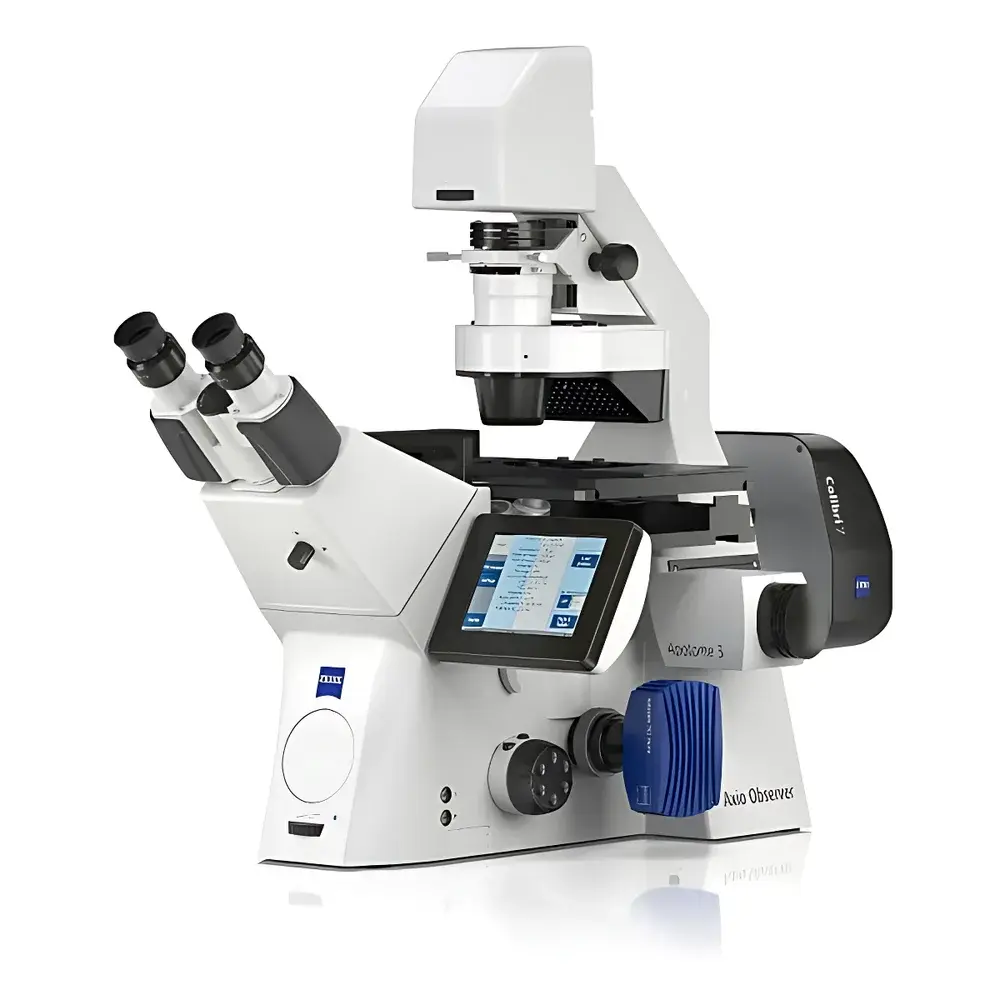
Zeiss Axio Observer 3/5/7 Research-Grade Inverted Fluorescence Microscope
| Brand | Zeiss |
|---|---|
| Origin | Germany |
| Model | Axio Observer 3 / Axio Observer 5 / Axio Observer 7 |
| Instrument Type | Inverted Fluorescence Microscope |
| Excitation Source | High-Power LED |
| Illumination Sources | LED + Halogen (for brightfield) |
| Fluorescence Module | HXP 120 V Mercury Arc Lamp (optional or hybrid configuration) |
| Eyepieces | Widefield 10×/23 mm |
| Objective Lens Series | LD (Long Working Distance) Plan-Apochromat |
| Observation Head | Trinocular |
| Z-Axis Resolution | ≤10 nm (motorized fine focus) |
| Optical Path | V-shaped high-transmission path |
| Contrast Optics | IC2S (Integrated Contrast & Color Correction System) |
| Fluorescence Path | Apochromatic, equipped with fluorescence light trap technology |
| AI Functionality | Zeiss AI-based Sample Recognition and Auto-Focus Mapping |
Overview
The Zeiss Axio Observer 3/5/7 is a modular, research-grade inverted fluorescence microscope engineered for high-precision live-cell imaging, fixed-sample analysis, and multi-modal correlative microscopy. Its core optical architecture employs a V-shaped light path—optimized to minimize optical path length and maximize photon throughput—ensuring exceptional signal fidelity across widefield, confocal-ready, and TIRF-capable configurations. Designed for rigorous life science applications, the system integrates motorized precision mechanics (including sub-10 nm Z-axis resolution), apochromatic fluorescence optics with proprietary light-trap technology to suppress stray emission, and an open hardware interface compliant with third-party peripherals including environmental chambers, micromanipulators, and high-speed sCMOS cameras. The platform adheres to ISO 10934-1 (microscope terminology) and ISO 9022-3 (optical instrument environmental testing), supporting GLP-compliant documentation workflows when paired with Zeiss ZEN software.
Key Features
- IC2S Optical System: Simultaneous chromatic and spherical aberration correction across visible and near-UV spectral ranges—critical for quantitative multicolor fluorescence co-localization and spectral unmixing.
- V-Path Optics: A rigid, folded illumination and detection pathway reduces mechanical drift and thermal lensing effects, enhancing long-term imaging stability during time-lapse experiments exceeding 24 hours.
- Motorized Precision Mechanics: Z-axis stepping resolution ≤10 nm; fully programmable stage with 130 × 85 mm travel range; optional piezo-driven objective nosepiece for rapid modality switching (e.g., phase contrast → fluorescence → DIC).
- HXP 120 V Fluorescence Excitation: Mercury arc lamp delivering stable UV–blue excitation (365 nm, 405 nm, 436 nm, 470 nm, 546 nm); compatible with LED-based alternatives (e.g., Colibri 7) for reduced phototoxicity in live-cell assays.
- ZEISS AI Sample Recognition: Trained on >50,000 annotated biological specimen images; automatically identifies slide edges, coverslip boundaries, and region-of-interest (ROI) clusters without manual thresholding—reducing setup time from minutes to seconds.
- Ergonomic Trinocular Head & Modular Design: Adjustable interpupillary distance (55–75 mm), diopter compensation (±5 dpt), and tilt angle (0–30°); standardized C-mount and M42 interfaces for seamless integration with external detectors or custom optical paths.
Sample Compatibility & Compliance
The Axio Observer accommodates standard 35 mm glass-bottom dishes, 6–96-well plates, and custom chamber slides up to 40 mm height—enabling extended-duration live-cell imaging under controlled CO2, temperature (20–40 °C), and humidity conditions. All optical components meet DIN EN 61000-6-3 (EMC immunity) and IEC 61010-1 (safety for laboratory equipment). When configured with ZEN Blue software and audit trail modules, the system supports 21 CFR Part 11 compliance for regulated environments (e.g., preclinical assay development, medical device biocompatibility testing). It is routinely validated against ASTM E2867 (standard guide for fluorescence microscope performance verification) and ISO 19041 (digital pathology image quality assessment).
Software & Data Management
ZEN Core and ZEN Blue provide unified acquisition, processing, and metadata annotation for widefield, Z-stack, time-lapse, and multi-channel fluorescence datasets. Raw data is saved in TIFF or native .czi format with embedded EXIF-style metadata (objective ID, exposure time, gain, lamp intensity, stage coordinates). Advanced features include deconvolution (Wiener filter, constrained iterative), spectral unmixing (linear unmixing with reference spectra), and AI-assisted cell segmentation (ZEN AI module trained on HeLa, U2OS, and primary neuron morphologies). Export options comply with OMERO, Bio-Formats, and FAIR data principles—ensuring interoperability with ImageJ/Fiji, Python-based analysis pipelines (e.g., scikit-image, napari), and institutional LIMS systems.
Applications
- Live-Cell Dynamics: Real-time tracking of Alexa Fluor 488–labeled proteins and DAPI-stained nuclei in primary cortical neurons; microtubule polymerization assays using anti-α-tubulin antibodies conjugated to Cy5.
- High-Content Screening (HCS): Automated quantification of nuclear translocation events in 96-well plates under pharmacological perturbation; supported by ZEN’s batch processing and machine-learning classification tools.
- Correlative Light-Electron Microscopy (CLEM): Precise coordinate mapping between fluorescence ROIs and subsequent EM sectioning via integrated fiducial marker registration.
- Material–Biointerface Studies: Imaging protein adsorption on biomedical implant surfaces (e.g., Ti-6Al-4V, PEEK) using reflection darkfield and epifluorescence dual-mode acquisition.
- Plant Cell Physiology: Chlorophyll autofluorescence combined with FM4-64 membrane staining in Arabidopsis thaliana root tips under hypoxic stress.
FAQ
What is the maximum working distance supported by LD objectives on the Axio Observer?
Standard LD Plan-Apochromat objectives offer working distances from 2.5 mm (20×) to 5.6 mm (40×), enabling compatibility with thick culture vessels and perfusion chambers.
Can the Axio Observer be integrated with electrophysiology rigs?
Yes—via synchronized TTL triggering, analog voltage input/output ports, and Zeiss’ EPP (Electrophysiology Patch Clamp) interface module for simultaneous patch-clamp recording and fluorescence imaging.
Is ZEN software included with hardware purchase?
ZEN Blue is bundled with all Axio Observer systems; ZEN Black (for advanced confocal and super-resolution modes) requires separate licensing.
Does the system support structured illumination microscopy (SIM)?
The Axio Observer 7 platform is compatible with Zeiss Elyra 7 SIM modules; retrofitting requires optical path alignment certification and additional laser safety interlocks.
How is calibration traceability maintained for quantitative intensity measurements?
Zeiss provides NIST-traceable photometric calibration kits (e.g., QIClick standard slides) and built-in flat-field correction routines validated per ISO 17025-accredited protocols.



