
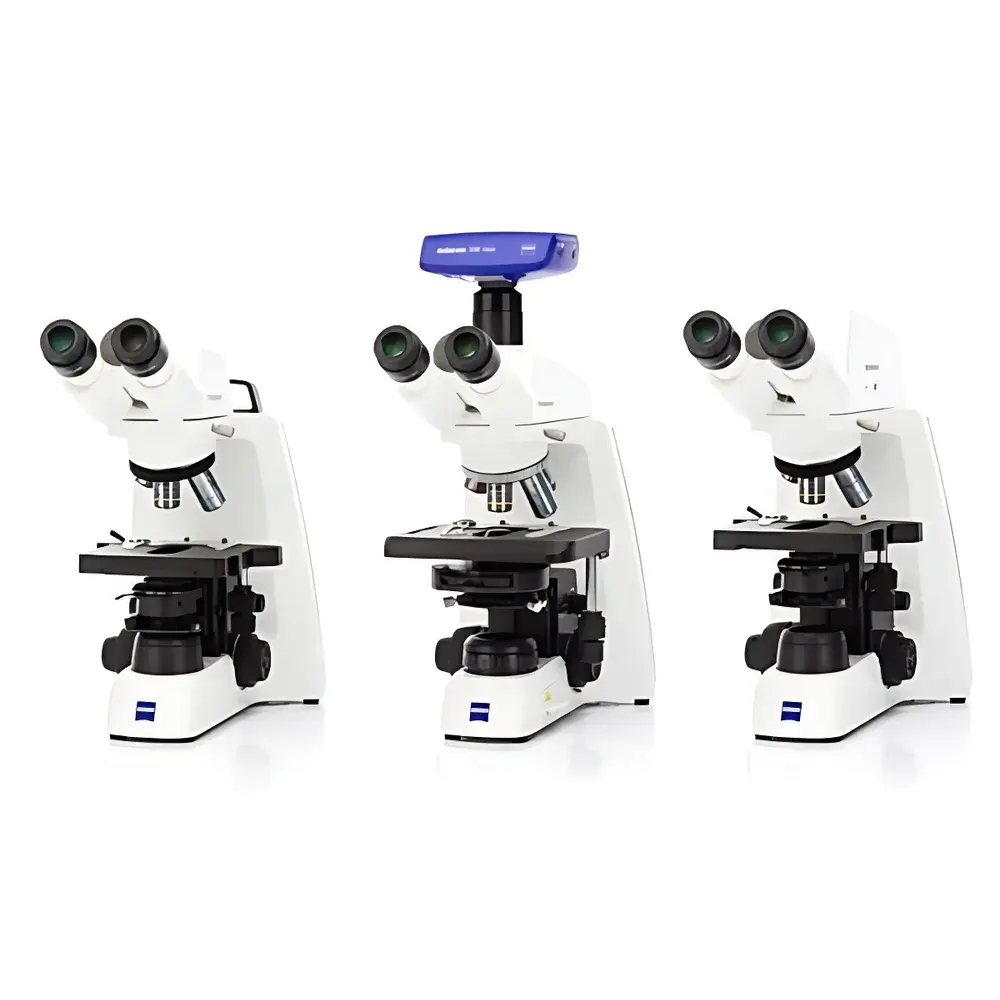
ZEISS Primostar 3 Upright Microscope
| Brand | ZEISS |
|---|---|
| Origin | Germany |
| Model | Primostar 3 |
| Illumination Options | Halogen and LED |
| Objective Turret | 4-position or 5-position |
| Field Number | 20 mm / 22 mm |
| Eyepiece Diopter Adjustment | Yes (both eyepieces) |
| Rotatable Binocular Tube | 360° |
| Stage | Ergonomic mechanical stage with dual slide clips |
| Illumination Control | Brightness management + energy-saving mode |
| Observation Modes | Brightfield, Darkfield, Simple Polarization, Phase Contrast, Fluorescence |
| Digital Integration | Compatible with ZEISS Labscope software and HDcam module |
| Compliance | Designed for ISO 13485-aligned laboratory environments and GLP-compliant teaching labs |
Overview
The ZEISS Primostar 3 upright microscope is an engineered solution for education laboratories and routine life science applications requiring robust optical performance, ergonomic usability, and seamless digital integration. Built on ZEISS’s decades of optical precision heritage, the Primostar 3 employs a fixed-Köhler and full-Köhler illumination architecture—ensuring consistent, glare-free illumination across all contrast modes without manual realignment. Its optical path supports five fundamental imaging modalities: brightfield, darkfield, simple polarization, phase contrast, and fluorescence—each optimized via dedicated condenser modules and filter sets calibrated to ZEISS standard tolerances. The system’s modular design allows configuration flexibility while maintaining mechanical stability critical for reproducible classroom demonstrations and student-led experiments. As a CE-marked instrument manufactured in Oberkochen, Germany, the Primostar 3 meets stringent EU safety and electromagnetic compatibility directives (2014/30/EU, 2014/35/EU), and its construction materials comply with RoHS 2011/65/EU restrictions.
Key Features
- Pre-aligned Köhler and full-Köhler illumination systems—minimizing setup time and eliminating user-dependent variability in illumination uniformity
- Selectable 4-position or 5-position objective turret accommodating standard DIN 25 mm parfocal objectives (e.g., Plan-Apochromat or Plan-Neofluar series)
- Wide-field eyepieces with field number 20 mm or 22 mm; integrated diopter correction on both oculars for individual visual acuity compensation
- 360° rotatable binocular observation tube—enabling optimal head positioning during prolonged use and collaborative viewing
- Ergonomic mechanical stage with low-profile coaxial controls and dual slide clips—designed for precise X/Y translation under repetitive handling conditions
- Integrated blue LED status indicators (five intensity levels) on both side panels—providing immediate visual feedback on power state and illumination mode selection
- Intelligent light management system with adjustable brightness control and automatic energy-saving mode—reducing thermal drift and extending lamp lifetime
Sample Compatibility & Compliance
The Primostar 3 accommodates standard 1 mm–1.2 mm thick glass slides and coverslips (22 × 22 mm or 24 × 50 mm), supporting histological sections, stained smears, live-cell preparations, and fluorescently labeled specimens—including plant tissue (e.g., Convallaria majalis root tip squashes) and clinical samples such as molluscum contagiosum biopsies imaged at 40× magnification. All optical components are anti-fungal coated and sealed against dust ingress per IP20 classification. The system conforms to ISO 10934-1 (microscope nomenclature) and ISO 7343 (ergonomic requirements for optical instruments). When equipped with ZEISS-certified fluorescence modules (e.g., Filter Set 46 for DAPI/FITC/TRITC), it satisfies spectral transmission criteria defined in ISO 10934-2 and supports documentation traceability required under GLP training protocols.
Software & Data Management
The Primostar 3 HDcam variant integrates natively with ZEISS Labscope software—a platform designed for pedagogical workflow efficiency. Labscope enables real-time image streaming over local area networks (IEEE 802.3 Ethernet), synchronized multi-user annotation, and timestamped image capture with embedded metadata (objective used, illumination mode, exposure settings). Audit trails record user logins, image export events, and parameter modifications—supporting compliance with institutional GLP policies and facilitating remote instruction verification. Export formats include TIFF (uncompressed), JPEG2000 (lossless compression), and CSV-based measurement logs compatible with LIMS integration. No proprietary drivers are required; the HDcam operates via UVC 1.5 standard, ensuring compatibility with Windows 10/11, macOS 12+, and Linux LTS kernels.
Applications
- Higher Education Teaching: Standardized microscopy curricula in biology, medicine, and veterinary science—particularly for comparative histology, mitotic index analysis, and morphometric assessment
- Tissue Pathology Support: Routine screening of H&E-stained sections and special stains (e.g., Masson’s trichrome) in preclinical diagnostic labs
- Cell Biology Instruction: Live-phase imaging of unstained eukaryotic cells (e.g., Acanthamoeba, yeast), including motility and division dynamics
- Plant Morphology Studies: Epidermal peel analysis, stomatal density quantification, and vascular bundle mapping in angiosperm models
- Clinical Microbiology: Gram staining interpretation, fungal hyphae identification, and acid-fast bacilli detection using Ziehl–Neelsen protocol
- Veterinary Diagnostics: Skin scrapings, ear swabs, and fecal flotation mounts for ectoparasite and protozoan identification
FAQ
Is the Primostar 3 compliant with FDA 21 CFR Part 11 for electronic records?
No—the Primostar 3 itself is not a regulated medical device under FDA jurisdiction; however, when deployed in GxP environments, Labscope-generated audit logs may be validated as part of a broader laboratory quality system.
Can third-party cameras be used with the Primostar 3?
Yes—any UVC-compliant USB 3.0 camera with C-mount or 23.2 mm thread adapter may be mounted, though ZEISS calibration profiles and software optimization apply only to HDcam modules.
What is the maximum working distance supported for long-working-distance objectives?
The stage clearance allows up to 30 mm vertical travel; with optional extended-focus objectives (e.g., EC Epiplan-Neofluar 20×/0.50), sample thickness up to 2.5 mm is accommodated.
Does the LED illumination option support fluorescence excitation?
Standard LED units provide white-light continuum output only; fluorescence requires dedicated high-power LED cubes (e.g., LED FL EDU set) with narrow-band excitation filters matched to common fluorophores.
How is maintenance performed on the optical train?
All optical elements are factory-aligned and sealed; routine cleaning follows ZEISS-recommended protocols using lens-grade acetone and anti-static wipes—no user-serviceable internal adjustments are intended.




