
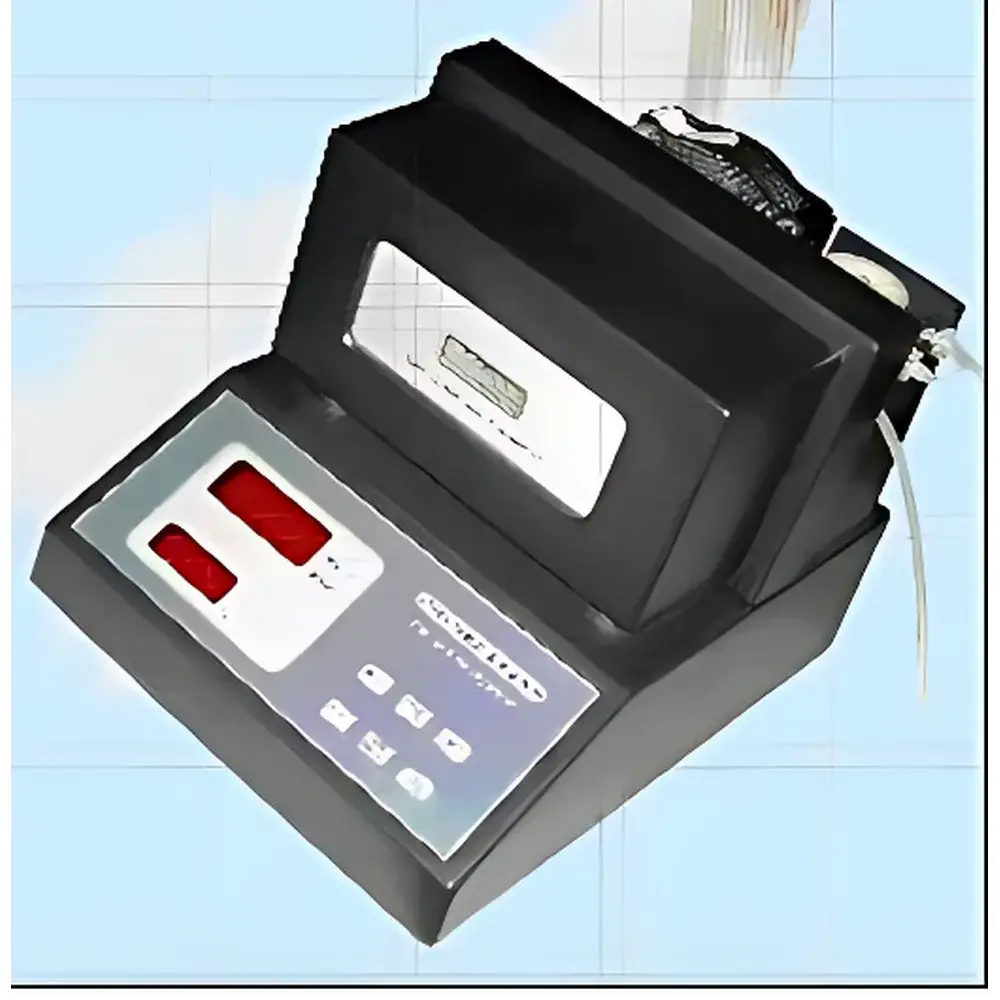
Q1 Dual-U-Tube Digital Liquid Densimeter with Alcohol Concentration Measurement
| Density measurement range | 0–1.999 g/cm³ |
|---|---|
| Density accuracy | ±0.001 g/cm³ |
| Alcohol concentration range | 0–100% (v/v) |
| Alcohol accuracy | ±0.5% (v/v) |
| Temperature control | 20 °C ±0.1 °C |
| Sample volume per measurement | 2 mL |
| Data storage capacity | 80 entries |
| Power supply | 220 V ±22 V, 50 Hz ±1 Hz, 50 VA |
| Operating ambient temperature | 5–35 °C |
| Net weight | 2 kg |
Overview
The Q1 Dual-U-Tube Digital Liquid Densimeter is an advanced oscillating U-tube densimeter engineered for high-precision, temperature-compensated density determination of homogeneous liquids. It operates on the fundamental physical principle that the resonant frequency of a vibrating U-shaped glass tube filled with liquid is inversely proportional to the square root of the liquid’s density—governed by the relationship f ∝ 1/√ρ. This method eliminates reliance on buoyancy-based calibration (as in traditional pycnometers or hydrometers) and delivers direct, real-time density output traceable to SI units. The instrument maintains a precisely regulated thermal environment at 20 °C ±0.1 °C using a Peltier-controlled thermostatic system, ensuring compliance with ISO 12084, ASTM D4052, and USP standards for density measurement under standardized reference conditions. Unlike legacy glass hydrometers—which suffer from narrow range limitations, fragility, manual interpolation errors, and absence of data handling—the Q1 integrates digital signal processing, automated sample handling, and non-volatile memory to support GLP-compliant laboratory workflows.
Key Features
- Dual-U-tube resonant sensor architecture with proprietary anti-wetting inner surface treatment to minimize residual film formation and ensure repeatability across sequential measurements.
- Onboard microcontroller performs automatic temperature compensation and direct conversion to density at 20 °C, eliminating manual lookup tables and interpolation-related uncertainty.
- Integrated stepper-motor-driven peristaltic pump enables unattended, consistent 2 mL sample aspiration—reducing operator variability and cross-contamination risk.
- Self-calibration function using certified 20 °C deionized water as primary reference standard; no external calibration weights or certified reference materials required for routine operation.
- Simultaneous dual-mode display: density (g/cm³) and alcohol concentration (% v/v) at 20 °C, with configurable output for user-defined concentration scales (e.g., sulfuric acid wt%, sugar Brix, or API gravity) via firmware update.
- Embedded EEPROM stores up to 80 measurement records with timestamp, density value, alcohol content, and thermal equilibrium status—accessible for review, selective deletion, or export via RS-232 interface.
Sample Compatibility & Compliance
The Q1 is validated for use with clear, low-viscosity, non-particulate, non-gassing liquids—including aqueous ethanol solutions, organic solvents, mineral acids (dilute), syrups, and pharmaceutical excipients. It is not suitable for suspensions, emulsions, or highly viscous fluids (>200 mPa·s) due to damping effects on resonance amplitude. All wetted parts are borosilicate glass and PTFE—chemically inert per ISO 8513 and compliant with FDA 21 CFR Part 11 requirements when paired with audit-trail-enabled software (optional). Instrument design adheres to IEC 61010-1 for electrical safety and EN 61326-1 for electromagnetic compatibility in laboratory environments.
Software & Data Management
While the Q1 operates autonomously via front-panel interface, optional PC connectivity (RS-232) supports integration with laboratory information management systems (LIMS) or custom QC databases. A Windows-compatible configuration utility allows firmware updates, data export in CSV format, and user-defined calibration curve loading. Audit trail functionality—including operator ID, measurement timestamp, calibration event log, and data modification history—is available when deployed with validated third-party software compliant with 21 CFR Part 11 Annex 11 and ISO/IEC 17025 documentation requirements.
Applications
This densimeter serves critical quality control functions across regulated and industrial sectors: ethanol content verification in distilled spirits (per OIML R 22), concentration monitoring of fermentation broths in biopharma, density-based assay of electrolyte solutions in battery manufacturing, batch release testing of food-grade glycerin or propylene glycol, and regulatory compliance checks for net content labeling in packaged beverages (NIST Handbook 133). Academic laboratories utilize it for teaching fundamental fluid property relationships and validating thermodynamic models in physical chemistry courses.
FAQ
What reference standard is used for calibration?
Deionized water at 20 °C is the primary reference material; its certified density (0.998203 g/cm³) is embedded in firmware for automatic zero-point and span validation.
Can the instrument measure density at temperatures other than 20 °C?
No—it is optimized exclusively for 20 °C reference condition per international metrological conventions; temperature deviation beyond ±0.1 °C triggers automatic hold-and-stabilize protocol.
Is cleaning validation supported for GMP environments?
Yes—residue-free operation is verified using conductivity and visual inspection protocols; cleaning SOPs are provided in the technical manual.
Does the device meet ISO/IEC 17025 traceability requirements?
When calibrated annually against NIST-traceable density standards (e.g., Cannon-Manning certified reference oils), full measurement uncertainty budgets can be generated per ISO/IEC 17025 Clause 6.5.
How is sample carryover mitigated between measurements?
The anti-wetting coating combined with programmable rinse cycles (using air purge and solvent flush) reduces carryover to <0.02% v/v, verified per ASTM E2656.



