
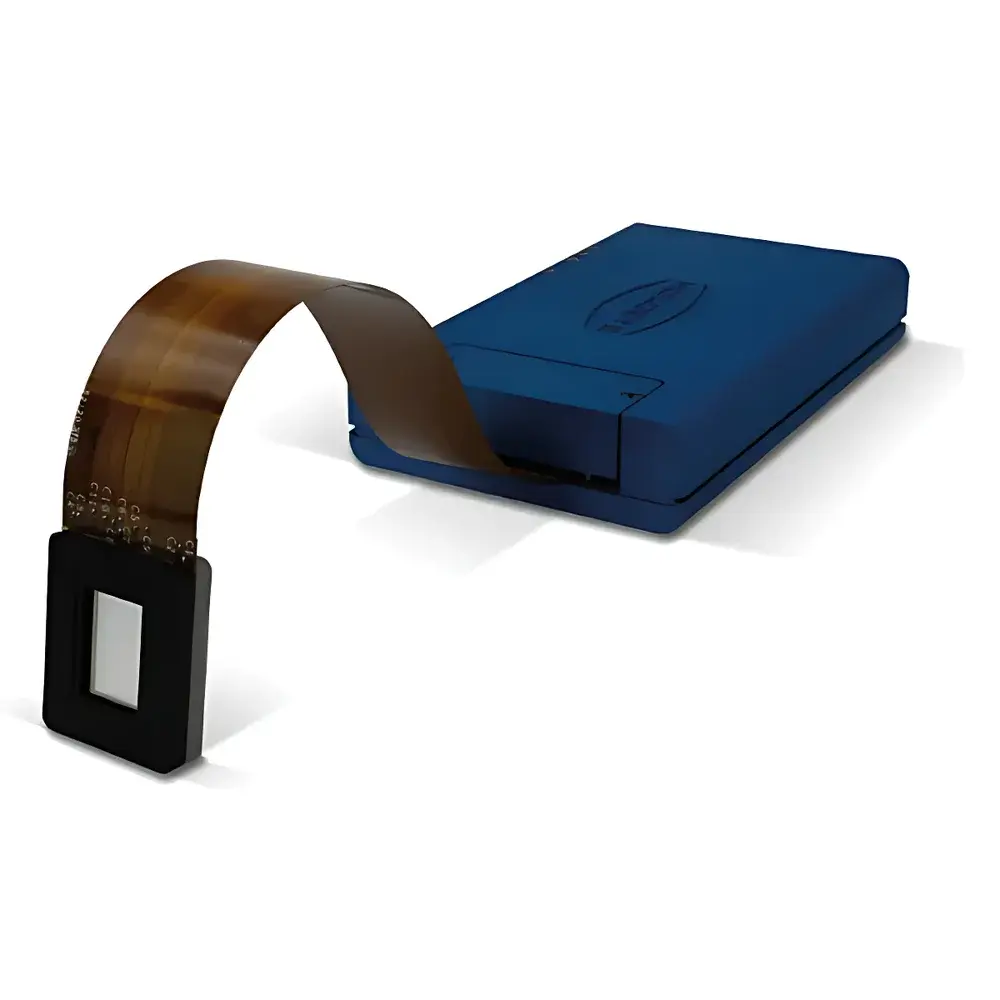
Holoeye ERIS Pure-Phase Spatial Light Modulator
| Brand | Holoeye |
|---|---|
| Origin | Germany |
| Model | ERIS |
| Pixel Resolution | 1920 × 1200 |
| Pixel Pitch | 8 µm |
| Wavelength Range | 400–1600 nm |
| Phase Depth | 0–2π (adjustable) |
| Phase Quantization | 8-bit standard, up to 10-bit supported |
| Interface | HDMI (phase pattern input), USB (driver control & gamma/dynamic range calibration) |
| Trigger Output | TTL-sync enabled |
| Display Technology | 0.717″ LCOS microdisplay |
| Operating Mode | Plug-and-play, extended desktop mode compatible |
Overview
The Holoeye ERIS Pure-Phase Spatial Light Modulator is a high-fidelity, reflective liquid-crystal-on-silicon (LCOS) device engineered for precise, dynamic wavefront manipulation in coherent optical systems. Operating on the principle of voltage-controlled birefringence in nematic liquid crystal layers aligned over a silicon backplane, the ERIS modulates only the phase component of incident light—minimizing amplitude coupling and preserving optical efficiency across its operational bandwidth. Designed for laboratory-grade interferometry, holographic beam shaping, adaptive optics prototyping, and quantum optics experiments, the ERIS delivers deterministic phase control with sub-millisecond latency and thermal drift compensation built into its driver architecture. Its monolithic LCOS core—fabricated on a 0.717-inch silicon substrate—ensures pixel-level uniformity and long-term stability under continuous illumination, making it suitable for applications demanding repeatable, artifact-free phase profiles over extended acquisition sequences.
Key Features
- True pure-phase modulation architecture with <0.5% intensity cross-talk across visible and NIR bands (400–1600 nm)
- Native resolution of 1920 × 1200 pixels and 8 µm pixel pitch, enabling diffraction-limited spatial sampling for wavefront reconstruction up to ~30 line pairs/mm at 633 nm
- Dual-mode phase addressing: 8-bit grayscale mapping (256 discrete phase levels) as standard; optional 10-bit mode (1024 levels) for enhanced fidelity in iterative hologram optimization
- HDMI-based real-time pattern streaming from any GPU-enabled host system—no proprietary frame grabbers or dedicated hardware required
- Integrated USB-controlled driver supporting per-wavelength gamma calibration, dynamic range adjustment (0–12 V LC bias), and temperature-compensated voltage lookup tables
- TTL-compatible trigger output synchronized to frame update events—enabling precise temporal alignment with pulsed lasers, CCD/CMOS cameras, or lock-in detection systems
- Hot-pluggable operation compliant with Windows/macOS/Linux extended desktop protocols; recognized as a secondary display device without kernel-level drivers
Sample Compatibility & Compliance
The ERIS SLM is compatible with collimated, polarized input beams of diameter ≤12 mm (full active aperture). It requires linear polarization aligned to the device’s designated orientation axis (supplied with extinction ratio >500:1 calibration report). No optical coatings are applied post-fabrication—each unit undergoes spectral reflectance verification across its specified wavelength bands (e.g., VIS: 400–700 nm; Telecom C-band: 1530–1565 nm) and receives individual phase-response calibration data (wrapped/unwrapped phase maps at 532, 633, 780, 1064, and 1550 nm). While not certified to ISO 10110 or MIL-PRF-13830 surface quality standards as a standalone optic, its LCOS substrate meets SEMI F47 specifications for microdisplay reliability. Device firmware supports audit-trail logging of calibration parameters—facilitating GLP-compliant experimental documentation when used in regulated research environments.
Software & Data Management
Holoeye provides three interoperable software layers: (1) Pattern Generator GUI—a MATLAB- and Python-scriptable tool for generating kinoforms, vortex arrays, and Gerchberg-Saxton iterations; (2) SLM Slide Player—a lightweight application for loading precomputed .bmp/.png phase masks in sequence with user-defined dwell times and frame triggers; and (3) Holoeye SLM SDK—a cross-platform development kit offering native C/C++, Python, and LabVIEW APIs for low-latency, memory-mapped pattern updates (<15 ms end-to-end latency from CPU write to optical response). All software components generate reproducible binary outputs conforming to the IEEE 1344-1999 grayscale encoding standard. Calibration metadata—including wavelength-specific gamma curves and pixel-wise phase nonlinearity corrections—is embedded in exported pattern files, ensuring traceability across instrument deployments and multi-user labs.
Applications
- Dynamic holography and computer-generated hologram (CGH) projection for optical trapping and micromanipulation
- Multi-plane fluorescence microscopy (MUM) and structured illumination patterning in super-resolution modalities
- Real-time aberration correction in closed-loop adaptive optics systems using Shack-Hartmann sensor feedback
- Optical encryption and information multiplexing via phase-only Fourier-plane filtering
- Quantum state engineering—e.g., generation of orbital angular momentum (OAM) modes for high-dimensional quantum key distribution
- Beam steering and focus scanning in laser materials processing setups requiring programmable Bessel or Airy profile synthesis
FAQ
What is the maximum frame rate for full-resolution phase updates?
The ERIS supports up to 60 Hz at native 1920×1200 resolution via HDMI 1.4; frame rates scale inversely with bit depth—e.g., 30 Hz in 10-bit mode.
Can the ERIS be used with femtosecond laser pulses?
Yes—provided pulse energy density remains below 0.1 mJ/cm² at 1 kHz repetition rate (verified per ISO 21254-1 damage threshold testing); dispersion compensation must be applied externally.
Is phase calibration data provided with each unit?
Yes—each ERIS ships with a wavelength-specific calibration certificate containing measured phase response curves, pixel uniformity maps, and RMS phase error quantification at five reference wavelengths.
Does the device support external triggering for synchronization with pulsed sources?
Yes—the rear-panel SMA-trigger output delivers a TTL pulse synchronized to the start of each displayed frame, configurable for rising/falling edge and adjustable delay (0–100 ms) via USB command.
How is gamma correction implemented across different wavelengths?
Gamma tables are stored in non-volatile memory and loaded automatically based on selected wavelength preset; users may upload custom LUTs via USB using the SDK’s calibration utility.




