
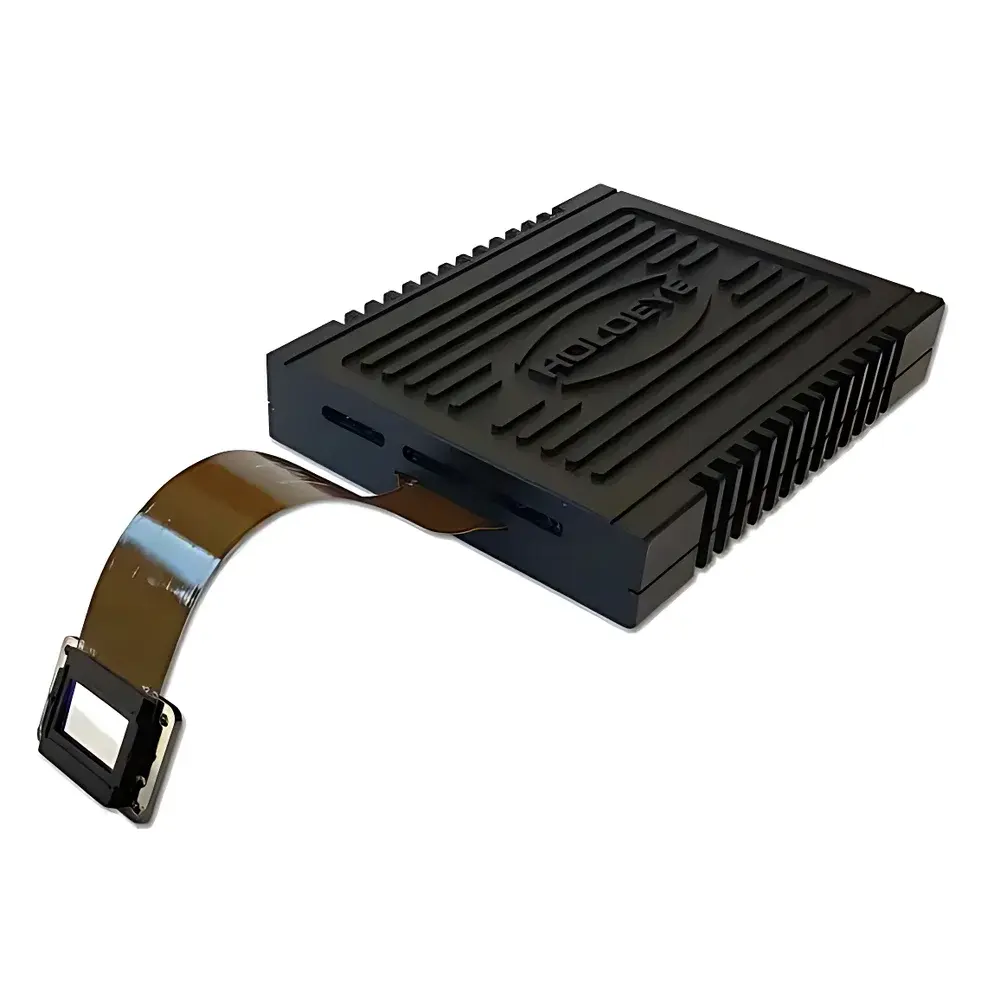
Holoeye GAEA-2-NIR High-Resolution Pure-Phase Spatial Light Modulator
| Brand | Holoeye |
|---|---|
| Origin | Germany |
| Model | GAEA-2-NIR |
| Wavelength Range | 650–1100 nm |
| Active Area | 0.7" (15.32 × 8.97 mm) |
| Resolution | 4160 × 2464 pixels |
| Pixel Pitch | 3.74 µm |
| Fill Factor | 90% |
| Reflectivity | 72% |
| Maximum Spatial Frequency | 133.5 lp/mm |
| Gray Levels | 8-bit (256 levels) |
| Interface | HDMI |
| Frame Rate | 24 Hz @ full resolution (4160 × 2464), 30 Hz @ 3840 × 2160 |
| Phase Modulation Type | Pure-phase, nematic liquid crystal on silicon (LCoS) |
Overview
The Holoeye GAEA-2-NIR is a high-fidelity, pure-phase spatial light modulator (SLM) engineered for precision wavefront control in near-infrared (NIR) optical systems. Based on nematic liquid crystal on silicon (LCoS) technology, it operates as a reflective, pixelated phase retarder—enabling programmable manipulation of the optical phase profile across its active aperture without introducing significant amplitude modulation. Its native wavelength range spans 650 to 1100 nm, making it suitable for applications including ultrafast pulse shaping, adaptive optics, holographic beam steering, optical trapping, and computational imaging in the NIR band. With a native resolution of 4160 × 2464 pixels and a pixel pitch of 3.74 µm, the device achieves a theoretical maximum spatial frequency of 133.5 line pairs per millimeter—supporting diffraction-limited performance when integrated with high-NA illumination optics. The 90% fill factor minimizes inter-pixel diffraction effects, while the 72% average reflectivity ensures efficient coupling into downstream optical trains.
Key Features
- Ultra-high-resolution phase modulation: 4160 × 2464 pixel array with sub-micron pixel pitch (3.74 µm) for fine-grained wavefront sampling.
- Pure-phase operation: Optimized LCoS architecture suppresses amplitude modulation (< 5% intensity variation over full phase stroke), preserving signal fidelity in interferometric and coherent applications.
- NIR-optimized optical stack: Anti-reflection and dielectric mirror coatings tailored for 650–1100 nm, delivering >72% average reflectivity and low polarization-dependent loss (PDL < 0.3 dB).
- High fill factor (90%): Reduces zero-order leakage and mitigates higher-order diffraction artifacts common in low-fill-factor SLMs.
- HDMI 2.0 interface: Enables direct compatibility with standard graphics processing units (GPUs) and real-time pattern generation software; supports native 24 Hz frame rate at full resolution.
- Thermally stabilized design: Integrated temperature monitoring and passive thermal management ensure phase stability within ±0.02π rad over 8-hour continuous operation at ambient conditions (20–25 °C).
Sample Compatibility & Compliance
The GAEA-2-NIR is designed for integration into laboratory-grade optical benches and OEM instrumentation platforms. Its 0.7-inch active area (15.32 × 8.97 mm) conforms to standard C-mount and SM1-threaded optical mounts, facilitating alignment with off-the-shelf lenses, collimators, and Fourier transform lenses. The device complies with CE marking requirements for electromagnetic compatibility (EMC Directive 2014/30/EU) and low-voltage safety (LVD Directive 2014/35/EU). While not certified for medical or industrial safety standards (e.g., IEC 60601 or IEC 61508), it meets GLP-relevant traceability criteria for calibration documentation and factory characterization reports—including measured phase response curves, uniformity maps, and temporal response histograms. Users deploying the SLM in regulated environments (e.g., ISO 17025-accredited labs) may incorporate it into validated workflows with documented uncertainty budgets per ISO/IEC 17025:2017 Clause 7.6.
Software & Data Management
Holoeye provides the SLM Control Suite—a cross-platform application (Windows/macOS/Linux) supporting real-time phase pattern upload, gamma correction, and hardware synchronization via external TTL triggers. The suite exports phase maps in industry-standard formats (TIFF, BMP, binary float32) and includes Python and MATLAB APIs for automated experiment orchestration. All firmware updates are digitally signed and version-logged; configuration files include embedded metadata (timestamp, user ID, instrument serial number) to support audit trails required under FDA 21 CFR Part 11 for electronic records in pharmaceutical or biotech R&D settings. Raw phase calibration data (voltage-to-phase transfer function per pixel group) is archived with each measurement session, enabling retrospective uncertainty analysis.
Applications
- Adaptive optics: Real-time correction of atmospheric turbulence or system aberrations in astronomical imaging and free-space optical communications.
- Holographic optical tweezers: Generation of multiple, independently controllable 3D optical traps for micromanipulation of colloids, cells, or nanowires.
- Ultrafast pulse shaping: Spectral phase modulation in 4f-zero-dispersion compressors for coherent control of femtosecond laser pulses.
- Computational imaging: Structured illumination microscopy (SIM), Fourier ptychography, and single-pixel imaging architectures requiring programmable illumination masks.
- Quantum optics: Encoding of orbital angular momentum (OAM) states, generation of entangled photon patterns, and reconfigurable Bell-state analyzers.
- OEM integration: Embedded wavefront control in laser material processing heads, OCT reference arms, and lidar beam-forming modules.
FAQ
What is the typical phase stroke of the GAEA-2-NIR at 1064 nm?
At 1064 nm, the device delivers a minimum-to-maximum phase shift of ≥2π radians with <1.5% nonlinearity (RMS) across the full 8-bit drive voltage range.
Can the SLM be used in transmission mode?
No—the GAEA-2-NIR is a reflective LCoS device and requires illumination from the front side (glass substrate); transmission-mode operation is not supported.
Is there a factory calibration certificate included?
Yes—each unit ships with a NIST-traceable calibration report listing measured phase uniformity (±0.05π rad RMS), pixel response time (τrise ≈ 18 ms, τfall ≈ 22 ms), and spectral reflectance curve.
Does the device support analog voltage input for phase control?
No—phase modulation is exclusively digital via HDMI video signal; analog voltage interfaces are not implemented.
What is the recommended optical power density limit?
For continuous-wave (CW) operation at 1064 nm, the maximum incident power density is 1.5 W/cm² averaged over the active area; pulsed operation (e.g., 10 ns pulses at 1 kHz) is limited to 5 mJ/cm² per pulse.





