
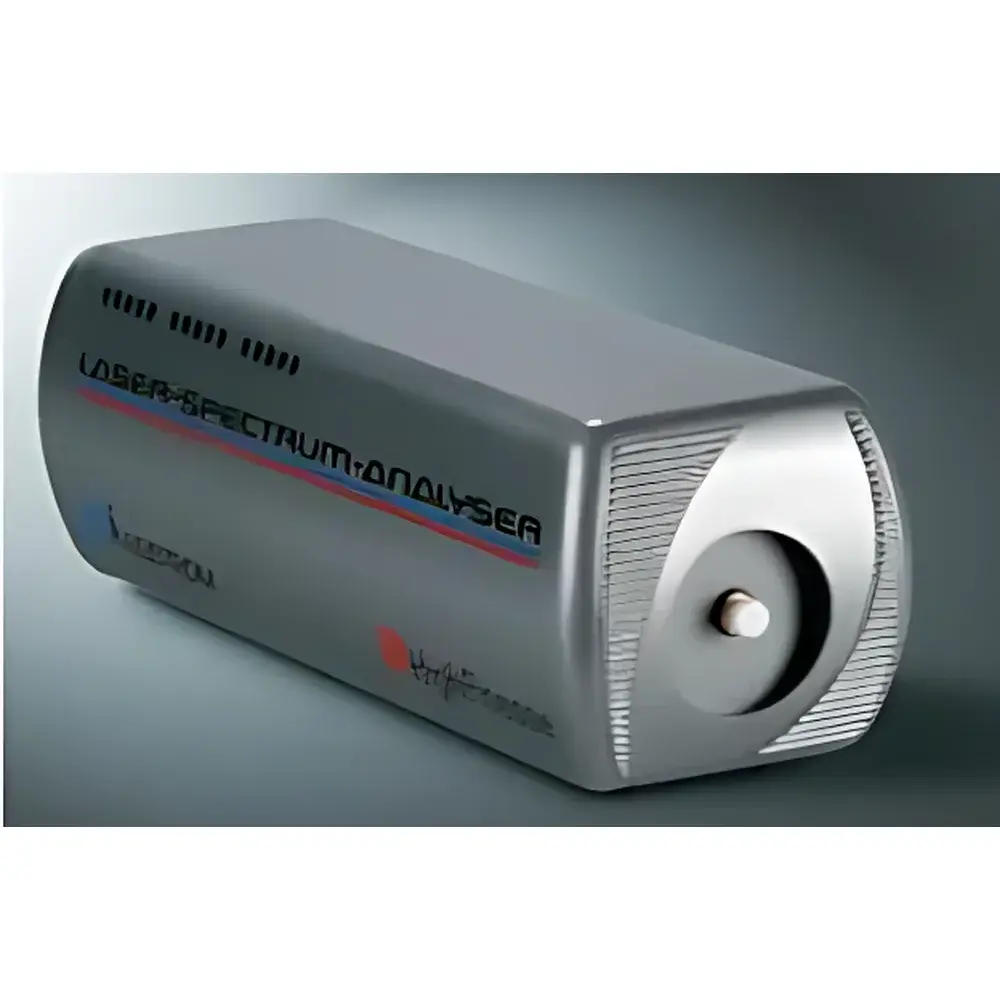
HighFinesse LSA-245 Laser Spectrum Analyzer
| Origin | Imported |
|---|---|
| Manufacturer Type | Authorized Distributor |
| Model | LSA-245 |
| Price | Upon Request |
| Wavelength Range | 350–1100 nm (standard), 200–1100 nm (UV option) |
| Measurement Accuracy | ±5 pm @ 633 nm |
| Sensitivity | 5 nJ @ 633 nm |
| Maximum Spectral Span (High-Resolution Mode) | λ/30 |
| Spectral Finesse | 30,000 (single-mode fiber), 15,000 (50 µm multimode fiber) |
| First-Order Resolution | 1 nm |
| Relative Linewidth Measurement Accuracy | ±5 × 10⁻⁶ (single-mode fiber) |
| Repetition Rate Capability | Up to 100 Hz |
Overview
The HighFinesse LSA-245 Laser Spectrum Analyzer is a high-precision interferometric spectrometer engineered for absolute wavelength calibration, spectral linewidth quantification, and multi-line or broadband emission characterization of coherent and incoherent optical sources. Based on the principle of scanning Michelson interferometry with active stabilization and piezoelectric path-length control, the LSA-245 delivers traceable, sub-picometer-level wavelength accuracy without requiring external reference lasers. Its design conforms to the physical foundations of optical heterodyne detection and Fourier-transform spectral reconstruction, enabling direct measurement of optical frequency deviation, mode spacing (FSR), and coherence length—critical parameters in quantum optics, laser development, and photonic component validation.
Key Features
- Interferometric architecture with thermally stabilized, vacuum-sealed optical path for long-term drift suppression (<0.5 pm/h typical)
- Switchable input optics supporting both single-mode (SMF-28) and multimode (50 µm core) fiber coupling, with integrated FC/APC and SMA connectors
- Real-time acquisition at up to 100 Hz scan repetition rate, enabling dynamic monitoring of laser frequency jitter and mode-hopping events
- On-board calibration using internal HeNe reference line (632.816 nm) traceable to NIST standards; optional external Rb or I₂ reference integration available
- High-finesse operation mode delivering spectral resolution down to λ/30—e.g., ~20 pm at 633 nm—without slit-based dispersion
- Automated peak detection, centroid calculation, and full-width-at-half-maximum (FWHM) fitting with uncertainty propagation per ISO/IEC 17025 guidelines
Sample Compatibility & Compliance
The LSA-245 supports continuous-wave (CW) and pulsed lasers (≥1 ns pulse width), gas discharge lamps (HeNe, Ar⁺, Kr⁺), superluminescent diodes (SLDs), laser diodes (LDs), and light-emitting diodes (LEDs). It accommodates both narrow-linewidth (<1 MHz) and broadband (up to 50 nm FWHM) emitters without hardware reconfiguration. The instrument complies with CE marking requirements (2014/30/EU EMC Directive and 2014/35/EU LVD Directive) and meets mechanical robustness specifications per IEC 60068-2 environmental testing standards. Data integrity workflows support audit-ready operation under GLP and GMP environments, including configurable user access levels, electronic signatures, and 21 CFR Part 11–compliant audit trails when used with optional software modules.
Software & Data Management
Bundled LSA Control Software (v4.x) provides intuitive GUI-driven operation across Windows 10/11 platforms, with native support for LabVIEW™, MATLAB®, and Python (via PyLSA API). All spectral acquisitions are stored in HDF5 format with embedded metadata—including timestamp, instrument configuration, calibration history, and environmental sensor readings (temperature, humidity). Batch processing enables automated report generation compliant with ASTM E2919 (Standard Guide for Spectral Data Evaluation) and ISO 13697 (Optics and photonics — Spectral measurement methods). Export options include CSV, SPC, and XML formats compatible with LIMS integration and third-party spectral analysis tools such as OriginPro and Igor Pro.
Applications
- Wavelength certification of tunable lasers and external cavity diode lasers (ECDLs) for metrology labs and national institutes
- Linewidth validation of ultra-stable lasers used in optical atomic clocks and gravitational wave interferometers (e.g., LIGO, Virgo)
- Characterization of semiconductor laser arrays and VCSELs in telecom and sensing applications
- Verification of spectral purity in UV-VIS light sources for fluorescence lifetime imaging (FLIM) and Raman spectroscopy systems
- Process monitoring during fiber Bragg grating (FBG) inscription and distributed feedback (DFB) laser fabrication
- Education and research in advanced photonics laboratories requiring hands-on Fourier-transform spectroscopy training
FAQ
Is the LSA-245 suitable for measuring femtosecond laser spectra?
Yes—when operated in broadband acquisition mode with appropriate dispersion compensation, it resolves spectra from Ti:sapphire oscillators and OPO outputs. Pulse duration estimation requires deconvolution with known instrumental response.
Can the system be integrated into an automated test bench?
Yes—RS-232, USB 2.0, and Ethernet (TCP/IP) interfaces enable full remote control and synchronization with trigger signals from arbitrary waveform generators or DAQ systems.
Does the analyzer require periodic recalibration by the manufacturer?
No—built-in HeNe reference allows user-performed daily verification. Full factory recalibration is recommended every 24 months or after mechanical shock exceeding 5 g.
What is the minimum measurable power for reliable spectral acquisition?
At 633 nm, the system achieves SNR > 100:1 with ≥5 nJ per pulse (for pulsed sources) or ≥100 nW average power (for CW sources), depending on integration time and fiber coupling efficiency.
Is UV-enhanced operation (200–350 nm) supported out-of-the-box?
UV capability requires optional fused silica collimator optics and UV-grade beam splitters; standard configuration covers 350–1100 nm.




