
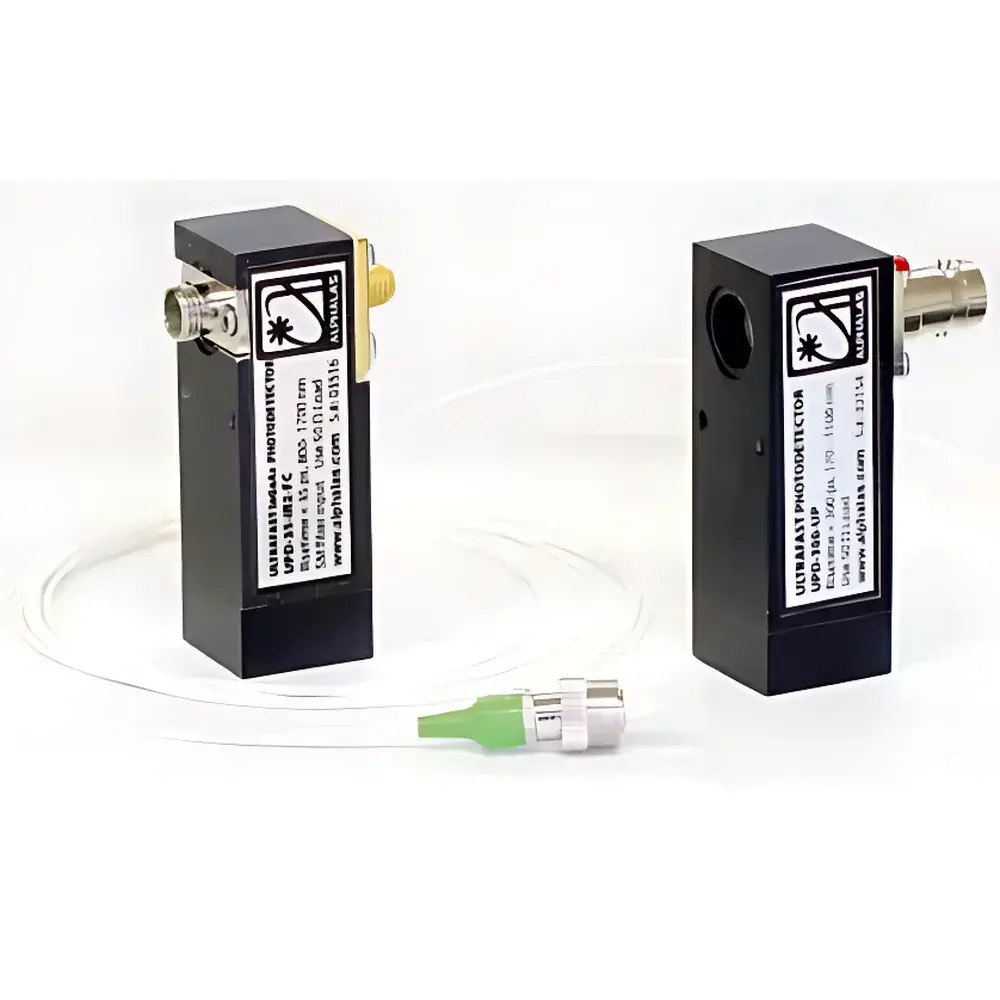
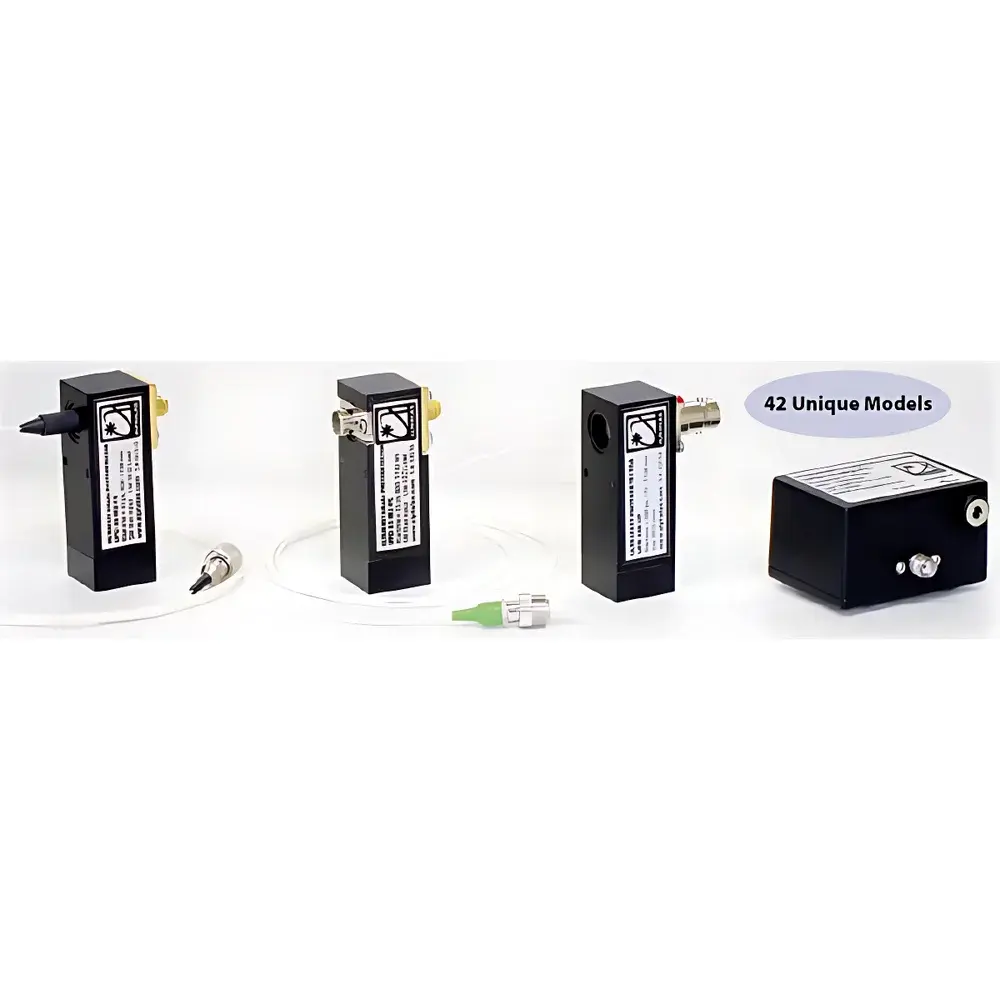
AlphaLas UPD Series Ultrafast Photodetectors
| Brand | AlphaLas |
|---|---|
| Origin | Germany |
| Model | UPD Series |
| Spectral Range | 170–2600 nm |
| Rise Time | 15 ps to 75 ns |
| Bandwidth | DC to 25 GHz |
| Detector Materials | Si, GaAs, InGaAs, Ge |
| Input Options | Free-space (polished/diffuse MgF₂/quartz/glass windows), FC/PC fiber receptacle, or FC/APC-pigtailed fiber |
| Output Interface | SMA or BNC |
| Power Supply | Battery or external DC source |
| Housing | Anodized aluminum, hermetically sealed |
Overview
The AlphaLas UPD Series Ultrafast Photodetectors are engineered for high-fidelity time-domain optical signal acquisition in demanding photonics research and industrial laser diagnostics. Based on optimized PIN photodiode architectures and integrated microwave packaging, these detectors operate on the principle of ultrafast carrier drift and low-capacitance junction design to achieve sub-15 ps rise times and bandwidths extending to 25 GHz. Unlike conventional photodiodes limited by RC time constants or transit-time dispersion, the UPD series employs impedance-matched 50 Ω transmission-line integration directly at the photodiode anode-cathode interface—minimizing parasitic inductance and reflection-induced waveform distortion. This architecture enables faithful reproduction of transient optical waveforms from DC-coupled continuous-wave references to femtosecond-scale pulse trains, making the UPD family a foundational tool for ultrafast laser characterization, optical timing synchronization, and coherent detection systems.
Key Features
- Sub-15 ps rise time (UPD-15-IR2-FC) with bandwidth up to 25 GHz — among the highest available for commercial free-space and fiber-coupled photodetectors
- Extended spectral coverage: 170–1100 nm (UV-enhanced Si), 350–1700 nm (UV-sensitive InGaAs), 800–2600 nm (extended-InGaAs and Ge variants)
- Hermetically sealed, anodized aluminum housing providing mechanical robustness, EMI shielding, and thermal stability for lab and OEM integration
- Dual power options: internal battery operation for portable measurements or regulated external DC supply (±5 V typical) for long-term stability
- Flexible impedance configuration: 50 Ω termination for maximum bandwidth and minimal overshoot; high-impedance load option for enhanced voltage output in low-noise, low-speed applications
- Multiple input configurations: free-space (with MgF₂, quartz, or BK7 windows), FC/PC receptacle, or factory-pigtailed FC/APC fiber (9 µm SMF or MMF-compatible)
- Low noise equivalent power (NEP) down to 1.0 × 10⁻¹⁵ W/√Hz and dark currents as low as 0.001 nA (Si) or 0.1 nA (InGaAs), enabling high-dynamic-range detection of weak pulsed signals
Sample Compatibility & Compliance
The UPD series supports direct measurement of pulsed and modulated optical sources without external amplification or biasing circuitry. It is compatible with Ti:sapphire, Yb:fiber, Er:fiber, OPO, and diode lasers across UV, visible, NIR, and SWIR bands. All models meet CE marking requirements for electromagnetic compatibility (EMC Directive 2014/30/EU) and low-voltage safety (LVD Directive 2014/35/EU). The detector housings conform to IP54-rated environmental protection when mated with appropriate connectors. For regulated environments—including ISO/IEC 17025-accredited calibration labs and GMP-compliant photonics manufacturing—the UPD series supports traceable calibration documentation and can be integrated into systems compliant with FDA 21 CFR Part 11 when paired with validated data acquisition software featuring audit trails and electronic signatures.
Software & Data Management
While the UPD detectors are analog-output devices requiring external digitization, they are fully interoperable with industry-standard oscilloscopes (e.g., Keysight Infiniium, Tektronix DPO70000SX), RF spectrum analyzers, and lock-in amplifiers. AlphaLas provides detailed impedance-matching guidelines, S-parameter datasets (upon request), and layout recommendations for PCB-level integration to preserve signal integrity. When used with high-bandwidth digitizers (≥50 GS/s), the UPD enables time-resolved measurements compliant with IEEE Std 181-2011 (Standard for Transitions, Pulses, and Related Waveforms). Optional integration with AlphaLas’ BBA-series broadband amplifiers extends dynamic range while maintaining sub-20 ps system-level response—eliminating the need for APDs in many ultrafast applications where gain uniformity, linearity, and pulse fidelity are critical.
Applications
- Pulse shape and width characterization of mode-locked lasers (fs–ps regimes)
- Optical cross-correlation and autocorrelation trigger reference generation
- Timing jitter analysis and synchronous pump-probe experiments
- High-speed optical communications testing (NRZ, PAM4, OFDM modulation formats)
- THz time-domain spectroscopy (TDS) electro-optic sampling gate synchronization
- Laser-induced breakdown spectroscopy (LIBS) plasma emission timing
- Quantum optics experiments requiring low-jitter, high-repetition-rate single-photon timing (in conjunction with TCSPC modules)
- OEM integration into laser processing monitoring systems (e.g., real-time ablation feedback control)
FAQ
What is the difference between “P”, “D”, “FR”, and “FC” suffixes in UPD model numbers?
“P” = polished optical window (optimized for collimated free-space beams); “D” = diffuse quartz window (for uniform angular response and reduced etalon effects); “FR” = FC/PC receptacle (accepts standard FC/PC connectors); “FC” = factory-pigtailed with FC/APC connector (single-mode fiber, AR-coated).
Can UPD detectors be used with femtosecond laser pulses?
Yes—provided the optical fluence remains below damage threshold (typically < 100 µJ/cm² for 100 fs pulses). Rise time specification reflects system-limited temporal resolution; actual pulse reconstruction depends on oscilloscope bandwidth and sampling rate.
Is temperature stabilization required for stable operation?
Most UPD models operate reliably from 15–35 °C without active cooling. For ultra-low-dark-current applications (e.g., UPD-2M-IR2-P-1TEC), thermoelectric cooling maintains junction temperature at 25 ± 0.1 °C to suppress thermal noise and drift.
How is calibration traceability provided?
AlphaLas offers NIST-traceable spectral responsivity calibration (per ISO/IEC 17025) across defined wavelength points (e.g., 405, 635, 780, 1064, 1550 nm) with uncertainty budgets compliant with EURAMET cg-19.
Are custom configurations available for OEM integration?
Yes—AlphaLas supports tailored mechanical form factors, connector types (e.g., MMCX, K-type), spectral filtering, and multi-channel array packaging upon request, with full RoHS and REACH compliance documentation.




