
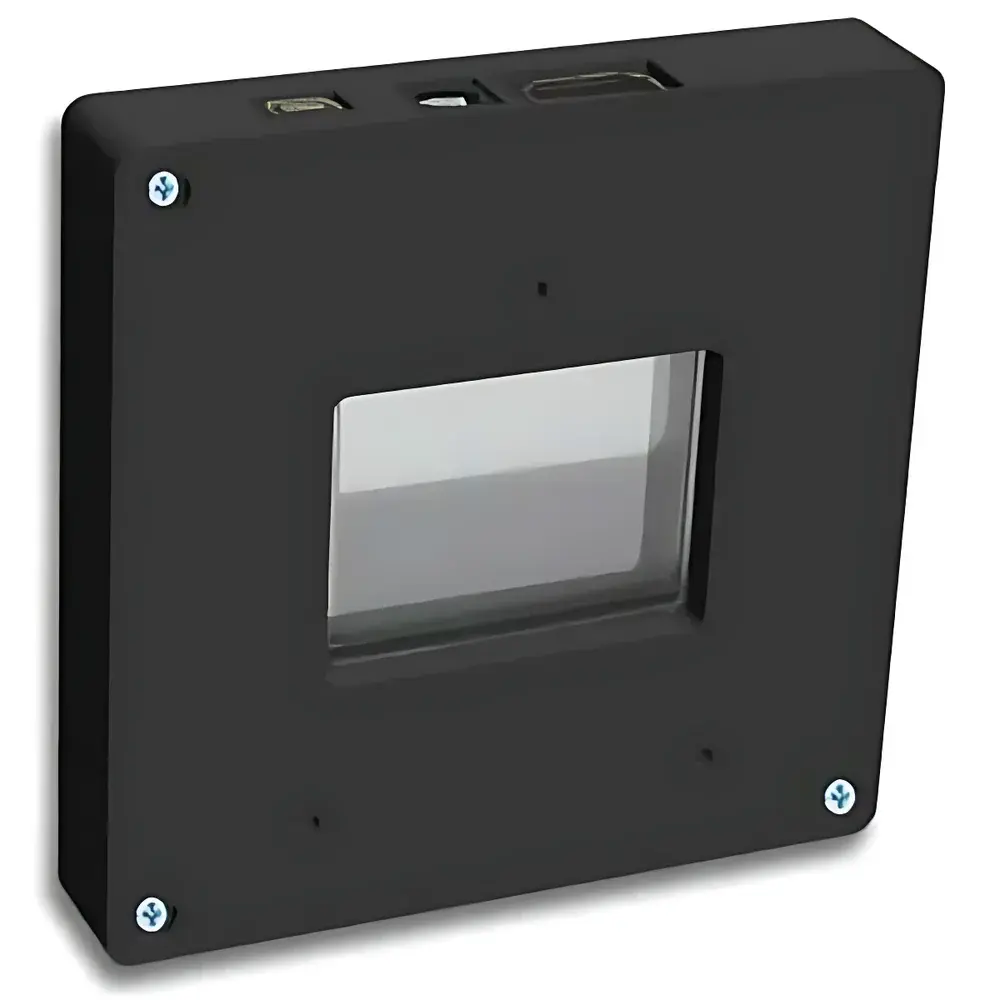
Holoeye LC 2012 Transmissive Liquid Crystal Spatial Light Modulator
| Brand | Holoeye |
|---|---|
| Origin | Germany |
| Model | LC 2012 |
| Display Resolution | 1024 × 768 pixels |
| Operating Wavelength Range | 450–800 nm |
| Maximum Phase Modulation | 2π @ 450 nm, 1.8π @ 532 nm, π @ 800 nm |
| Amplitude Modulation Capability | Yes |
| Contrast Ratio | 1000:1 @ 633 nm |
| Interface | HDMI (video input), USB (configuration & parameter control) |
| Form Factor | Integrated LCoS module with embedded driver electronics |
| Mounting | Standard optical cage system compatible (e.g., 30 mm or 60 mm rail mounts) |
Overview
The Holoeye LC 2012 is a transmissive liquid crystal on silicon (LCoS) spatial light modulator engineered for high-fidelity wavefront shaping in advanced optical research and industrial photonics applications. Unlike reflective SLMs, its transmissive architecture enables straightforward integration into collimated beam paths without retro-reflection constraints—making it especially suitable for interferometric setups, adaptive optics testbeds, holographic optical trapping, and programmable diffractive optics. The device operates on the principle of electrically controlled birefringence in nematic liquid crystal layers aligned over a transparent indium tin oxide (ITO) electrode array. Incident linearly polarized light passes through the LC layer, where local phase retardation is spatially modulated pixel-by-pixel via applied voltage gradients. This allows precise, dynamic control over both phase and amplitude profiles across the full 1024 × 768 active area. Its calibrated phase response—up to 2π at 450 nm and 1.8π at 532 nm—ensures compatibility with common visible-wavelength lasers used in quantum optics, ultrafast pulse shaping, and optical metrology.
Key Features
- Transmissive LCoS architecture optimized for collimated beam modulation without optical path reversal
- Native resolution of 1024 × 768 pixels with 19.2 µm pixel pitch and >90% fill factor
- Dual-mode operation: configurable for pure phase, pure amplitude, or simultaneous phase-amplitude modulation
- Wavelength-flexible performance: validated phase modulation depth of 2π at 450 nm, 1.8π at 532 nm, and π at 800 nm
- High optical contrast ratio of 1000:1 measured at 633 nm under standard polarization conditions
- Fully integrated design: LC panel, driver ASIC, timing controller, and thermal stabilization are housed in a single compact aluminum enclosure
- Plug-and-play connectivity: HDMI for real-time grayscale image streaming; USB 2.0 for firmware updates, gamma calibration, and bias voltage tuning
- Mechanically robust mounting interface compliant with standard 30 mm and 60 mm optical cage systems
Sample Compatibility & Compliance
The LC 2012 is designed for use with free-space optical systems operating in the visible to near-infrared spectrum (450–800 nm). It requires input illumination with well-defined linear polarization aligned to the device’s designated axis, typically achieved using external Glan-Taylor or broadband wire-grid polarizers. No sample preparation is required—the device functions as a programmable optical element rather than a measurement sensor. All electronic subsystems comply with CE marking requirements for electromagnetic compatibility (EMC Directive 2014/30/EU) and low-voltage safety (LVD Directive 2014/35/EU). While not certified for medical or aerospace-grade environments, its thermal management and power regulation meet laboratory-grade reliability standards per IEC 61000-4 series immunity testing protocols.
Software & Data Management
Holoeye provides the SLM Display software suite (Windows 10/11, 64-bit), which supports real-time pattern generation, phase map import (BMP, TIFF, PNG), and hardware-accelerated Fourier transform-based hologram calculation. The USB interface enables non-volatile storage of user-defined calibration tables—including pixel-wise phase-to-voltage look-up tables (LUTs)—ensuring repeatability across sessions. Audit-trail functionality logs all configuration changes with timestamps, supporting GLP-aligned documentation practices. Export options include raw 16-bit phase maps and metadata-rich CSV files containing wavelength, temperature, and drive voltage settings—facilitating traceability in publication-grade experiments.
Applications
- Dynamic holography and computer-generated hologram (CGH) projection
- Optical tweezers and multi-point trapping with real-time beam steering
- Wavefront correction in low-order adaptive optics demonstrators
- Programmable diffractive optical elements (DOEs) for laser beam shaping
- Quantum optics experiments requiring spatial mode sorting (e.g., OAM multiplexing)
- Pulse shaping in ultrafast optics via spectral phase modulation in 4f configurations
- Educational platforms for teaching Fourier optics, interference, and polarization phenomena
FAQ
Is the LC 2012 suitable for high-power laser applications?
No—it is rated for continuous-wave (CW) optical power densities below 1 W/cm² at 532 nm. For pulsed lasers, peak fluence must remain below 10 mJ/cm² (10 ns pulses) to avoid LC layer degradation.
Can multiple LC 2012 units be synchronized?
Yes—external trigger input (TTL-compatible) allows frame-locked operation across up to four units using a shared clock signal.
Does the device support custom gamma correction?
Yes—user-defined 256-point gamma LUTs can be uploaded via USB and stored permanently in onboard flash memory.
What is the typical rise/fall time for phase modulation?
Measured gray-level switching time is 25–35 ms at 25°C, varying slightly with wavelength and drive voltage range.
Is MATLAB or Python API support available?
Yes—Holoeye provides documented DLL libraries and Python wrappers (PySLM) for direct integration into automated experiment control workflows.





