
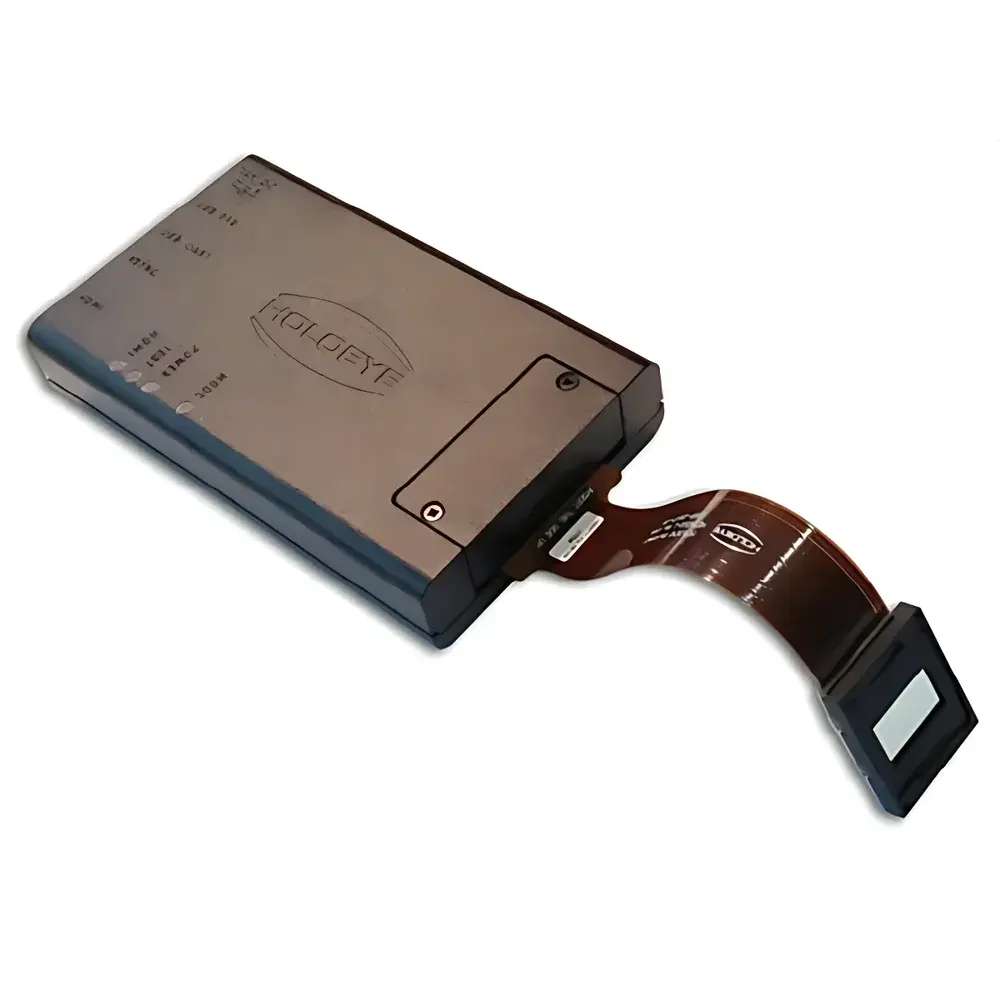
Holoeye PLUTO-2.1-UV-099 Pure-Phase Spatial Light Modulator
| Brand | Holoeye |
|---|---|
| Origin | Germany |
| Model | PLUTO-2.1-UV-099 |
| Pixel Resolution | 1920 × 1080 |
| Pixel Pitch | 8 µm |
| Wavelength Range | UV-optimized (typically 355–405 nm) |
| Interface | USB-controlled gamma/dynamic range calibration |
| Video Input | Standard HDMI/VGA via GPU extended display (Green channel, 8-bit grayscale) |
| Operating Mode | Pure-phase modulation only |
| Compliance | CE-marked, RoHS-compliant |
Overview
The Holoeye PLUTO-2.1-UV-099 is a high-resolution, pure-phase spatial light modulator (SLM) engineered for precision wavefront shaping in ultraviolet and near-UV spectral regions. Based on transmissive liquid crystal on silicon (LCoS) microdisplay technology, it delivers 1920 × 1080 active pixels with an 8 µm pixel pitch, enabling diffraction-limited phase control across beam diameters up to 15.4 mm (active aperture). Unlike intensity-modulating devices, the PLUTO-2.1-UV-099 operates exclusively in pure-phase mode—introducing programmable optical path differences without amplitude attenuation—making it ideal for applications requiring high modulation fidelity, such as holographic beam steering, adaptive optics correction, structured illumination microscopy, and quantum optics experiments involving single-photon interference or optical tweezer arrays. Its UV-optimized alignment layer and dielectric mirror stack ensure stable phase response and low absorption at wavelengths from 355 nm to 405 nm, supporting Nd:YAG third-harmonic generation setups, UV lithography prototyping, and photochemical patterning systems.
Key Features
- 1920 × 1080 full-HD resolution LCoS microdisplay with 8 µm pixel pitch and >99% fill factor
- UV-grade optical stack: anti-reflection coated fused silica windows and optimized liquid crystal alignment for 355–405 nm operation
- Pure-phase modulation architecture: 2π phase stroke achievable with <±0.02π RMS phase error across full aperture (typical, calibrated)
- Hot-pluggable operation: compatible with standard desktop GPUs via extended desktop mode; phase patterns loaded as 8-bit grayscale images using the green channel only
- USB-based driver unit enables real-time gamma curve adjustment and dynamic voltage range tuning—critical for wavelength-specific calibration and long-term phase stability
- Integrated thermal management: passive heatsink design ensures <0.5°C temperature drift during 60-minute continuous operation under ambient lab conditions
- CE-marked and RoHS-compliant; designed for integration into ISO Class 5 cleanroom-compatible optical benches and laser safety enclosures (Class 1/3B compliant when used with appropriate interlocks)
Sample Compatibility & Compliance
The PLUTO-2.1-UV-099 is not a sample-measurement instrument but a programmable optical component—its compatibility is defined by incident beam parameters and system-level integration requirements. It accepts collimated or weakly focused UV beams with diameters ≤15 mm and peak irradiance <100 mW/cm² (CW) or <10 mJ/cm² (pulsed, 10 ns @ 10 Hz). The device complies with IEC 61000-6-3 (EMC emission limits) and IEC 61000-6-2 (immunity), and its mechanical housing meets DIN ISO 2768-mK general tolerances. For regulated environments—including GLP-compliant optical metrology labs or FDA-regulated photolithography development workflows—the SLM supports traceable calibration protocols via Holoeye’s optional Phase Calibration Kit (PCK-UV), which provides NIST-traceable interferometric verification of phase response linearity and hysteresis behavior.
Software & Data Management
Holoeye provides the SLM Display Software (v4.3+), a Windows-based application supporting real-time phase pattern generation, Fourier- and Gerchberg-Saxton-based hologram synthesis, and batch loading of sequence files (.bmp/.tif, 8-bit grayscale). The software exports phase maps in industry-standard formats (e.g., .mat, .fits) and logs all hardware parameter changes—including USB-set gamma values, frame rate, and timestamped calibration events—for audit-ready data provenance. While the device itself does not store configuration history, the USB driver firmware implements non-volatile memory for last-used voltage ranges and gamma tables—enabling reproducible startup states across power cycles. Integration with MATLAB, Python (via PySLM or custom ctypes wrappers), and LabVIEW is supported through documented DLL APIs and example scripts, facilitating automated experiment control in ISO 17025-accredited testing environments.
Applications
- Holographic optical trapping and dynamic micromanipulation of nanoparticles and biological cells in UV-transparent media
- Wavefront correction in UV stellar interferometry testbeds and synchrotron beamline diagnostics
- Programmable diffractive optical elements (DOEs) for maskless UV photolithography and microfabrication R&D
- Quantum information processing: generation of orbital angular momentum (OAM) modes and multi-path interferometric states at 355 nm
- Structured illumination super-resolution microscopy (SIM) using UV-excited fluorophores
- Laser pulse shaping for coherent control experiments in gas-phase photochemistry
FAQ
Is the PLUTO-2.1-UV-099 suitable for pulsed UV lasers? What are the damage threshold specifications?
Yes—it is rated for nanosecond pulses at 355 nm (10 ns, 10 Hz); maximum fluence is 10 mJ/cm². Continuous-wave operation is limited to 100 mW/cm² to maintain phase stability and avoid thermal lensing.
Does it support closed-loop phase feedback or real-time aberration sensing?
No—the PLUTO-2.1-UV-099 is an open-loop spatial phase modulator. Integration with external wavefront sensors (e.g., Shack-Hartmann or interferometric systems) requires custom software synchronization via TTL triggers or shared clock signals.
Can multiple PLUTO units be synchronized for multi-beam interference experiments?
Yes—using external frame synchronization via the provided SYNC IN/OUT BNC ports, sub-microsecond timing alignment across up to four units is achievable with proper cabling and master-slave configuration.
What is the typical phase calibration frequency required in a production environment?
Under stable temperature and humidity (23 ± 1°C, 40–60% RH), recalibration is recommended every 72 operational hours or after any change in operating wavelength or ambient pressure exceeding ±5 kPa.
Is FDA 21 CFR Part 11 compliance supported for GxP-regulated applications?
The hardware and driver firmware do not include electronic signature or audit trail features per se; however, when deployed with validated third-party control software (e.g., certified LabVIEW modules or Python frameworks with cryptographic logging), full Part 11 compliance can be achieved at the system level.




