
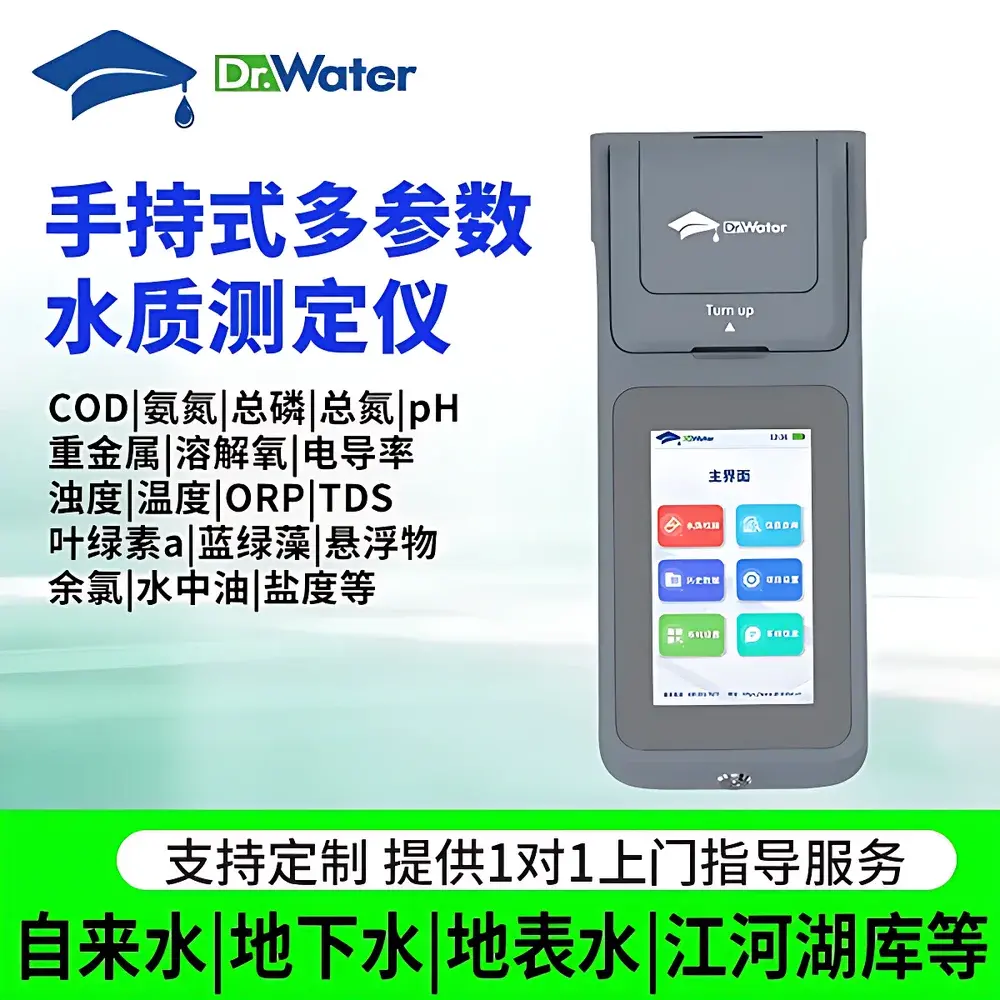
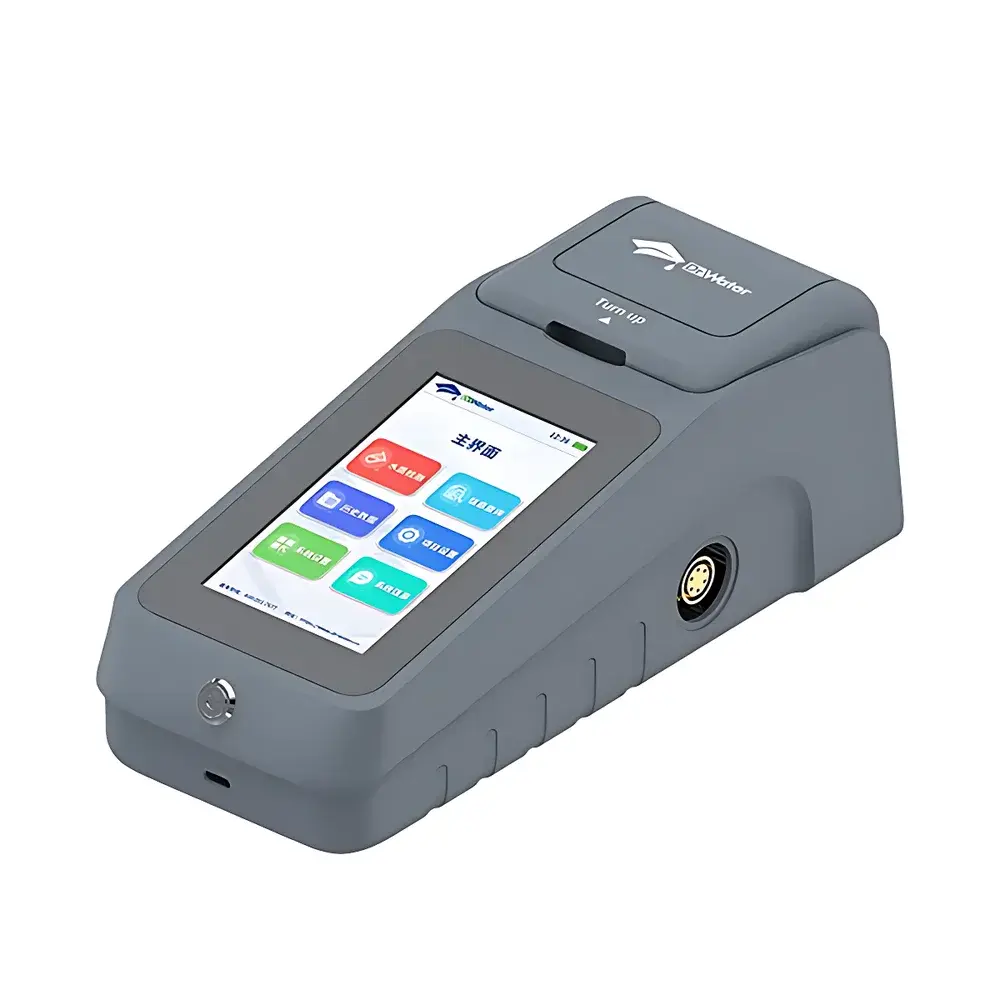
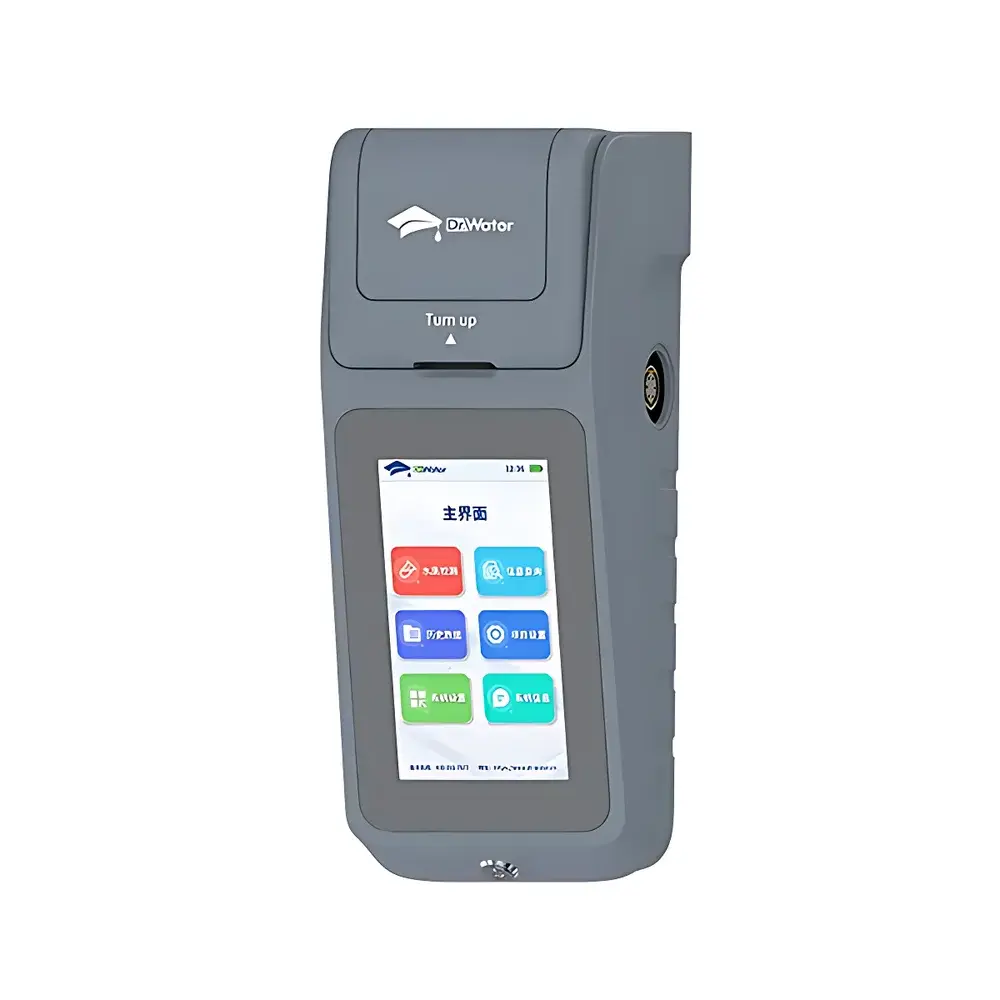
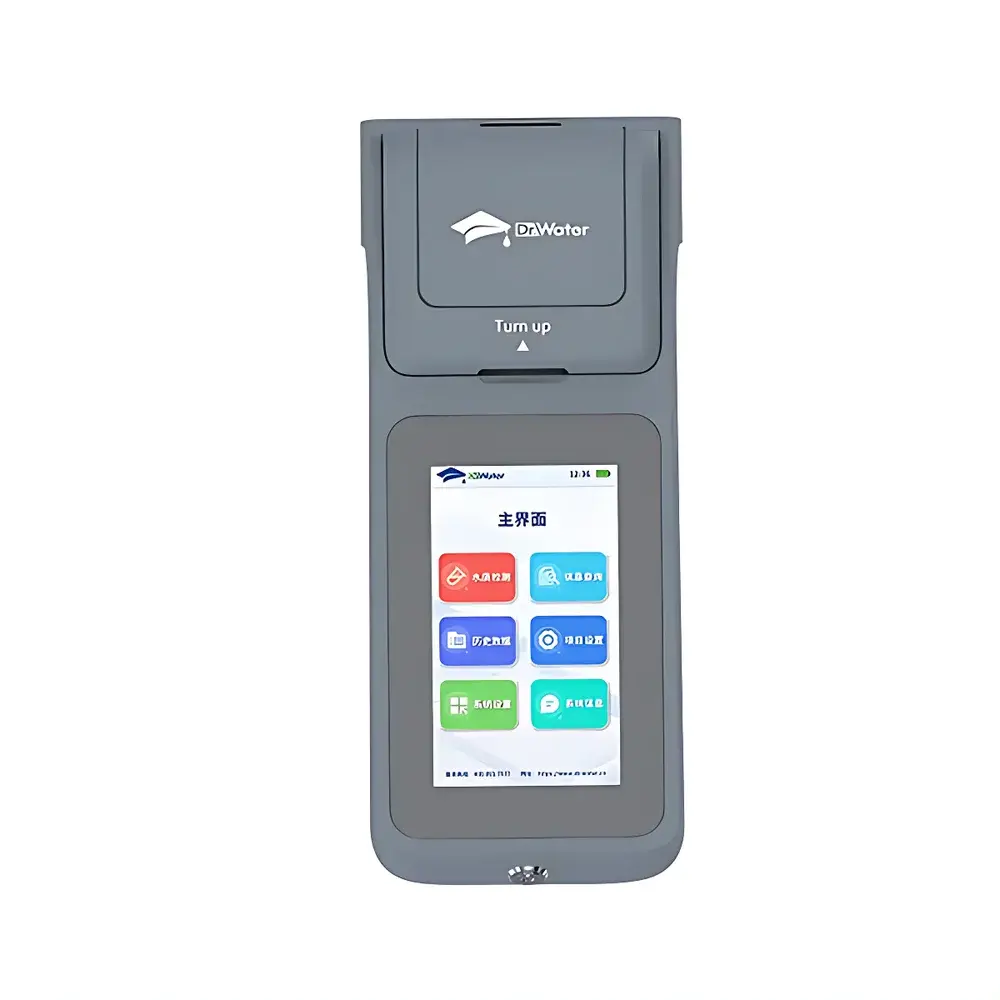
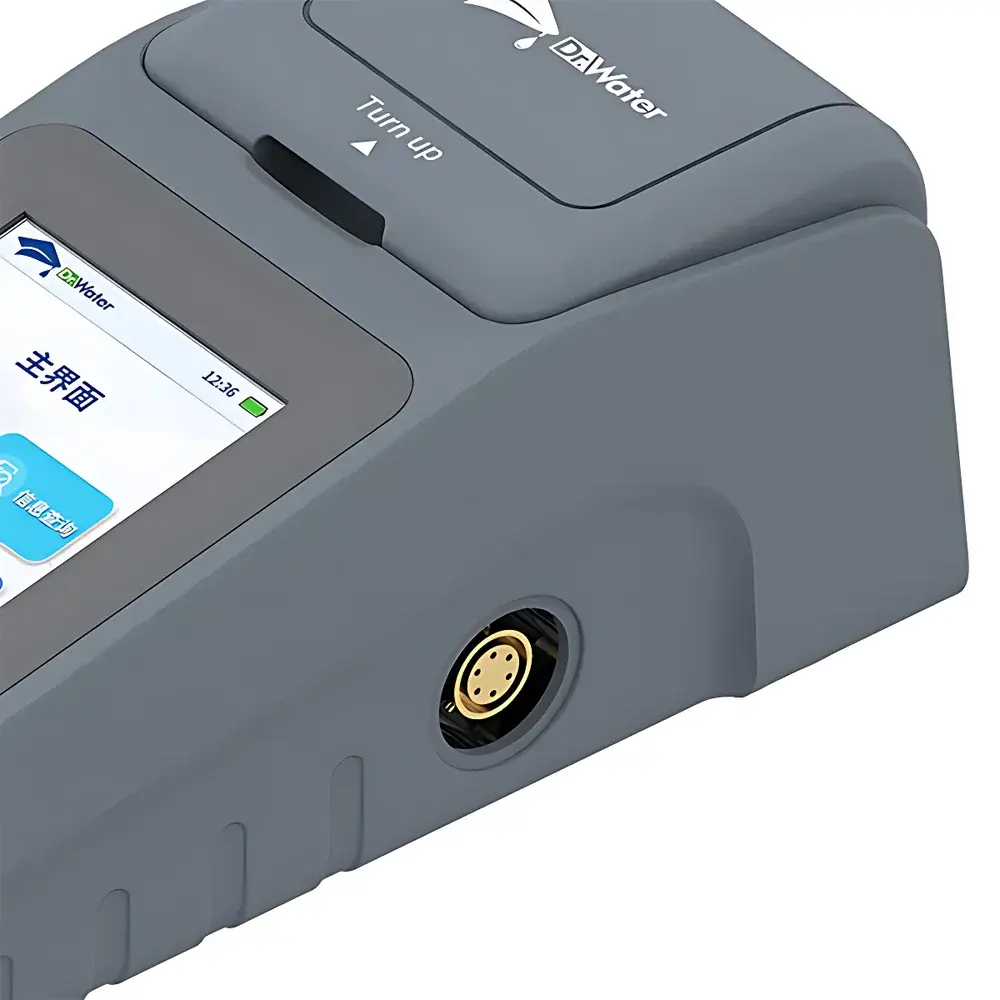
Dr-T9900 Handheld Multi-Parameter Water Quality Analyzer by DoctorWater
| Brand | DoctorWater |
|---|---|
| Origin | Hunan, China |
| Model | Dr-T9900 |
| Instrument Type | Portable/Handheld Water Quality Analyzer |
| Detection Principles | Spectrophotometry (340–900 nm) & Electrochemical Sensing |
| Measured Parameters | COD (2–20000 mg/L), Ammonia-N, Total Phosphorus, Total Nitrogen, Heavy Metals, pH, Dissolved Oxygen (DO), Conductivity, Turbidity, Temperature, ORP, TDS, Chlorophyll-a, Cyanobacteria, Suspended Solids, Residual Chlorine, Oil-in-Water, Salinity, and >80 additional parameters |
| Wavelength Accuracy | ±1 nm |
| Wavelength Repeatability | <0.2 nm |
| Spectral Bandwidth | 4 nm |
| Transmittance Error | ±0.5% |
| Transmittance Repeatability | ≤0.2% T |
| Absorbance Resolution | 0.001 Abs |
| Optical Stability | ≤±0.005 Abs/20 min |
| Pre-stored Calibration Curves | 600 |
| Data Storage Capacity | 1,000,000 records |
| Display | 5-inch HD capacitive touchscreen |
| Power Supply | Rechargeable Li-ion battery + AC adapter |
| Compliance | HJ/T 399–2007, HJ 535–2009, GB 11893–1989 |
Overview
The Dr-T9900 Handheld Multi-Parameter Water Quality Analyzer by DoctorWater is an integrated field-deployable instrument engineered for simultaneous quantitative analysis of over 80 water quality indicators using dual detection modalities: precision spectrophotometry (340–900 nm range) and multi-channel electrochemical sensing. Its optical architecture employs a stabilized cold-light source with >100,000-hour service life, coupled with a fiber-optic detection path and 4 nm spectral bandwidth to ensure high photometric fidelity. The electrochemical subsystem incorporates interchangeable, factory-calibrated digital electrodes for pH, DO, ORP, conductivity, and ion-selective measurements—each featuring automatic temperature compensation (ATC) and real-time signal digitization. Designed for compliance with key Chinese environmental standard methods—including HJ/T 399–2007 (COD via rapid digestion spectrophotometry), HJ 535–2009 (ammonia-nitrogen via Nessler reagent), and GB 11893–1989 (total phosphorus via ammonium molybdate)—the Dr-T9900 bridges regulatory method adherence with operational flexibility in non-laboratory settings.
Key Features
- Dual-mode optical measurement: 360° rotating tube cuvette holder for standardized vial-based assays + fixed-cell cuvette slot for reproducible absorbance reading
- Dedicated digital electrode bay supporting plug-and-play calibration and auto-recognition of pH, DO, ORP, EC, and ISE probes
- 5-inch high-resolution capacitive touchscreen with customizable UI; English language firmware available upon configuration
- 600 pre-programmed calibration curves covering EPA, ISO, and Chinese standard methods—editable, exportable, and traceable
- Optical performance certified: wavelength repeatability <0.2 nm, transmittance repeatability ≤0.2% T, absorbance resolution 0.001 Abs
- Robust mechanical design: ABS polymer housing rated IP67 for dust/water ingress protection; includes impact-resistant carrying case with chemical-resistant interior lining
- Dual-power architecture: Integrated 12,000 mAh Li-ion battery enabling ≥12 hours continuous operation; optional AC adapter for benchtop use
- Data integrity controls: Timestamped storage of 1 million test records locally; Bluetooth thermal printer support for immediate field reporting
Sample Compatibility & Compliance
The Dr-T9900 accommodates aqueous samples across diverse matrices—including raw sewage, industrial effluents, groundwater, surface water, reclaimed water, aquaculture ponds, and process streams in pharmaceutical or food manufacturing. Its optical system supports both 10 mm and 25 mm pathlength tubes per HJ/T 399–2007 requirements, while electrochemical modules meet ISO 7888 (conductivity), ISO 5814 (DO), and ASTM D1293 (pH) measurement principles. All onboard calibration protocols adhere to GLP-aligned practices, with audit-trail-capable calibration logs, user-access-level permissions, and full traceability of curve selection, dilution factors, and reagent lot numbers. Though not FDA 21 CFR Part 11-certified out-of-box, the device supports configurable electronic signature workflows and encrypted data export (CSV/Excel) compatible with LIMS integration.
Software & Data Management
Firmware version 3.2+ provides on-device data review, statistical summary (mean, SD, CV%), and trend visualization across time-series datasets. Raw spectra (absorbance vs. wavelength) and electrode response curves are storable per measurement. USB-C interface enables direct transfer of encrypted datasets to Windows/macOS systems; proprietary PC software (DoctorWater LabLink v2.4) offers advanced curve fitting, outlier detection, QC charting (X-bar/R), and automated report generation compliant with ISO/IEC 17025 documentation templates. Cloud sync capability (optional subscription) supports multi-site fleet management, remote firmware updates, and centralized audit log archiving.
Applications
Field technicians perform rapid screening at wastewater influent/effluent points, stormwater outfalls, and drinking water distribution nodes. Municipal utilities deploy the Dr-T9900 for routine compliance monitoring under China’s “Blue Sky and Clear Water” initiative. Environmental consultancies use it during Phase I/II site assessments to map spatial contaminant gradients. In academic labs, it serves as a teaching platform for water chemistry, sensor calibration theory, and method validation exercises. Industrial users—including power plants, textile mills, and biopharma facilities—leverage its portability for leak detection, pretreatment verification, and discharge permit compliance checks without requiring sample transport delays.
FAQ
Does the Dr-T9900 support US EPA-approved methods?
It implements equivalent photometric and electrochemical principles aligned with EPA 410.4 (COD), EPA 350.1 (ammonia), and EPA 365.3 (phosphate); however, formal EPA method validation documentation is not provided—users must conduct in-house method verification per 40 CFR Part 136.
Can calibration curves be imported from external sources?
Yes—via USB drive in CSV format, provided they conform to the defined column structure (wavelength, absorbance, concentration) and include metadata fields for method ID and uncertainty estimation.
Is electrode maintenance documented within the device?
Each electrode insertion triggers automatic logging of serial number, last calibration date, slope/mV offset, and membrane integrity status—accessible under Maintenance History.
What is the operating temperature range?
Instrument: –10 °C to 50 °C; Electrodes: 0 °C to 45 °C (standard), with optional high-temp DO probes rated to 80 °C.
How is data security ensured during transmission?
USB transfers use AES-128 encryption; Bluetooth printing employs pairing authentication; cloud uploads (if enabled) utilize TLS 1.3 with OAuth 2.0 token exchange.







