
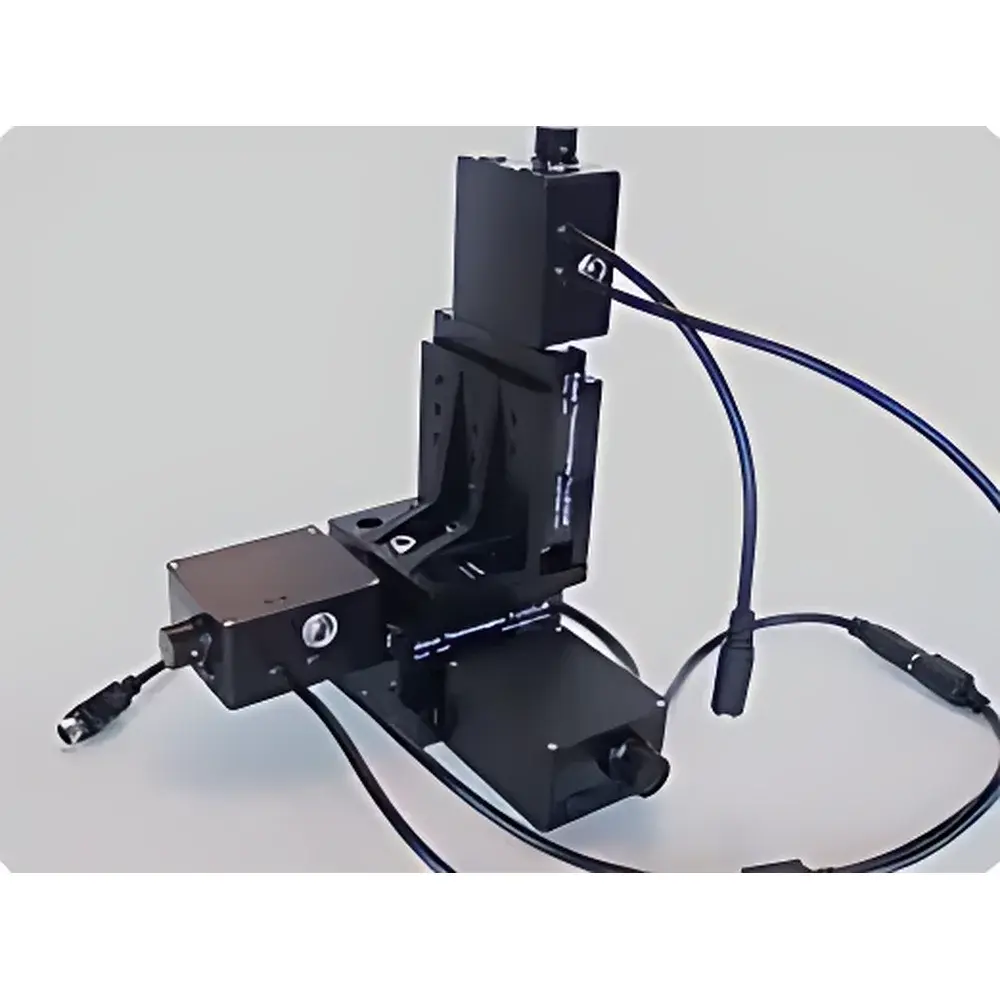
Modu-Laser 004 Sealed-Mirror Argon Ion Laser System
| Origin | USA |
|---|---|
| Manufacturer Type | Authorized Distributor |
| Origin Category | Imported |
| Model | 004 |
| Pricing | Available Upon Request |
| Wavelength Range | 457.9–514.5 nm |
| Max Total Output Power | 150 mW (multi-line) / 50 mW (single-line @ 488 nm) |
| Beam Mode | TEM₀₀ |
| Beam Diameter (1/e²) | 0.65 mm |
| Beam Divergence | 0.95 mrad |
| Beam Pointing Stability | <30 µrad |
| Output Power Drift (post-warm-up) | <±1% |
| Amplitude Noise | <1% RMS |
| Polarization Ratio | >100:1 |
| Warm-up Time | 5 min |
| Input Voltage/Frequency | 100–265 VAC, 50–60 Hz |
| Power Consumption | <1500 W |
| Dimensions (L×W×H) | 13.0" × 7.6" × 5.1" |
| Weight | 14 lbs (6.4 kg) |
Overview
The Modu-Laser 004 is a compact, air-cooled, sealed-mirror argon ion laser system engineered for stable, low-noise continuous-wave (CW) output across the visible blue–green spectrum. Based on the well-established Coulomb-driven plasma discharge principle in high-purity argon gas, this laser operates via electron-impact excitation of Ar⁺ ions within a magnetically confined plasma tube. Its sealed-mirror architecture eliminates the need for external mirror alignment or gas replenishment—significantly enhancing long-term operational reliability and reducing maintenance overhead. Unlike open-cavity ion lasers requiring water cooling and complex vacuum infrastructure, the 004 integrates a high-efficiency switching power supply and thermally optimized discharge tube into a single benchtop enclosure. It delivers up to 150 mW total multi-line output (457.9 nm, 488.0 nm, 514.5 nm dominant lines) or up to 50 mW in single-line configuration (e.g., 488 nm), both in diffraction-limited TEM₀₀ mode. This makes it suitable for applications demanding spatial coherence, polarization purity, and amplitude stability—including Raman spectroscopy excitation, confocal fluorescence microscopy alignment, and educational optics laboratories.
Key Features
- Sealed-mirror plasma tube with factory-aligned optics—no user realignment required over lifetime
- Integrated universal-input switching power supply (100–265 VAC, 50/60 Hz) enabling global deployment without voltage converters
- Thermally stabilized cavity design ensuring beam pointing stability <30 µrad and power drift <±1% after 5-minute warm-up
- Low-amplitude-noise operation (<1% RMS) critical for quantitative intensity-based measurements
- High polarization ratio (>100:1) supporting polarimetric experiments and interference-based setups
- Benchtop footprint (13.0″ × 7.6″ × 5.1″) and lightweight construction (6.4 kg) facilitating integration into optical tables, OEM subsystems, and teaching labs
- Compliance with IEC 60825-1:2014 Class 4 laser safety requirements; includes interlock connector and key switch per ANSI Z136.1
Sample Compatibility & Compliance
The Modu-Laser 004 is compatible with standard optomechanical mounts (e.g., Ø1″ post holders, kinematic platforms) and interfaces seamlessly with common spectrometers, monochromators, and detector systems via free-space coupling. Its fixed 0.65 mm (1/e²) beam diameter and 0.95 mrad divergence simplify collimation and fiber coupling (e.g., into multimode or polarization-maintaining fibers with appropriate focusing optics). The system conforms to electromagnetic compatibility standards per FCC Part 15 Subpart B (Class A) and CE marking directives (2014/30/EU EMC Directive, 2014/35/EU LVD Directive). For regulated environments—including GLP-compliant analytical labs and GMP-aligned R&D facilities—the laser supports optional audit-trail-enabled control firmware (via RS-232/USB) meeting FDA 21 CFR Part 11 data integrity prerequisites when paired with validated host software.
Software & Data Management
While the Modu-Laser 004 operates as a stand-alone analog device, it features TTL-compatible modulation input (0–5 V) and analog power control (0–5 V) for integration into automated test benches. Optional USB-to-RS232 adapters enable serial communication with third-party control platforms (e.g., LabVIEW, Python PySerial, MATLAB Instrument Control Toolbox). Firmware logs operational parameters—including runtime hours, thermal sensor readings, and interlock status—for preventive maintenance scheduling. No proprietary software is required; configuration and monitoring rely on industry-standard SCPI-like command sets documented in the technical manual. All calibration records, service history, and compliance certificates are provided in PDF format compliant with ISO/IEC 17025 documentation requirements.
Applications
- Raman spectroscopy: Primary excitation source for 488 nm and 514.5 nm resonant and non-resonant Raman measurements in material science and pharmaceutical analysis
- Confocal and fluorescence microscopy: Alignment and verification laser for scanning systems; compatible with GFP, FITC, and Alexa Fluor 488 dyes
- Flow cytometry: Stable 488 nm source for scatter and fluorescence channel calibration in clinical and research instruments
- Holography and interferometry: Coherent illumination with long coherence length (>1 m) for high-fidelity fringe generation
- Optical pumping: Pump source for dye lasers and Ti:sapphire amplifiers requiring narrow-linewidth visible excitation
- Undergraduate physics labs: Demonstration of plasma physics, atomic transitions, and Gaussian beam propagation principles
FAQ
Is the Modu-Laser 004 certified for use in Class 1 laser enclosures?
Yes—when integrated into an interlocked, fully enclosed housing meeting IEC 60825-1 Annex D requirements, the system qualifies for Class 1 operation. Full enclosure schematics and safety validation templates are available upon request.
Can the laser be operated continuously for extended periods (e.g., 8+ hours)?
Yes. Thermal management design allows uninterrupted operation under ambient temperatures ≤35°C and airflow ≥100 L/min. Recommended duty cycle for maximum tube lifetime is ≤12 hours/day.
Does the 004 support wavelength selection without external filters?
No—wavelength selection requires external bandpass filters or dichroic mirrors. The laser emits all supported lines simultaneously unless externally filtered; single-line models (e.g., 004-488) are configured at manufacture.
What is the expected plasma tube lifetime under normal operating conditions?
Rated minimum operational lifetime is 5,000 hours at rated output power, based on accelerated life testing per MIL-STD-781H. Actual longevity depends on thermal cycling frequency and ambient operating environment.
Is remote power modulation supported?
Yes—0–5 V analog input enables linear power control from 10% to 100% of rated output; TTL modulation supports on/off switching up to 10 kHz. Modulation linearity and rise/fall times are specified in the Electrical Interface Appendix.




