
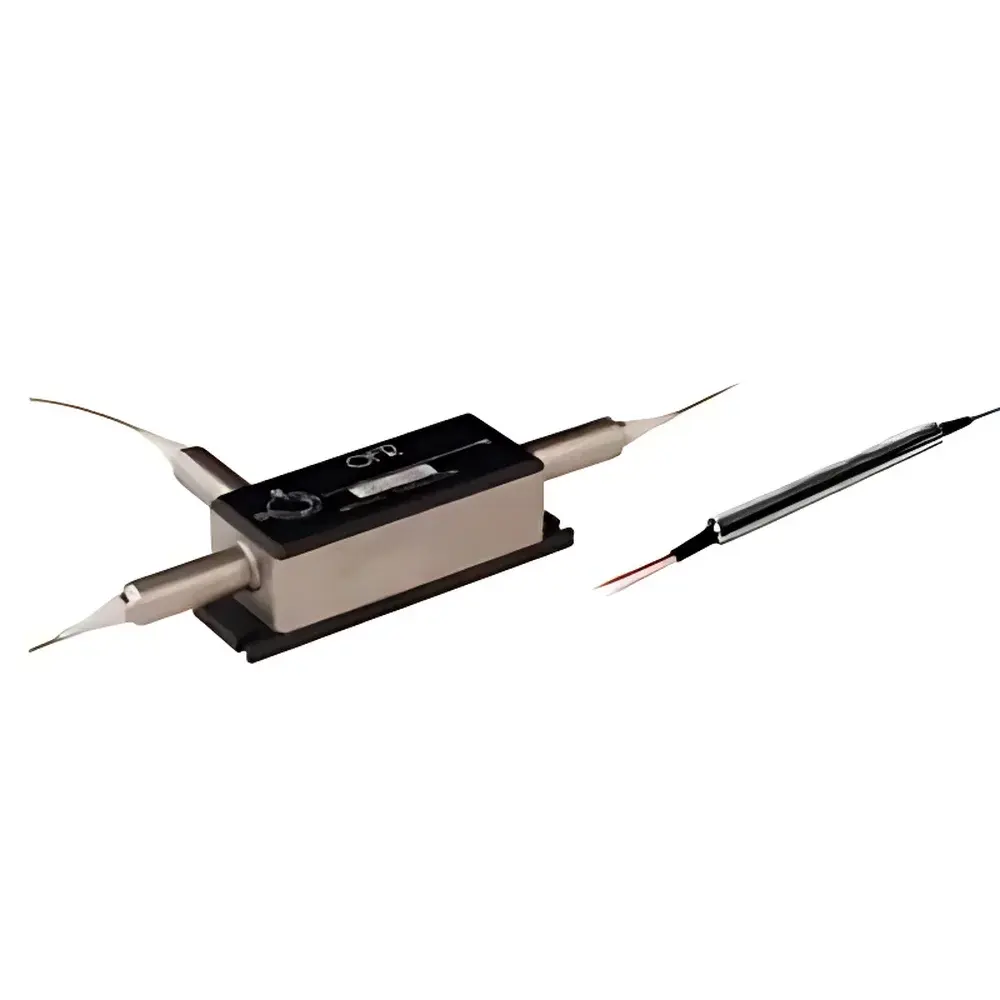
Optical Circulator Model CIR-235 – 3-Port Polarization-Insensitive Device for Telecom & Sensing Applications
| Origin | Imported |
|---|---|
| Manufacturer Type | Authorized Distributor |
| Model | CIR-235 |
| Pricing | Available Upon Request |
Overview
An optical circulator is a non-reciprocal, multi-port passive photonic component engineered to route light signals sequentially between ports with high directionality and minimal back-reflection. Unlike optical isolators—which operate bidirectionally across two ports—circulators enable unidirectional signal flow across three or more ports (e.g., Port 1 → Port 2 → Port 3 → Port 1), making them essential in bidirectional fiber-optic systems requiring signal separation, reflection management, and wavelength reuse. The CIR-235 is a polarization-insensitive, 3-port circulator optimized for operation in the C-band (1530–1570 nm) and compatible with standard single-mode fiber (SMF-28e). Its design leverages magneto-optic Faraday rotation combined with birefringent crystal walk-off and polarization beam combining techniques to achieve stable performance across temperature and polarization states. This architecture ensures robust functionality in dense wavelength division multiplexing (DWDM) networks, fiber Bragg grating (FBG)-based sensor interrogation systems, optical time-domain reflectometry (OTDR) setups, and laser cavity feedback control applications.
Key Features
- Three-port unidirectional routing: Light entering Port 1 exits exclusively at Port 2; light entering Port 2 exits exclusively at Port 3; light entering Port 3 exits exclusively at Port 1
- Polarization-insensitive design with ≤0.1 dB polarization-dependent loss (PDL), ensuring consistent insertion loss regardless of input SOP
- High isolation (>32 dB typical between non-sequential ports), critical for suppressing backscattered or reflected signals in sensitive receiver paths
- Directionality >50 dB (1→3 path), enabling effective suppression of crosstalk in cascaded configurations
- Low insertion loss (0.9–1.3 dB typical), minimizing signal attenuation in inline deployment
- High return loss (≥55 dB), reducing unwanted reflections that could destabilize lasers or degrade SNR
- Maximum optical power handling up to 5 W (CW), supporting high-power amplifier and pump applications
- Hermetically sealed metal-ceramic housing with precision-aligned SMF-28e pigtails (1.2 ± 0.2 m length, 900 µm loose tube)
- Operating temperature range: 10–50 °C; storage range: −20 to +70 °C; relative humidity tolerance: 20–80% RH (non-condensing)
Sample Compatibility & Compliance
The CIR-235 is designed for integration into standardized fiber-optic infrastructure compliant with ITU-T G.652.D and IEC 60793-2-50 specifications for single-mode fiber. It supports FC/APC connectorization (optional bare-fiber termination) and maintains mechanical stability under vibration per GR-1209-CORE and thermal cycling per Telcordia GR-1221-CORE. While not certified to a specific regulatory standard by itself, the device meets functional requirements referenced in IEEE 802.3, ITU-T G.694.1 (DWDM grid), and IEC 61300-2-17 (fiber optic connector durability). Its low PDL and high isolation support compliance with system-level test procedures defined in IEC 61280-2-9 (optical amplifier testing) and IEC 61753-1 (category U for uncontrolled environments).
Software & Data Management
As a passive optical component, the CIR-235 requires no embedded firmware, driver software, or configuration interface. Performance validation is conducted via traceable optical test methods—including insertion loss mapping, isolation sweep across wavelength and temperature, and PDL characterization using polarization controllers and calibrated power meters—in accordance with IEC 61300-3-4 and IEC 61300-3-11. All test reports include full metrological traceability to NIST-traceable standards. For system integration, the device is fully compatible with industry-standard optical network monitoring platforms (e.g., EXFO FTBx-500, VIAVI T-BERD/MTS-5800) when used in loopback or reflection-based diagnostics. Audit-ready documentation—including calibration certificates, MSA-compliant labeling, and RoHS/REACH declarations—is provided with each unit to support GLP/GMP and ISO 9001 quality system requirements.
Applications
- DWDM add/drop multiplexing nodes with integrated FBG filters
- Fiber-optic sensor interrogation systems (e.g., distributed acoustic sensing, FBG strain/temperature arrays)
- Optical amplifier architectures (e.g., EDFAs with bidirectional pumping or gain-flattening filter feedback)
- Laser cavity designs requiring intracavity isolation and output coupling
- OTDR launch modules for simultaneous transmission and reception on a single fiber
- Quantum optics experiments requiring directional photon routing and low-backreflection interfaces
- Free-space-to-fiber coupling systems where spatial mode separation and polarization management are critical
FAQ
What wavelength bands does the CIR-235 support?
The CIR-235 is specified for the C-band (1530–1570 nm), with guaranteed performance across this range at 25 °C and nominal input polarization state.
Can it be used with polarization-maintaining (PM) fiber?
No—the CIR-235 is polarization-insensitive and optimized for standard SMF-28e; PM fiber integration is not supported due to modal mismatch and alignment constraints.
Is the device compliant with RoHS and REACH regulations?
Yes—each unit ships with full material declaration and third-party verification confirming compliance with EU Directive 2011/65/EU (RoHS) and Regulation (EC) No 1907/2006 (REACH).
What is the maximum continuous optical power rating?
5 W (CW) at all ports, validated under worst-case thermal loading conditions per IEC 61300-2-4.
Does the CIR-235 require electrical power or active control?
No—it is a fully passive, magneto-optic device with no electrical interface, no warm-up time, and zero power consumption.



