
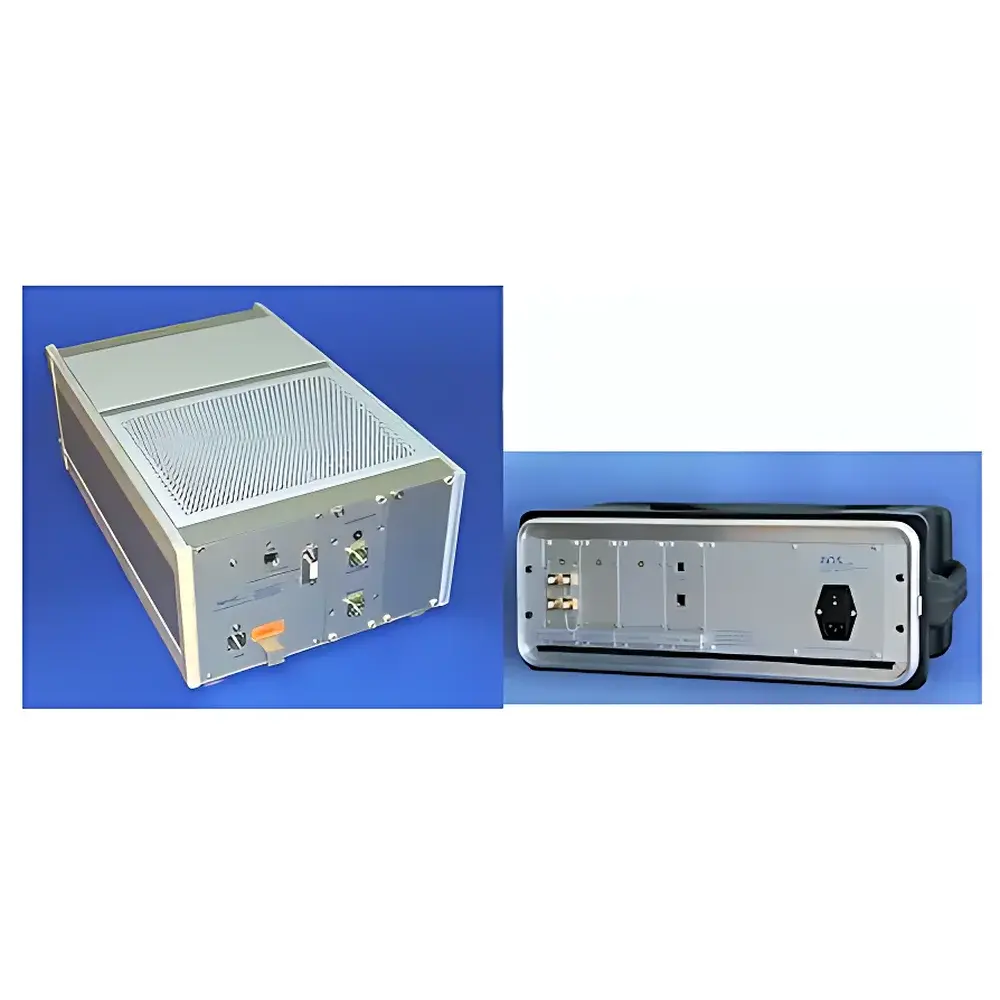
Fiber Bragg Grating Monitoring Unit – AOS DVNext Series
| Key | Brand: AOS/Advanced Optics Solutions |
|---|---|
| Origin | Germany |
| Manufacturer Type | Authorized Distributor |
| Origin Category | Imported |
| Model | Monitoring Unit for Cascaded FBG |
| Pricing | Upon Request |
Overview
The AOS DVNext Fiber Bragg Grating (FBG) Monitoring Unit is a high-stability, wavelength-encoded optical interrogation system engineered for long-term structural health monitoring (SHM) in demanding civil, industrial, and energy infrastructure environments. Operating on the principle of Bragg wavelength shift detection—where strain or temperature changes induce measurable shifts in the reflected central wavelength (λB) of fiber-integrated grating structures—the unit delivers passive, multiplexed, and inherently EMI-immune sensing capabilities. Unlike interferometric or intensity-based optical sensors, FBG interrogation provides absolute, drift-free measurements traceable to wavelength standards. The system employs a high-resolution CCD-based spectrometer architecture with no moving mechanical parts, ensuring operational robustness under continuous vibration, thermal cycling, and wide ambient temperature gradients (–20 °C to +70 °C operating range). Designed for unattended deployment over multi-year monitoring campaigns, it supports up to 32 cascaded FBG sensors per channel, enabling dense spatial sampling across extended structures without signal degradation or crosstalk.
Key Features
- CCD-based spectral interrogation engine with <1 pm wavelength resolution and ±5 pm measurement repeatability over 12 months
- Single-channel base configuration scalable via modular optical channel expansion units (up to 8 channels per rack-mounted chassis)
- Passive, all-fiber sensing architecture—no electrical components at the measurement point; intrinsically safe for explosive or high-voltage environments
- Integrated thermal stabilization of optical path and detector, minimizing zero-drift in non-climate-controlled installations
- Real-time dynamic sampling at configurable rates from 1 Hz (for static strain mapping) to 1 kHz (for modal analysis or impact detection)
- Rack-mountable 19″ enclosure compliant with IEC 60297-3-100 and EN 61000-6-2 EMC immunity standards
Sample Compatibility & Compliance
The monitoring unit is compatible with standard telecom-grade single-mode fiber (SMF-28) and polarization-maintaining FBG arrays written in hydrogen-loaded or femtosecond-inscribed configurations. It supports FBGs with reflectivity >70%, bandwidth <0.5 nm, and Bragg wavelengths between 1525 nm and 1565 nm (C-band). Calibration is performed using NIST-traceable wavelength references prior to shipment. The system meets ISO 16063-11 for vibration sensor calibration methodology and complies with ASTM E2820–22 for optical fiber sensor performance characterization in structural monitoring applications. Data acquisition workflows support GLP-compliant audit trails, including user authentication, timestamped raw spectrum logging, and immutable metadata embedding (sensor ID, location, calibration date).
Software & Data Management
AOS FiberSense™ v4.2 software suite is supplied with each unit, providing real-time visualization, automated peak tracking, and multi-parameter compensation (e.g., simultaneous strain–temperature decoupling using dual-wavelength or reference-grating schemes). The software exports time-synchronized datasets in HDF5 and CSV formats, with optional integration into SCADA platforms via OPC UA (IEC 62541) or Modbus TCP. All data files include embedded SHA-256 checksums and are stored with hierarchical folder structure aligned to ISO/IEC 17025 documentation requirements. Remote firmware updates and configuration management are supported over TLS 1.2-secured Ethernet connections, with role-based access control (RBAC) and full 21 CFR Part 11–compliant electronic signature capability available as an optional module.
Applications
- Long-term deformation monitoring of civil infrastructure: bridge decks, cable-stayed towers, tunnel linings, and heritage masonry structures
- Aerospace component testing: real-time strain mapping on composite wing spars, turbine blade root zones, and fuselage skin panels
- Energy sector asset integrity: dam deformation profiling, wind turbine blade twist monitoring, and subsea pipeline strain surveillance
- Geotechnical instrumentation: distributed strain sensing along retaining walls, landslide-prone slopes, and deep foundation piles
- Thermal anomaly detection: localized overheating identification in power transformers, generator stators, and HV transmission joints
FAQ
What is the maximum allowable distance between the monitoring unit and the farthest FBG sensor?
Up to 20 km using standard single-mode fiber with ≤0.2 dB/km attenuation; active dispersion compensation is not required due to the unit’s fixed-wavelength reference design.
Can the system perform simultaneous strain and temperature measurements?
Yes—using dual-gauge FBG configurations (e.g., one strain-sensitive and one temperature-reference grating) or specialized chirped/tilted FBG pairs with built-in cross-sensitivity compensation algorithms.
Is third-party sensor integration supported?
The unit accepts any FBG sensor meeting ITU-T G.652.D spectral and reflectivity specifications; custom calibration files can be imported via XML schema.
How is data synchronization handled across multiple monitoring units?
IEEE 1588v2 Precision Time Protocol (PTP) is implemented over the primary Ethernet interface, enabling sub-microsecond timestamp alignment across distributed nodes.
Does the system meet explosion-proof certification requirements for oil & gas applications?
While the interrogator itself requires Class I, Division 2 enclosure for hazardous locations, the passive FBG sensors are certified to ATEX/IECEx Zone 0 standards when installed with appropriate fiber cable routing and termination methods.




