
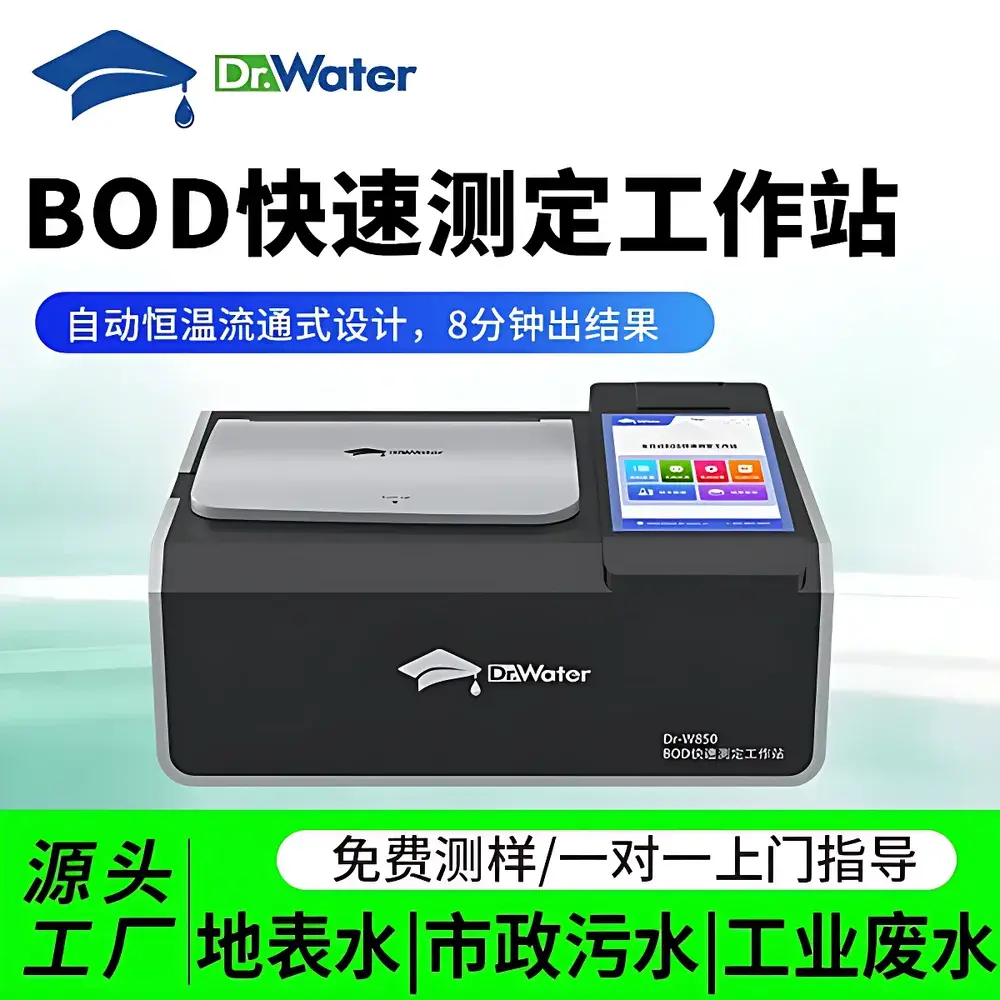
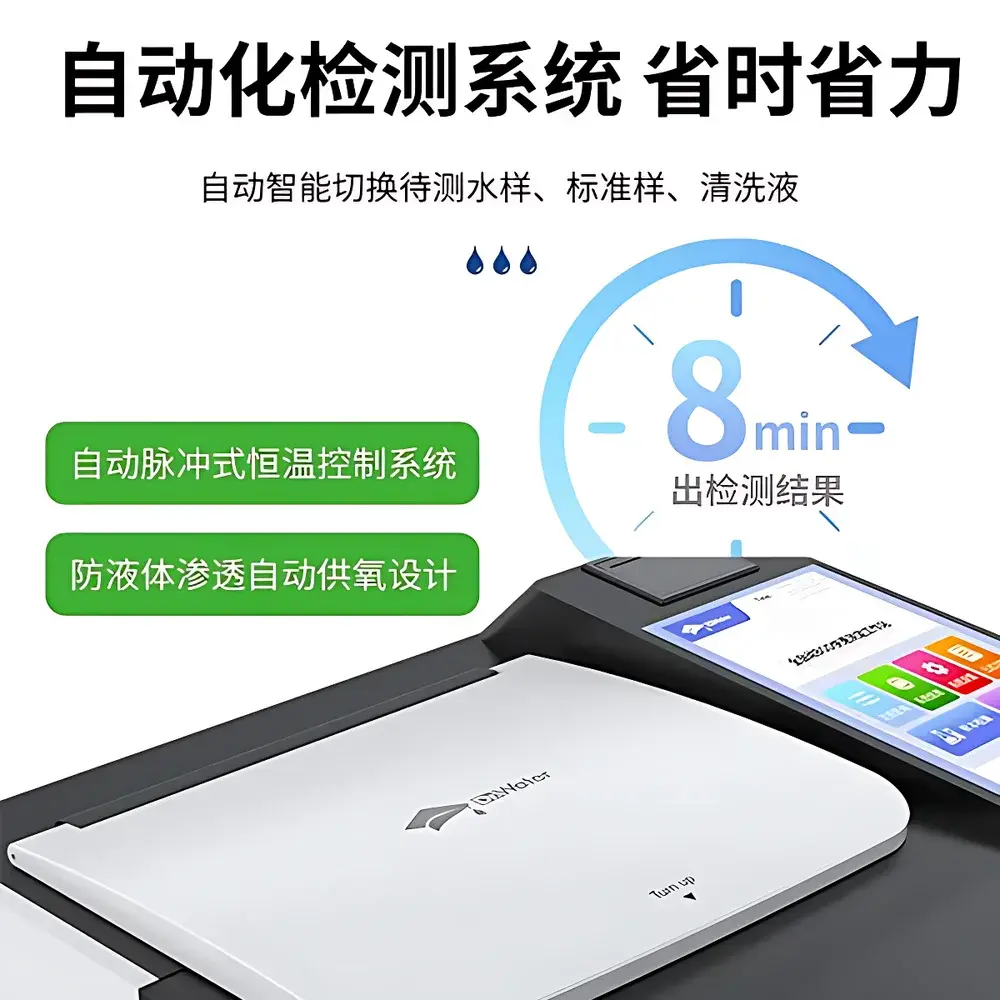
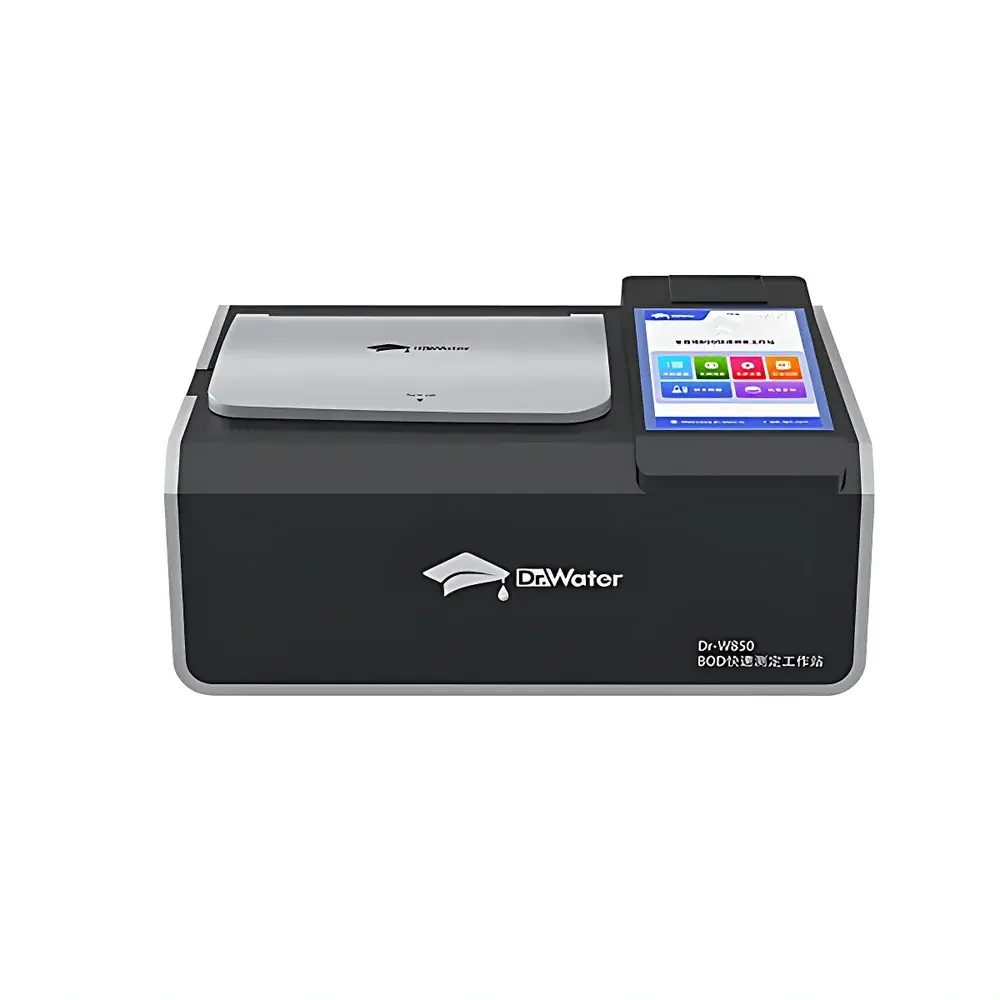
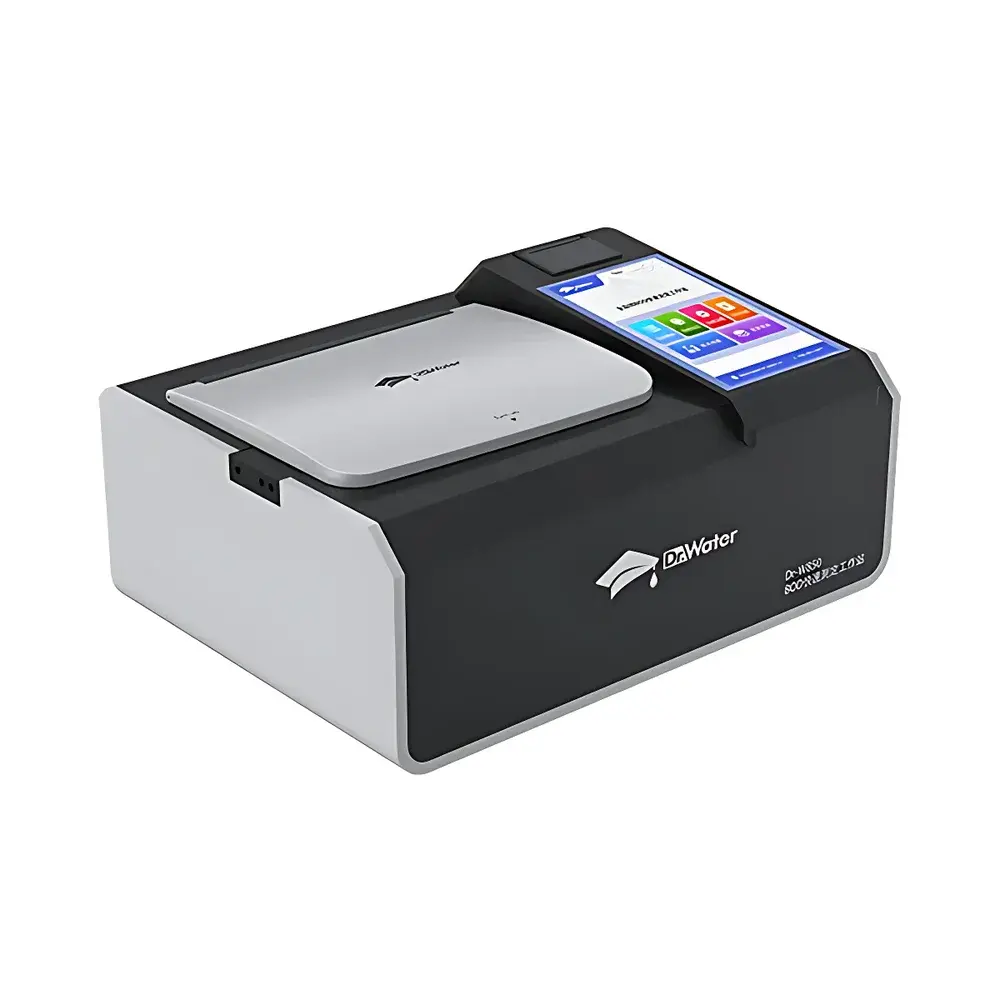
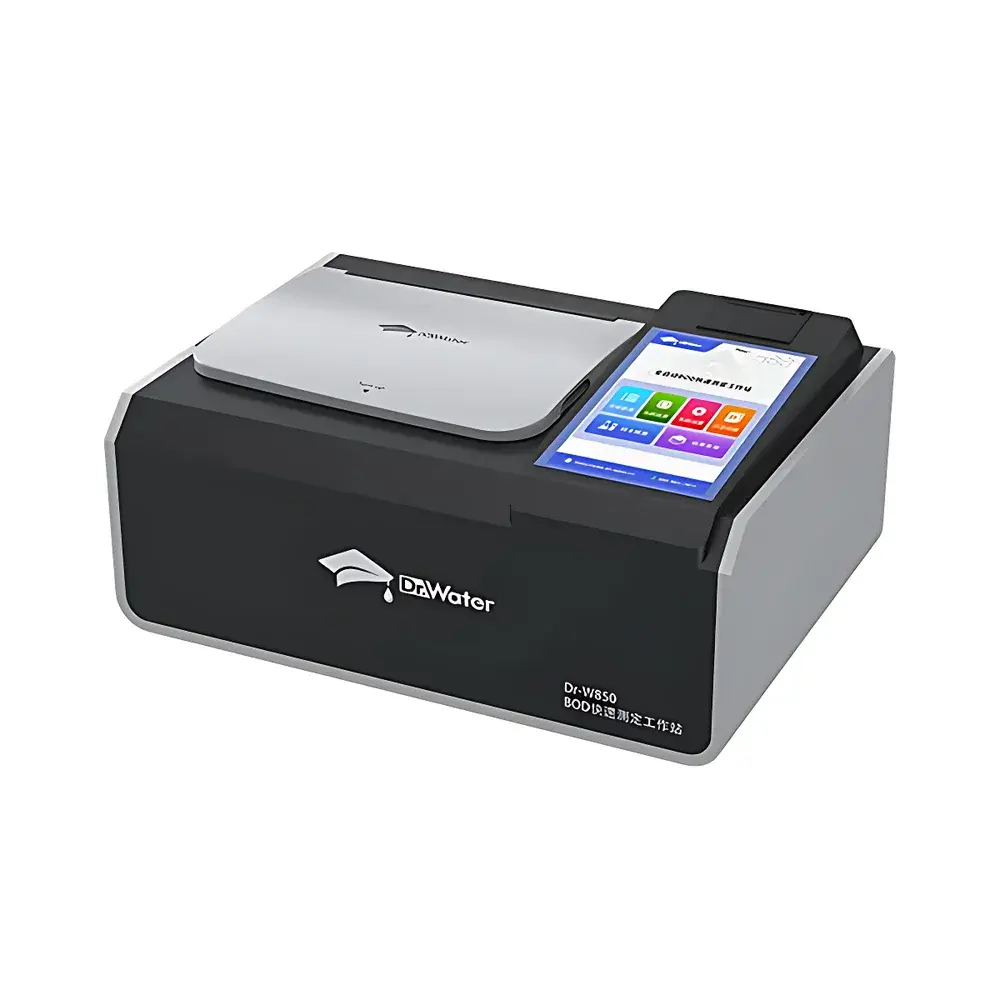
Dr-Water Dr-W850 BOD Rapid Determination Workstation
| Brand | Dr-Water |
|---|---|
| Origin | Hunan, China |
| Manufacturer Type | Authorized Distributor |
| Country of Origin | China |
| Model | Dr-W850 |
| Instrument Type | Laboratory BOD Analyzer |
| Measurement Principle | Microbial Electrode Method |
| Measurement Range | 2–4000 mg/L |
| Detection Limit | 2 mg/L |
| Accuracy | ≤ ±5% |
| Single-Sample Analysis Time | 8 min |
| Incubation Temperature Range | 5–40 °C (ambient) |
| Display | 8-inch HD color capacitive touchscreen |
| Sample Volume | 50 mL |
| Data Storage Capacity | 1,000,000 records |
| Power Supply | AC 220 V ±10%, 50 Hz |
| Rated Power | 48 W |
| Operating Humidity | <85% RH (non-condensing) |
| Microbial Membrane | Dry-layer immobilized biocatalyst membrane, non-toxic and biocompatible |
| Membrane Shelf Life | ≥12 months (dry storage at room temperature) |
| Active Service Life | ≥30 days post-hydration |
| Auto-sampling | Integrated peristaltic pump with multi-channel valve switching |
| Cleaning Mode | Fully automated rinse cycle |
| Oxygen Supply | Membrane-integrated pulsed oxygenation system |
| Thermal Control | Digital pulse-width modulated (PWM) ambient-temperature stabilization |
| Data Export | USB 2.0 interface |
| Built-in Thermal Printer | Yes |
Overview
The Dr-Water Dr-W850 BOD Rapid Determination Workstation is an engineered solution for quantitative biochemical oxygen demand (BOD) analysis in environmental laboratories, wastewater treatment facilities, and regulatory monitoring programs. It implements the microbial electrode method—standardized under HJ/T 86–2002 and referenced in the fourth edition of *Methods for the Examination of Water and Wastewater*—to deliver rapid, reproducible BOD measurements without conventional 5-day incubation. The system utilizes a flow-through configuration with immobilized microorganisms on a dry-layer biosensor membrane. When exposed to dissolved organic substrates, the microbes consume oxygen at a rate proportional to BOD concentration; this consumption is electrochemically transduced via a Clark-type oxygen electrode. Unlike respirometric or manometric methods, the Dr-W850 operates at ambient temperature (5–40 °C), eliminating the need for dedicated incubators while maintaining traceable compliance with national method validation requirements.
Key Features
- Microbial electrode-based detection with dry-layer immobilized biocatalyst membrane—non-toxic, stable, and compliant with ISO 10260:2019 (microbial sensor performance criteria)
- Automated multi-channel fluidic handling: intelligent switching between sample, calibration standard, and cleaning solution within a single assay cycle
- Digital PWM-driven ambient thermal stabilization ensures consistent reaction kinetics across variable laboratory environments
- Integrated pulsed oxygenation system prevents membrane desiccation and maintains optimal dissolved oxygen partial pressure at the bioactive interface
- 8-inch high-resolution capacitive touchscreen with customizable UI language support (English firmware option available upon configuration)
- Onboard thermal printer for immediate hardcopy reporting with timestamp, sample ID, and measurement metadata
- Robust data architecture supporting 1,000,000 measurement records with searchable indexing by date, operator ID, and batch tag
- USB 2.0 interface enabling secure export of CSV-formatted datasets compatible with LIMS integration and statistical process control (SPC) platforms
Sample Compatibility & Compliance
The Dr-W850 is validated for use with raw and treated water matrices including surface water (rivers, lakes, reservoirs), municipal wastewater, industrial effluents, and potable water sources. Its 50 mL sample volume requirement aligns with standard practice for BOD assessment under Chinese EPA guidelines (HJ/T 86–2002) and supports method transferability to international frameworks such as ISO 5815-1:2019 (BOD determination using microbial sensors). The system meets GLP documentation requirements through audit-trail-enabled operation logging, including operator login, calibration history, membrane activation timestamp, and error event capture. While not FDA 21 CFR Part 11-certified out-of-the-box, the firmware architecture supports optional digital signature modules for regulated QA/QC environments.
Software & Data Management
The embedded operating system provides real-time visualization of oxygen depletion curves, dynamic baseline correction, and automatic outlier rejection based on signal stability thresholds. All measurement sessions are time-stamped and tagged with user credentials, instrument serial number, and membrane lot code. Data export includes full metadata headers required for ISO/IEC 17025-compliant reporting. USB exports generate UTF-8 encoded CSV files with columns for BOD result (mg/L), confidence interval estimate, temperature reading, elapsed assay time, and QC flag status. Firmware updates are delivered via signed binary packages to ensure integrity verification prior to installation.
Applications
- Routine BOD screening in municipal wastewater treatment plants for process optimization and discharge compliance
- Field-deployable lab verification of BOD values prior to submission under national pollutant discharge permits
- Quality assurance testing of drinking water sources following disinfection and distribution network evaluation
- Industrial pretreatment monitoring for electroplating, food processing, and pharmaceutical manufacturing effluents
- Academic and research applications requiring high-throughput BOD profiling across seasonal or spatial gradients
FAQ
What regulatory standards does the Dr-W850 comply with?
The instrument implements the methodology specified in HJ/T 86–2002 and is referenced in the official Chinese standard compendium *Methods for the Examination of Water and Wastewater* (4th ed.). It satisfies technical performance criteria outlined in ISO 10260:2019 for microbial sensor-based BOD analyzers.
Can the Dr-W850 be integrated into a laboratory information management system (LIMS)?
Yes—structured CSV exports via USB interface include all required metadata fields for direct ingestion into common LIMS platforms. Optional API extensions are available for enterprise-level integration.
How is calibration verified and documented?
Calibration uses certified glucose-glutamic acid (GGA) standards. Each calibration event is logged with date/time, standard concentration, measured response, deviation from theoretical value, and operator ID—retained permanently in internal memory.
What maintenance is required for the microbial membrane?
The dry-layer membrane requires no refrigeration and remains viable for ≥12 months when stored desiccated at ambient temperature. After hydration, it delivers ≥30 days of continuous operational stability under routine use conditions.
Is ambient temperature compensation applied during measurement?
Yes—the system continuously monitors ambient temperature and applies empirically derived kinetic correction factors to maintain accuracy across the full 5–40 °C operating range.
Related Products







