
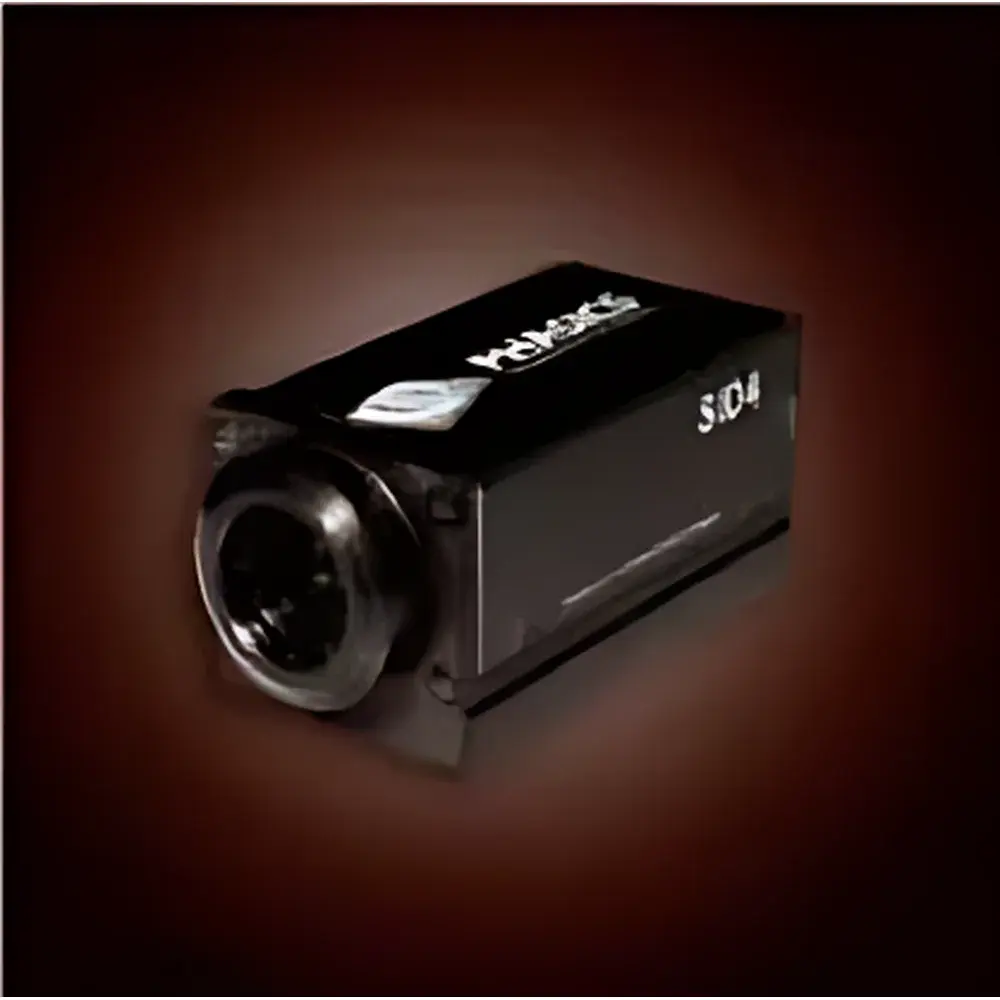
Phasics SID4-NIR Wavefront Sensor
| Brand | Phasics |
|---|---|
| Origin | France |
| Model | SID4-NIR |
| Aperture | 3.6 × 4.8 mm² |
| Spatial Resolution | 29.6 µm |
| Sampling Points | 160 × 120 |
| Wavelength Range | 1.5–1.6 µm |
| Dynamic Range | > 200 µm |
| Accuracy | > 15 nm RMS |
| Sensitivity | < 1 nm RMS (low-gain mode) |
| Frame Rate | 60 fps |
| Processing Rate | 10 Hz (high-resolution mode) |
| Dimensions | 44 × 33 × 57.5 mm |
| Weight | 250 g |
Overview
The Phasics SID4-NIR Wavefront Sensor is a high-precision, compact interferometric wavefront measurement instrument engineered for quantitative phase imaging and real-time optical characterization in the near-infrared spectral band (1.5–1.6 µm). Unlike conventional Shack-Hartmann sensors, the SID4-NIR employs Phasics’ proprietary four-wave lateral shearing interferometry (LTSI) — a self-referencing, common-path technique that delivers absolute wavefront measurements without reliance on reference beams or external calibration. This architecture ensures exceptional stability against mechanical drift and thermal perturbation, making it suitable for integration into demanding environments such as laser cavity diagnostics, adaptive optics loops, and industrial NIR metrology systems. Its monolithic design, absence of moving parts, and intrinsic achromaticity across its designated wavelength range eliminate the need for recalibration when operating within the 1.5–1.6 µm window — a critical advantage for telecom-grade fiber lasers, quantum cascade laser characterization, and mid-IR source alignment where spectral consistency and repeatability are governed by ISO 10110-5 and IEC 61228 standards.
Key Features
- Four-wave lateral shearing interferometry (LTSI) for direct, absolute wavefront reconstruction without reference beam dependency
- Achromatic operation across 1.5–1.6 µm — no hardware reconfiguration or software recalibration required for wavelength shifts within specification
- High spatial fidelity with 160 × 120 sampling points over a 3.6 × 4.8 mm² active aperture and 29.6 µm pixel pitch
- Real-time performance: up to 60 frames per second acquisition with on-device processing at 10 Hz in high-resolution mode
- Sub-nanometer sensitivity ( 200 µm dynamic range for characterizing both weak aberrations and highly divergent beams
- Compact form factor (44 × 33 × 57.5 mm) and lightweight construction (250 g), optimized for OEM integration and space-constrained optical benches
- Robust architecture compliant with MIL-STD-810G shock/vibration profiles and RoHS/CE directives
Sample Compatibility & Compliance
The SID4-NIR is designed for non-contact, non-destructive wavefront analysis of collimated or moderately divergent NIR beams (up to ±15° full divergence angle), including single-mode and multimode fiber outputs, quantum cascade lasers (QCLs), and superluminescent diodes (SLDs). It supports free-space and fiber-coupled configurations via standard SMF-28 or PM1550 patch cables equipped with FC/APC or FC/PC connectors. The sensor meets ISO/IEC 17025 traceability requirements when used with NIST-traceable flatness and curvature standards. Its measurement uncertainty budget accounts for environmental factors (temperature coefficient: ±0.02 nm/°C), detector linearity (< 0.5% deviation over 95% of full scale), and algorithmic reproducibility (inter-run standard deviation < 2 nm RMS under controlled lab conditions). For regulated environments, raw data export supports FDA 21 CFR Part 11-compliant audit trails when deployed with Phasics’ QWLS software suite.
Software & Data Management
The SID4-NIR operates with Phasics’ QWLS (Quantitative Wavefront Lab Software), a Windows-based application providing real-time Zernike decomposition, PV/RMS wavefront error reporting, M² estimation, beam propagation simulation (via embedded Rayleigh-Sommerfeld diffraction engine), and custom mask-based region-of-interest (ROI) analysis. All acquired phase maps are stored in HDF5 format with embedded metadata (timestamp, exposure settings, lens ID, operator tag), enabling automated traceability in GLP/GMP workflows. APIs (C++, Python, MATLAB) allow seamless integration into LabVIEW, EPICS, or custom control architectures. Export options include CSV (Zernike coefficients), TIFF (phase/residual maps), and JSON (structured metrology reports), facilitating interoperability with LIMS and MES platforms. Firmware updates are delivered via signed binary packages with SHA-256 verification to ensure integrity and compliance with IEC 62443-3-3 security guidelines.
Applications
- Laser beam quality assessment for 1550 nm telecom sources, including M², BPP, and Strehl ratio quantification per ISO 11146-1/-2
- Adaptive optics closed-loop correction in astronomical instrumentation and free-space optical communication terminals
- Surface figure and transmitted wavefront error (TWE) evaluation of NIR-transmissive optics (e.g., Ge, ZnSe, CaF₂ windows and lenses)
- Characterization of ultrafast optical parametric amplifiers (OPAs) and difference-frequency generation (DFG) sources
- In-line process monitoring of fiber Bragg grating (FBG) writing systems and photonic integrated circuit (PIC) packaging
- Phase-contrast microscopy extensions for label-free biological tissue imaging in the SWIR transparency window
FAQ
Does the SID4-NIR require periodic factory recalibration?
No. The LTSI principle and monolithic micro-optics ensure long-term stability. Phasics recommends annual verification using a certified plano reference surface; full recalibration is only necessary after physical impact or exposure to >85% RH without desiccant.
Can the SID4-NIR measure wavefronts from pulsed lasers?
Yes — provided pulse energy exceeds 5 µJ per pulse at 1.55 µm and repetition rate is ≥1 kHz. For lower-energy pulses, external gated intensifiers or lock-in acquisition modes are supported via QWLS API.
Is USB 3.0 the only interface option?
The standard interface is USB 3.0 Gen 1 (5 Gbps) with real-time streaming capability. Optional GigE Vision and Camera Link variants are available for synchronized multi-sensor deployments.
How is beam divergence handled during measurement?
The sensor’s native f/# tolerance is f/2.8 to f/12. For beams outside this range, optional telecentric relay lenses (focal lengths: 35 mm, 75 mm, 150 mm) maintain sampling fidelity while preserving wavefront fidelity per ISO 10110-19 Annex D.
Does the system support automated pass/fail criteria for production testing?
Yes. QWLS allows definition of user-configurable tolerancing templates (e.g., “Z4 + Z5 + Z6 < 0.15 µm RMS”) with CSV-based batch reporting and statistical process control (SPC) charting aligned with AIAG SPC-2 requirements.




