
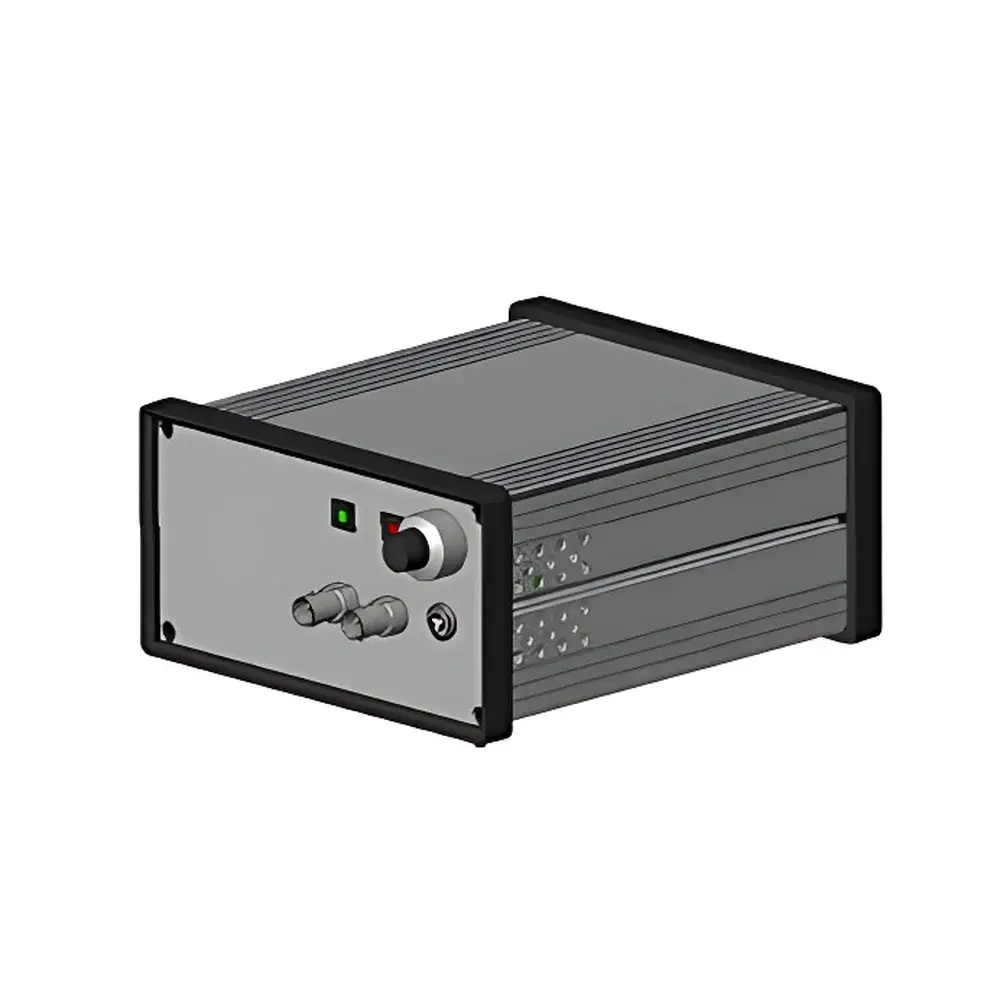
Orbits Lightwave HVA-1 High-Voltage Amplifier for Eternal™ Slowlight™ Laser Frequency Modulation
| Origin | USA |
|---|---|
| Manufacturer Type | Authorized Distributor |
| Origin Category | Imported |
| Model | HVA-1 |
| Core Component | Semiconductor Laser System Integration Platform |
| Input Voltage Range | 0–5 V |
| Output Voltage Range | –30 to +180 V |
| Small-Signal Bandwidth | 1 kHz |
| Noise Spectral Density | ≤2 nV/√Hz (30 Hz – 10 kHz), ≤100 nV/√Hz (>10 kHz) |
| 1/f Voltage Noise | ≤20 nV/√Hz @ 20 Hz |
| AC Input | 90–264 VAC, 47–63 Hz |
| Power Connector | IEC 320-C14 |
| Dimensions | 3.25 × 6.25 × 7 in (82.6 × 158.8 × 177.8 mm) |
| Weight | 3 lbs (1.36 kg) |
| Operating Temperature | 0–40 °C |
| Operating Humidity | 20–90 % RH (non-condensing) |
Overview
The Orbits Lightwave HVA-1 is a precision high-voltage amplifier engineered specifically for frequency modulation of the Eternal™ Slowlight™ semiconductor laser modules. Unlike general-purpose HV amplifiers, the HVA-1 integrates ultra-low-noise analog signal conditioning architecture optimized for optical frequency stabilization and narrow-linewidth laser control in demanding photonics applications. Its design adheres to the fundamental requirements of coherent optical systems—namely, sub-millivolt-level voltage noise floor, minimal 1/f drift, and stable DC-coupled output response—enabling precise electro-optic tuning of laser cavity resonance or external modulator bias points. The amplifier operates as a critical interface between low-voltage digital-to-analog converters (DACs) and high-impedance piezoelectric transducers (PZTs) used in slowlight™ laser cavity length actuation. It is not a standalone laser source but a dedicated driver subsystem integral to closed-loop frequency-locking architectures in metrology-grade optical setups.
Key Features
- Ultra-low noise spectral density: ≤2 nV/√Hz over 30 Hz – 10 kHz bandwidth, supporting sub-kHz laser linewidth control
- Optimized 1/f noise performance: ≤20 nV/√Hz at 20 Hz, minimizing low-frequency phase drift in long-term locking applications
- High-voltage bipolar output range: –30 V to +180 V with <0.01 % gain linearity error across full scale
- DC-coupled, unity-gain stable design with 1 kHz small-signal bandwidth—sufficient for Pound-Drever-Hall (PDH) error signal actuation
- Industrial-grade power input compliance: 90–264 VAC, 47–63 Hz, with IEC 320-C14 connector and internal EMI filtering per CISPR 11 Class B
- Ruggedized mechanical packaging: aluminum chassis with thermal management for continuous operation at ambient temperatures up to 40 °C
- Designed for integration into ISO/IEC 17025-accredited optical metrology labs and FDA-regulated photonic manufacturing environments
Sample Compatibility & Compliance
The HVA-1 is validated for use exclusively with Orbits Lightwave Eternal™ Slowlight™ laser modules (e.g., SL-1550-PM, SL-1064-FC), where its output drives integrated PZT elements for sub-picometer cavity length adjustment. It is incompatible with free-space electro-optic modulators requiring >200 V swing or RF-driven devices. From a regulatory standpoint, the unit complies with UL 61010-1 (Safety Requirements for Electrical Equipment for Measurement, Control, and Laboratory Use) and meets CE marking requirements under the EMC Directive 2014/30/EU and Low Voltage Directive 2014/35/EU. While not a medical device itself, its use in laser-based analytical instrumentation may support compliance with IEC 60601-2-22 (laser product safety) when deployed within certified system-level assemblies. Traceable calibration documentation is provided per ISO/IEC 17025 guidelines upon request.
Software & Data Management
The HVA-1 operates as a hardware analog stage without embedded firmware or digital communication interfaces (e.g., USB, Ethernet, or GPIB). It accepts analog control signals from external DAQ systems or lock-in amplifiers—commonly National Instruments PXIe-6363 or Zurich Instruments HF2LI—configured to generate PDH or FM spectroscopy waveforms. For traceability in GLP/GMP environments, users are advised to log HVA-1 input voltage traces alongside laser output spectra using time-synchronized acquisition software (e.g., LabVIEW 2022 with TDMS logging or Python-based PyMeasure frameworks). Audit trails must include amplifier serial number, calibration date, and environmental monitoring data (temperature/humidity logs) per FDA 21 CFR Part 11 requirements when used in regulated pharmaceutical or biophotonics QC workflows.
Applications
- Frequency stabilization of external-cavity diode lasers (ECDLs) in atomic physics experiments (e.g., Rb/D2-line cooling, optical lattice clocks)
- Bias control of Mach-Zehnder interferometric sensors in distributed fiber-optic acoustic sensing (DAS) systems
- Active cavity length tuning in ultra-stable reference cavities for optical frequency combs
- Slowlight™ laser module modulation in industrial process monitoring—e.g., high-resolution absorption spectroscopy for trace gas detection (CH₄, CO₂, NH₃) per ASTM E1444 standards
- Integration into OEM photonic test platforms requiring low-drift, high-reproducibility HV bias for semiconductor laser characterization
FAQ
Is the HVA-1 compatible with non-Orbits Lightwave laser modules?
No. The HVA-1’s output impedance, noise floor, and gain profile are co-designed with the Eternal™ Slowlight™ laser’s PZT electro-mechanical transfer function. Interfacing with third-party lasers may result in instability, reduced modulation depth, or accelerated PZT hysteresis.
Does the HVA-1 support remote monitoring or digital control?
No. It is an analog-only amplifier. All control signals must be delivered via shielded BNC inputs; no digital bus interface is implemented.
What calibration services are available?
Orbits Lightwave offers NIST-traceable voltage gain and noise floor verification annually, documented per ISO/IEC 17025. Calibration includes spectral noise measurement across 10 Hz–100 kHz and DC offset stability assessment over 8 hours.
Can the HVA-1 be used in vacuum or high-humidity environments?
It is rated for 20–90 % RH non-condensing operation at ambient pressure only. Operation below 10 % RH or above 90 % RH is not validated. Vacuum deployment requires custom hermetic housing and feedthrough adaptation—not supplied by default.





