
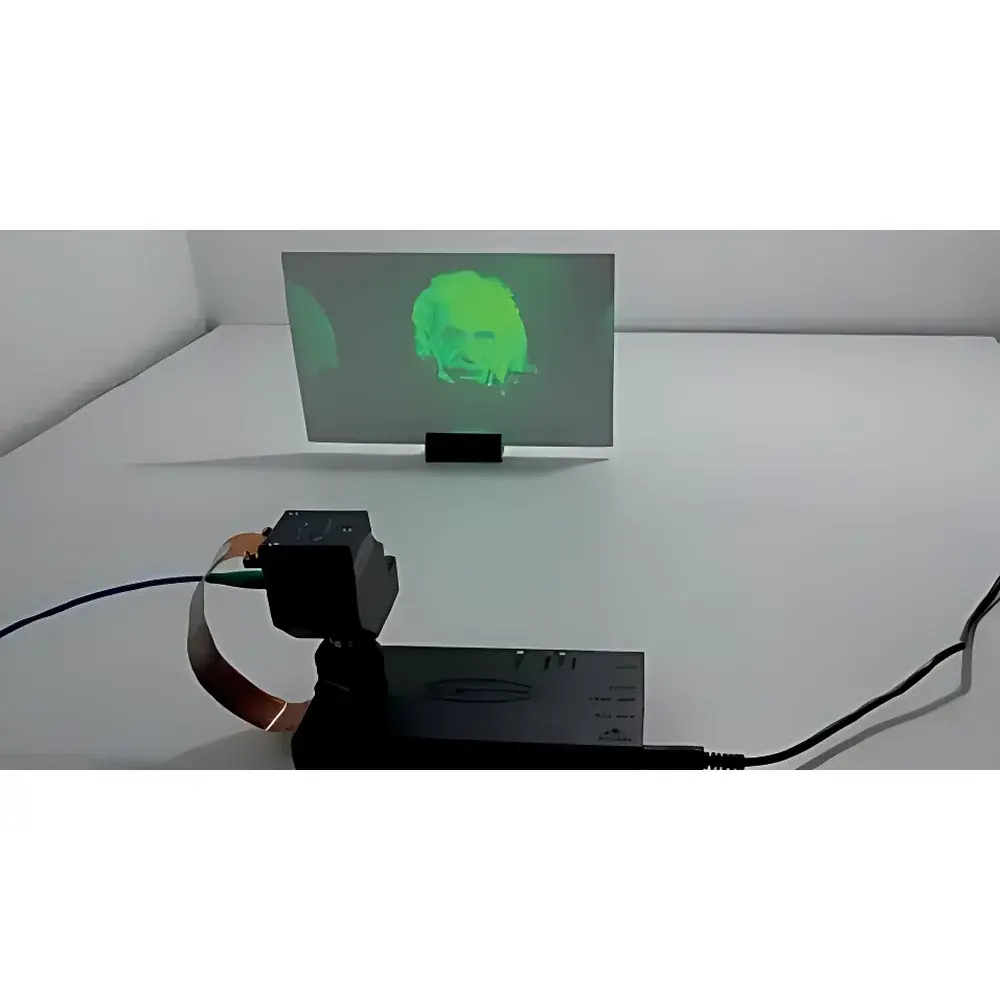
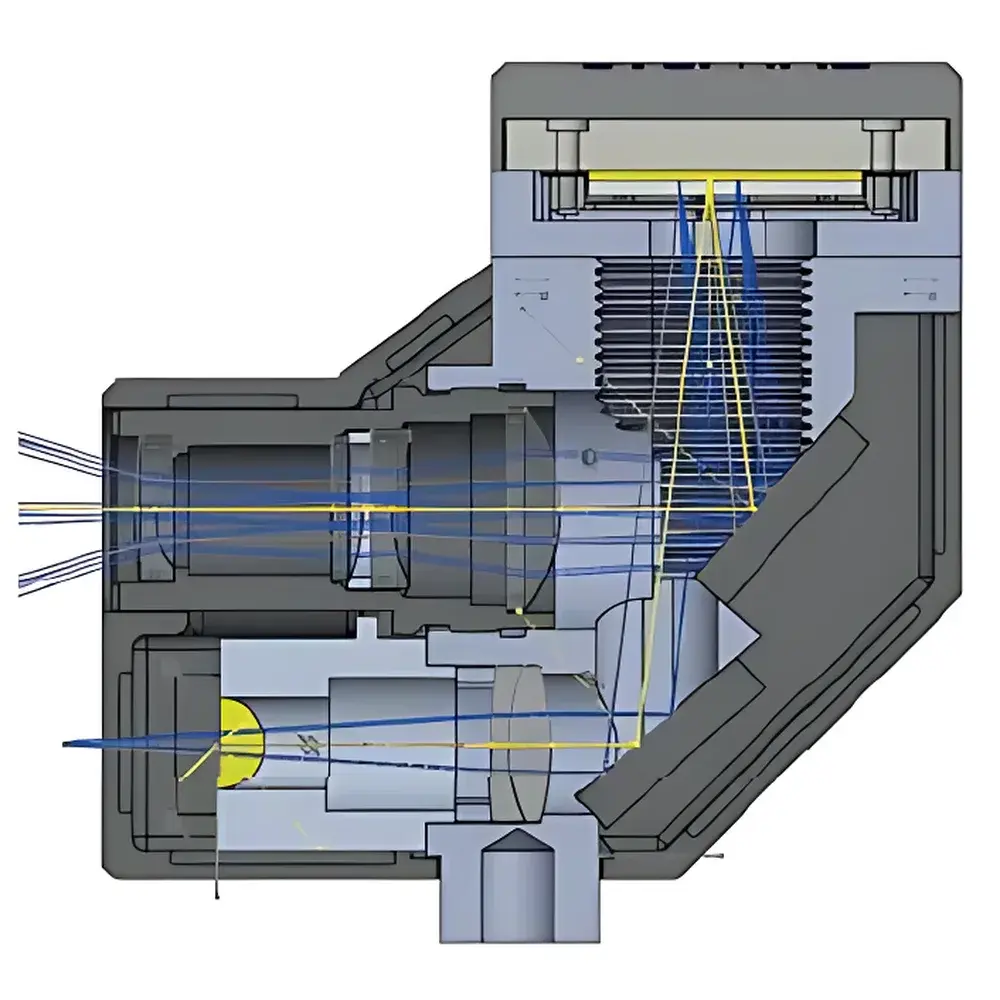
Holoeye DPE Diffractive Projection Engine Kit
| Brand | Holoeye |
|---|---|
| Origin | Germany |
| Manufacturer Type | Authorized Distributor |
| Import Status | Imported |
| Model | DPE |
| Price Range | USD 6,800 – 13,600 (FOB Hamburg) |
Overview
The Holoeye DPE (Diffractive Projection Engine) is a purpose-engineered optical integration kit designed to transform standard spatial light modulators (SLMs) into turnkey diffractive projection systems. Unlike conventional free-space optical setups requiring precise alignment of lasers, beam expanders, polarization optics, and relay lenses, the DPE provides a compact, pre-aligned, fiber-coupled architecture optimized for high-fidelity wavefront modulation and stable far-field diffraction pattern generation. Based on coherent laser illumination and liquid crystal-on-silicon (LCoS) phase modulation principles, the DPE enables rapid deployment of dynamic holographic projections, structured light patterns, and computational imaging sources—without requiring specialized optical bench infrastructure or advanced alignment expertise. Its modular design supports plug-and-play operation with Holoeye’s Pluto, Gaea, Leto, and Luna series LCoS-SLMs, making it suitable for both research laboratories and industrial prototyping environments where space, reproducibility, and system stability are critical constraints.
Key Features
- Fiber-coupled input interface accepting polarization-maintaining (PM) single-mode fiber (FC/PC or FC/APC), enabling seamless integration with compact diode or DPSS lasers (e.g., 532 nm, 633 nm, or 1064 nm)
- Integrated collimation and relay optics with fixed focal length and optimized M² preservation, ensuring consistent beam quality and minimal wavefront distortion across operating wavelengths
- Mounting interface compliant with standard SLM mechanical footprints (including 19 mm and 25.4 mm pitch configurations), supporting interchangeable use with Holoeye’s full LCoS-SLM product line
- Passive thermal stabilization architecture minimizing drift-induced pattern degradation during extended operation
- Compact form factor (≤ 120 × 80 × 55 mm) enabling desktop-scale deployment without vibration isolation tables or environmental enclosures
- No active electronics or firmware—fully passive optical engine compatible with any host computer driving the SLM via standard HDMI or DisplayPort video signals
Sample Compatibility & Compliance
The DPE is fully compatible with Holoeye’s commercially available LCoS-SLM platforms operating in phase-only or amplitude-phase hybrid modulation modes. It has been validated for use with 1920 × 1080 (Pluto), 3840 × 2160 (Gaea), and 4096 × 2400 (Luna) resolution panels at pixel pitches ranging from 6.4 µm to 8.0 µm. The optical path maintains >92% transmission efficiency for linearly polarized input at design wavelengths and complies with ISO 10110-7 surface quality specifications for all internal optics. While the DPE itself contains no electronic control components, its integration into larger systems may require adherence to IEC 60825-1 (laser safety) and EN 61326-1 (EMC for laboratory equipment) when used with certified laser sources. No regulatory certification (e.g., FDA, CE marking) applies directly to the DPE as a passive optical subassembly.
Software & Data Management
The DPE operates entirely in conjunction with the user’s existing SLM driver software environment—no proprietary firmware or dedicated control software is required. Compatible platforms include Holoeye’s LC2000 SDK, MATLAB-based SLMToolbox, Python libraries (e.g., slmcontrol), and commercial hologram synthesis tools such as HOLOEYE’s HoloStudio or third-party packages like LightTrans VirtualLab Fusion. All generated holograms or structured light masks must be rendered as grayscale or RGB bitmap images conforming to the native SLM resolution and gamma calibration profile. The DPE imposes no additional data throughput or latency constraints; real-time frame rates up to 60 Hz are achievable depending on GPU rendering performance and SLM interface bandwidth (e.g., HDMI 2.0). Audit trails, version-controlled mask libraries, and metadata tagging (wavelength, pixel pitch, phase depth) remain under the user’s software governance—no built-in logging or 21 CFR Part 11 compliance features are embedded in the hardware.
Applications
- Augmented reality (AR) and virtual reality (VR) near-eye display prototyping, including pupil-steering and multi-plane focus rendering
- Automotive head-up display (HUD) development with dynamic field-of-view expansion and glare suppression algorithms
- 3D metrology and fringe projection profilometry using programmable sinusoidal, binary, or Gray-coded patterns
- Biomedical structured illumination microscopy (SIM) requiring precise temporal synchronization between pattern projection and camera acquisition
- Wearable holographic displays integrating micro-laser diodes and ultra-compact Luna-series SLMs for portable point-light-source arrays
- Education and training modules in optical physics, computational imaging, and diffractive optics—enabling students to observe Fourier plane relationships and Talbot self-imaging effects without alignment overhead
FAQ
Does the DPE include a laser source?
No—the DPE is a passive optical engine and does not contain or integrate any laser diode. Users must supply a polarization-maintaining fiber-coupled laser matching the specified wavelength and power class.
Can the DPE be used with non-Holoeye SLMs?
Mechanical compatibility is limited to Holoeye’s standardized mounting interfaces. Optical performance cannot be guaranteed with third-party SLMs due to variations in fill factor, voltage response, and polarization sensitivity.
Is thermal management required during continuous operation?
The DPE uses passive heat dissipation only. For ambient temperatures ≤35°C and duty cycles <100%, no active cooling is necessary. Prolonged operation above 40°C may reduce long-term birefringent stability of internal polymer-based retardation elements.
What is the maximum supported input power?
The PM fiber input connector and internal optics are rated for ≤500 mW average power at 532 nm. Higher powers require custom quartz-based collimation optics and must be evaluated case-by-case.
Does the DPE support dual-wavelength or broadband operation?
No—it is optimized for single-wavelength operation. Multi-wavelength use introduces chromatic aberration and phase error accumulation; separate DPE units are recommended per wavelength channel.




