
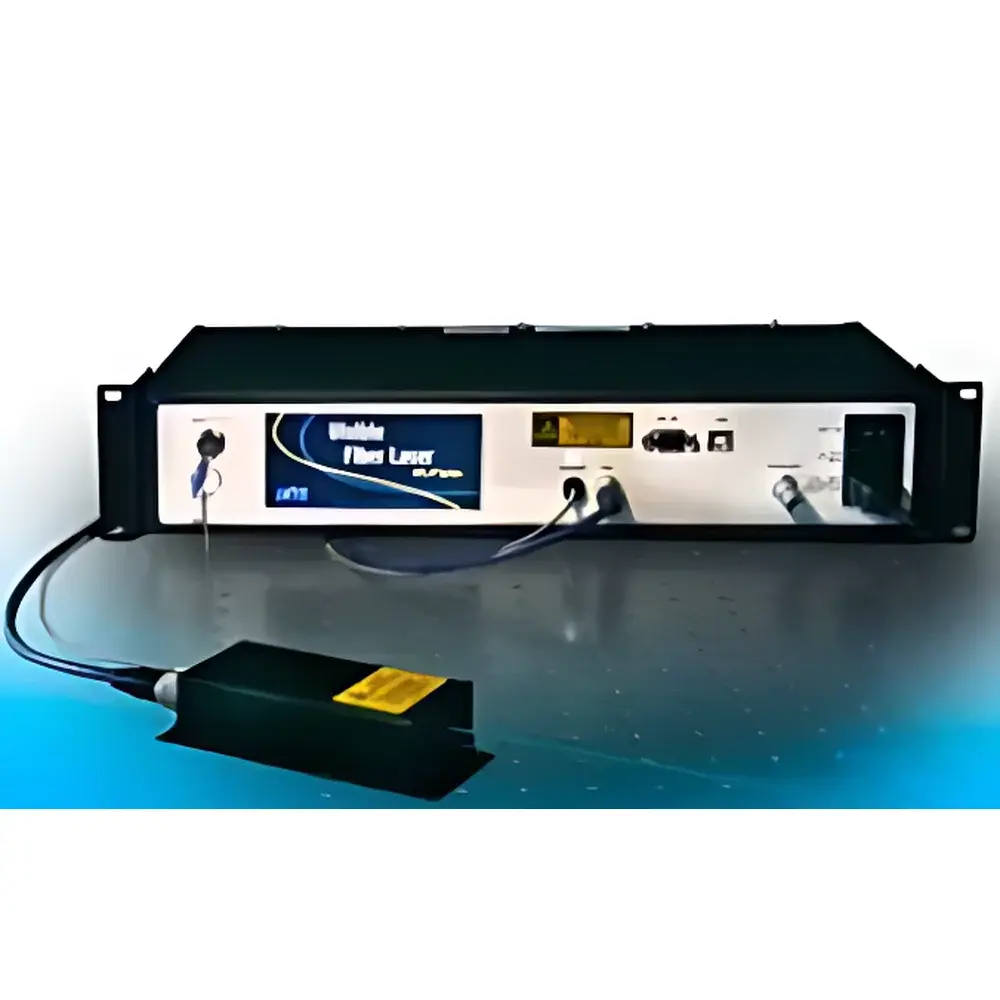
MPB VFL-P-200-542 542 nm Single-Frequency Fiber Laser
| Brand | MPB |
|---|---|
| Origin | Canada |
| Model | VFL-P-200-542 |
| Wavelength | 542 nm |
| Output Power | 200 mW |
| Beam Mode | TEM₀₀ |
| M² | ≤1.1 |
| Polarization | Linear, vertical to baseplate |
| Beam Divergence (Full Angle) | <5 mrad |
| Power Stability (RMS, 8h) | ±0.5% |
| Wavelength Stability | ±0.02 nm |
| Control Interfaces | RS232, USB |
| Cooling | Air-cooled |
| Form Factor | Benchtop or 2RU Rack-mountable (19", 23", ETSI compliant) |
| Safety | Interlock-enabled (benchtop) |
Overview
The MPB VFL-P-200-542 is a continuous-wave (CW), single-frequency, wavelength-stabilized fiber laser operating at 542 nm — a key spectral line in the green visible band optimized for high-sensitivity photonic applications requiring narrow linewidth, exceptional beam quality, and long-term power and wavelength stability. Engineered using frequency-doubled, polarization-maintaining fiber amplifier technology, this laser leverages intracavity second-harmonic generation (SHG) to convert 1084 nm fundamental emission from a Yb-doped fiber oscillator into stable 542 nm output. Its TEM₀₀ spatial profile (M² ≤ 1.1), linear vertical polarization, and low beam divergence (<5 mrad full angle) ensure diffraction-limited focusing and high coupling efficiency into single-mode optical fibers or microscope objectives. Designed for integration into regulated laboratory and industrial environments, the system meets stringent requirements for reproducibility in quantitative optical measurements where spectral fidelity and intensity consistency directly impact data validity.
Key Features
- Stable CW output at 542 nm with ±0.02 nm wavelength drift over 8 hours — suitable for resonance-sensitive spectroscopic techniques.
- TEM₀₀ Gaussian beam profile with M² ≤ 1.1 and collimated free-space output, enabling precise spatial filtering and high numerical aperture focusing.
- Dual thermal and electronic stabilization architecture: air-cooled design with active temperature control of nonlinear crystal and gain fiber stages.
- Flexible operation modes: analog modulation (0–5 V), digital TTL triggering, and programmable setpoint control via RS232/USB interfaces.
- Comprehensive safety compliance: Class 3B laser product per IEC 60825-1:2014; includes hardware interlock circuit (benchtop), integrated emergency stop, and redundant current-limiting protection (rackmount).
- Modular mechanical packaging: available in compact benchtop enclosure or industry-standard 2RU rack format compatible with 19″, 23″, and ETSI rack systems.
Sample Compatibility & Compliance
The VFL-P-200-542 is compatible with standard optical components rated for 500–550 nm operation, including dichroic mirrors, bandpass filters, and silica-based single-mode fibers (e.g., SM600). Its polarization-maintaining output facilitates integration with electro-optic modulators, acousto-optic tunable filters (AOTFs), and interferometric detection systems. The laser conforms to ISO 13406-2 for beam classification and adheres to laser safety protocols required under FDA 21 CFR Part 1040.10 and EU Directive 2014/30/EU (EMC). All units undergo factory calibration traceable to NRC Canada standards and include full test reports covering power stability, pointing stability (50 dB).
Software & Data Management
MPB provides the LaserControl Suite — a cross-platform (Windows/macOS/Linux) GUI application supporting real-time monitoring of output power, diode current, heatsink temperature, and interlock status. The software enables automated power ramping, scheduled on/off sequences, and logging of operational parameters at user-defined intervals (down to 100 ms resolution). Exported data conform to CSV and HDF5 formats for direct ingestion into MATLAB, Python (NumPy/Pandas), or LabVIEW environments. For GxP-regulated workflows, optional firmware upgrade supports audit-trail logging compliant with FDA 21 CFR Part 11 — including user authentication, electronic signatures, and immutable event records for all configuration changes.
Applications
- Fluorescence Microspectroscopy: Excitation source for GFP, FITC, and Alexa Fluor 488 derivatives with minimal photobleaching due to narrow spectral bandwidth and low intensity noise.
- Flow Cytometry: High-brightness, low-noise excitation enabling improved signal-to-noise ratio in multi-parameter cell analysis platforms.
- Ophthalmic Instrumentation: Used in adaptive optics retinal imaging systems requiring stable green illumination for wavefront sensing and confocal scanning.
- Raman Spectroscopy: Pump source for shifted-excitation Raman difference spectroscopy (SERDS) where dual-wavelength stability at sub-picometer level is critical.
- Thin-Film Metrology: Interferometric thickness mapping and ellipsometry calibration reference due to fixed wavelength and high coherence length (>10 m).
- Laser Sintering R&D: Precision ablation and localized thermal processing of photoactive polymer composites in additive manufacturing prototyping.
FAQ
Is the 542 nm output derived from direct diode emission or nonlinear conversion?
The VFL-P series uses intra-cavity second-harmonic generation (SHG) in a periodically poled lithium niobate (PPLN) waveguide, pumped by a stabilized 1084 nm Yb-fiber oscillator — not a direct green semiconductor laser.
Can output power be adjusted in real time during operation?
Yes — analog voltage input (0–5 V) enables continuous power tuning from 20% to 100% of rated output without mode hops or wavelength shift.
What is the typical coherence length of this laser?
With a linewidth <50 kHz (typ.), the coherence length exceeds 6 km in air, making it suitable for high-resolution interferometry and holographic applications.
Does the rack-mount version support remote power cycling via network command?
No — Ethernet or LAN interface is not standard; remote control is limited to RS232/USB. Optional OEM modules for TCP/IP integration are available upon request.
Are calibration certificates provided with each unit?
Yes — each laser ships with a factory-issued calibration certificate documenting wavelength accuracy, power stability, beam pointing stability, and polarization extinction ratio, traceable to NRC Canada.





