
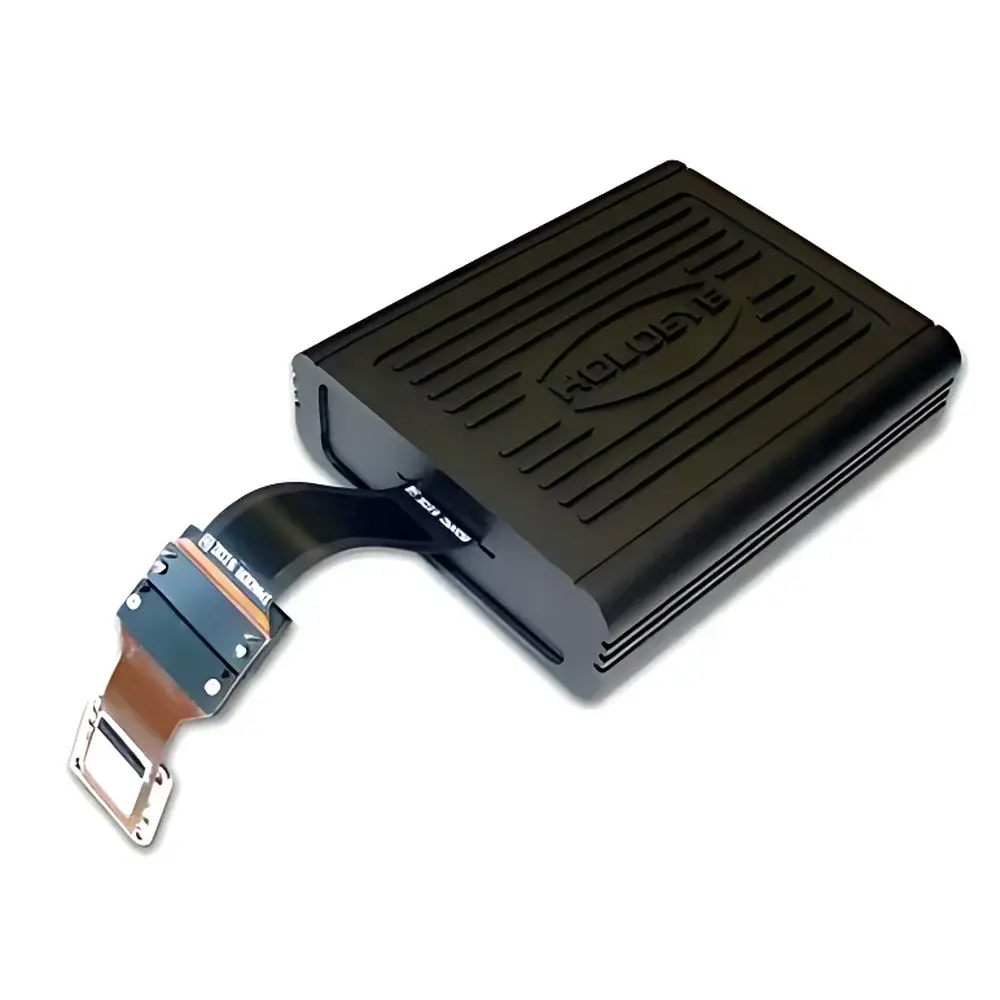
Holoeye GAEA-2-VIS High-Resolution Pure-Phase Spatial Light Modulator
| Brand | Holoeye |
|---|---|
| Origin | Germany |
| Model | GAEA-2-VIS |
| Wavelength Range | 420–650 nm |
| Active Area | 15.32 × 8.97 mm (0.7″) |
| Resolution | 4094 × 2464 pixels |
| Pixel Pitch | 3.74 µm |
| Fill Factor | 90% |
| Maximum Phase Modulation | 3π @ 532 nm |
| Reflectivity | 62% |
| Spatial Resolution (Nyquist) | 133.5 lp/mm |
| Grayscale Depth | 8-bit (256 levels) |
| Interface | HDMI |
| Frame Rate | 24 Hz (full resolution), 30 Hz (3840 × 2160) |
Overview
The Holoeye GAEA-2-VIS is a high-fidelity, pure-phase spatial light modulator (SLM) engineered for advanced wavefront shaping in visible-light optical systems. Based on ferroelectric liquid crystal-on-silicon (LCoS) microdisplay technology, it delivers diffraction-limited phase control across its full active aperture. Unlike intensity-modulating devices, the GAEA-2-VIS operates exclusively in phase-only mode—enabling precise, high-efficiency beam steering, holographic projection, adaptive optics correction, and structured illumination without amplitude distortion. Its native resolution of 4094 × 2464 pixels provides over 10 million independently addressable phase elements, supporting sub-wavelength wavefront discretization critical for quantitative interferometry, optical trapping, and single-shot computational imaging. Designed and manufactured in Germany, the device complies with industrial-grade environmental stability requirements and integrates seamlessly into laser-based metrology platforms operating within the 420–650 nm spectral band.
Key Features
- Pure-phase modulation architecture with no inherent amplitude coupling—ensures minimal zero-order leakage and high diffraction efficiency in first-order holograms.
- Native resolution of 4094 × 2464 pixels on a 15.32 × 8.97 mm active area, enabling fine spatial sampling of complex wavefronts.
- Pixel pitch of 3.74 µm and 90% fill factor yield high optical throughput and reduced inter-pixel crosstalk.
- Calibrated phase depth of up to 3π at 532 nm—sufficient for multi-level kinoform generation and high-fidelity aberration compensation.
- HDMI 1.4 interface supports real-time phase pattern streaming at 24 Hz (full resolution) or 30 Hz (downsampled UHD mode), compatible with standard GPU-accelerated pattern generation workflows.
- Reflective configuration with 62% average reflectivity across the VIS band—optimized for integration into folded-path interferometers and retro-reflected beam control setups.
- Thermally stabilized housing ensures phase stability < ±0.02π RMS over 2-hour operation under ambient lab conditions (23 ± 2°C).
Sample Compatibility & Compliance
The GAEA-2-VIS is designed for use with collimated, linearly polarized input beams aligned to its specified polarization axis. It is compatible with continuous-wave and pulsed laser sources (including DPSS and diode lasers) operating between 420 nm and 650 nm. No sample mounting or preparation is required—the SLM itself serves as the programmable optical element. The device conforms to CE marking requirements for electromagnetic compatibility (EMC Directive 2014/30/EU) and low-voltage safety (LVD Directive 2014/35/EU). Its firmware architecture supports deterministic timing triggers via external TTL sync input, facilitating synchronization with camera acquisition or laser pulsing in time-resolved experiments. While not certified for medical or aerospace applications out-of-the-box, its design principles align with ISO 10110-7 (optical component surface quality) and IEC 61223-3-5 (performance testing of imaging systems).
Software & Data Management
Holoeye provides the SLM Display Software Suite (v5.x), a Windows-based application supporting real-time phase map rendering, calibration file management, and LUT-based gamma correction. The SDK includes C/C++, Python, and MATLAB APIs for custom waveform synthesis—including Gerchberg-Saxton algorithms, Zernike decomposition, and iterative Fourier transform methods. All phase patterns are stored in lossless 16-bit TIFF format; metadata (wavelength, calibration timestamp, SLM ID) is embedded per EXIF standard. Audit trails for pattern uploads, exposure duration, and hardware status logs are maintained locally and exportable as CSV for GLP-compliant documentation. The system does not implement FDA 21 CFR Part 11 electronic signature functionality but supports external logging via networked time-stamped syslog servers.
Applications
- Adaptive optics in microscopy: dynamic correction of spherical and coma aberrations in multiphoton and confocal systems.
- Holographic optical tweezers: simultaneous manipulation of >1000 colloidal particles with independent trap positioning and force calibration.
- Computational imaging: single-shot ptychography, Fourier ptychographic microscopy (FPM), and lensless coherent diffraction imaging (CDI).
- Laser beam shaping: generation of Bessel, Airy, or vortex beams for material processing, optical communications, and quantum optics experiments.
- Optical testing: programmable reference wavefronts for digital holographic interferometry (DHI) and null testing of aspheric optics.
- Educational platforms: hands-on instruction in Fourier optics, diffraction theory, and wave optics simulation validation.
FAQ
Is the GAEA-2-VIS suitable for ultrafast laser applications?
Yes—its reflective LCoS architecture exhibits negligible group delay dispersion and has been validated with sub-100 fs pulses at 515 nm and 800 nm (with appropriate harmonic filtering). Thermal load limits require average power < 500 mW on the active area.
Can it be used in transmission geometry?
No—the GAEA-2-VIS is a reflective-only device. Transmission-mode operation requires alternative transmissive SLMs such as those based on nematic LC cells.
Does it support real-time closed-loop wavefront control?
Yes—when paired with a Shack-Hartmann sensor and compatible control software (e.g., MATLAB-based AO toolboxes), latency from wavefront measurement to phase update is < 12 ms at full resolution.
What calibration files are included?
Factory-provided pixel-wise phase response maps (at 488 nm, 532 nm, and 633 nm), intensity uniformity correction LUTs, and polarization alignment guides are delivered on encrypted USB drive.
Is OEM integration supported?
Yes—Holoeye offers mechanical mounting drawings, electrical pinouts, thermal derating curves, and extended temperature range variants (−10°C to +50°C) under NDA for embedded system developers.





