
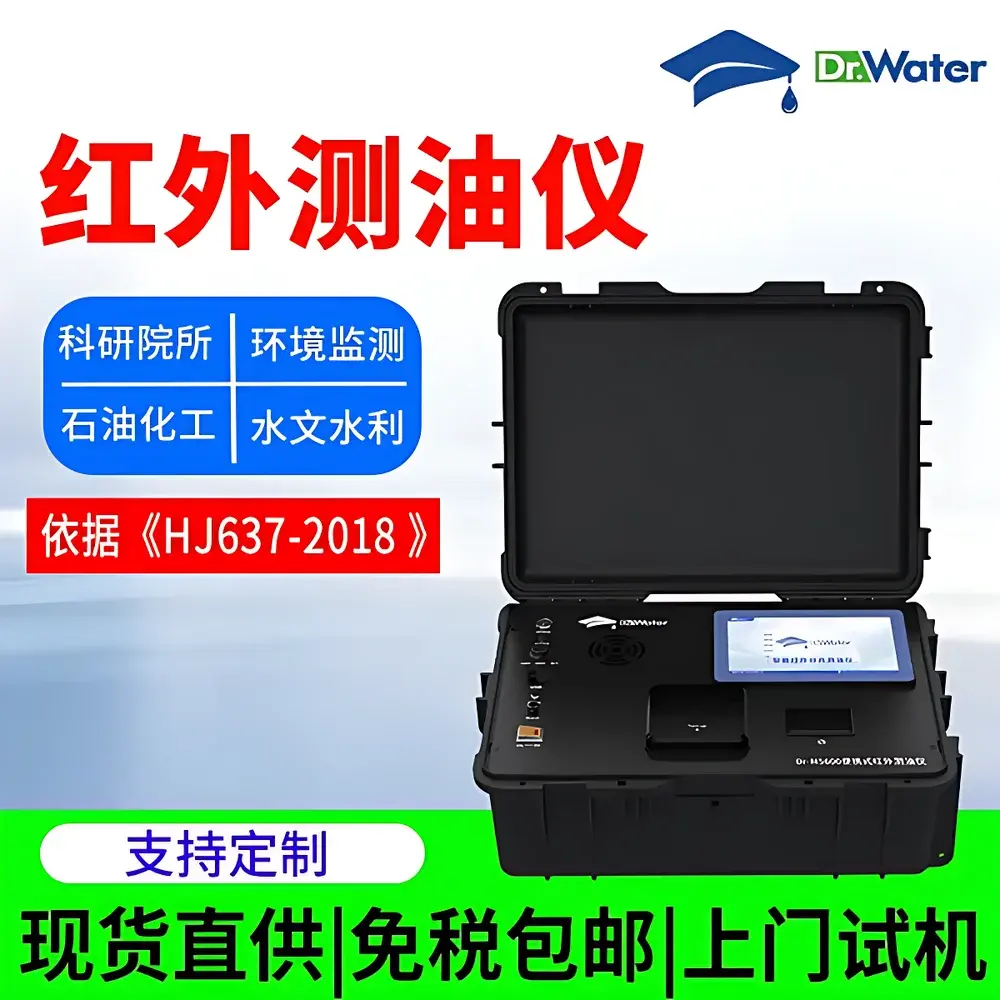
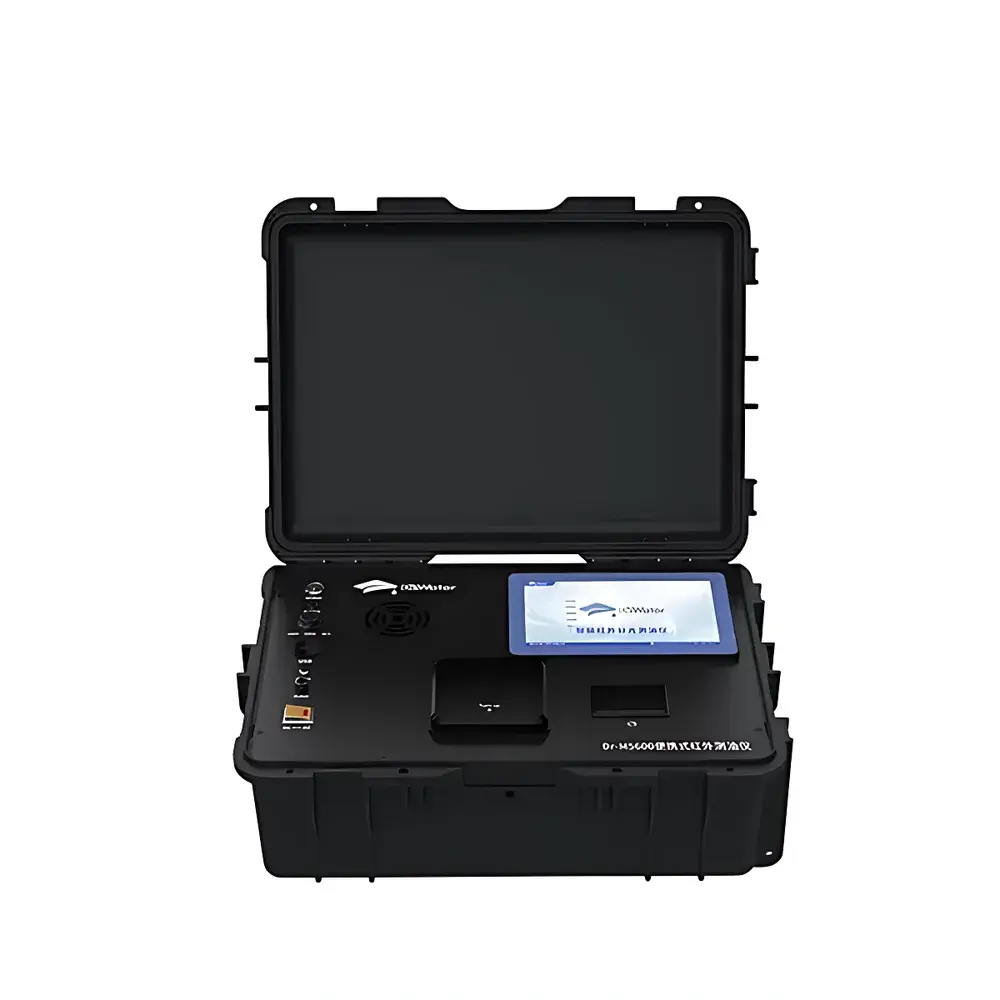
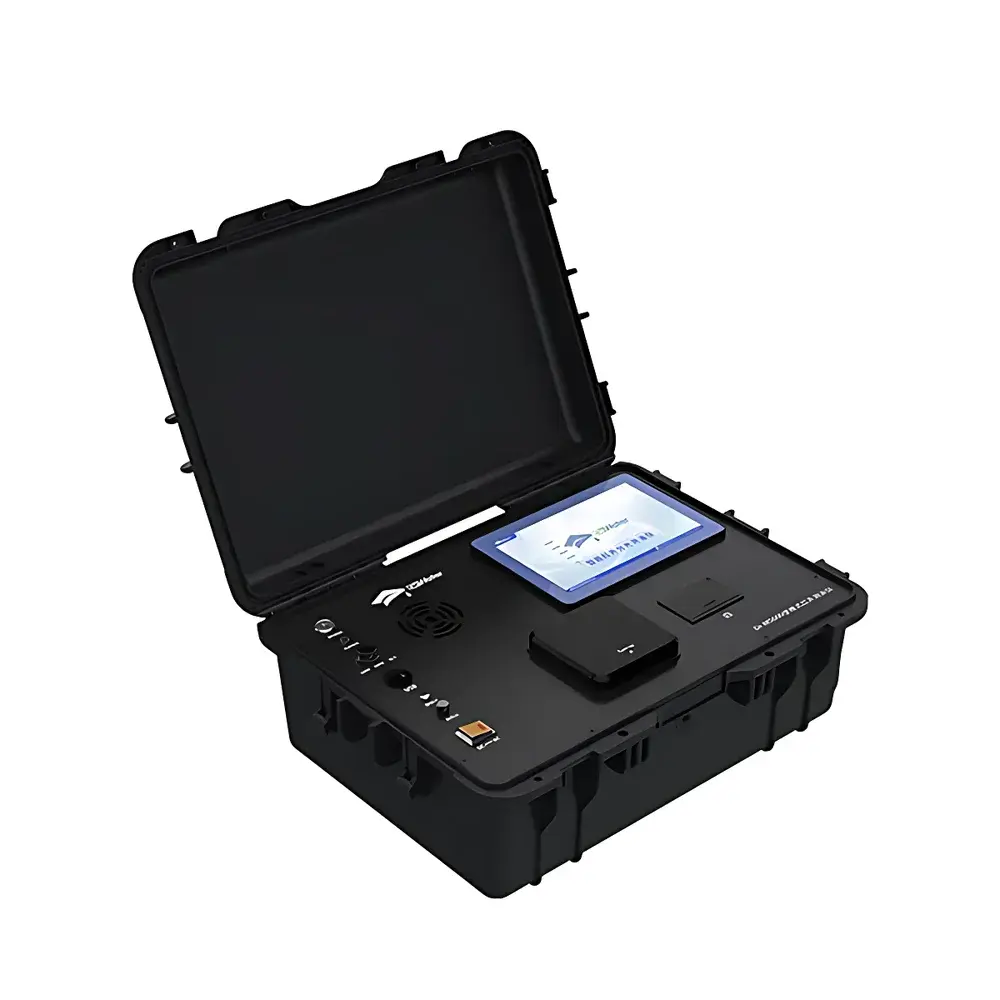
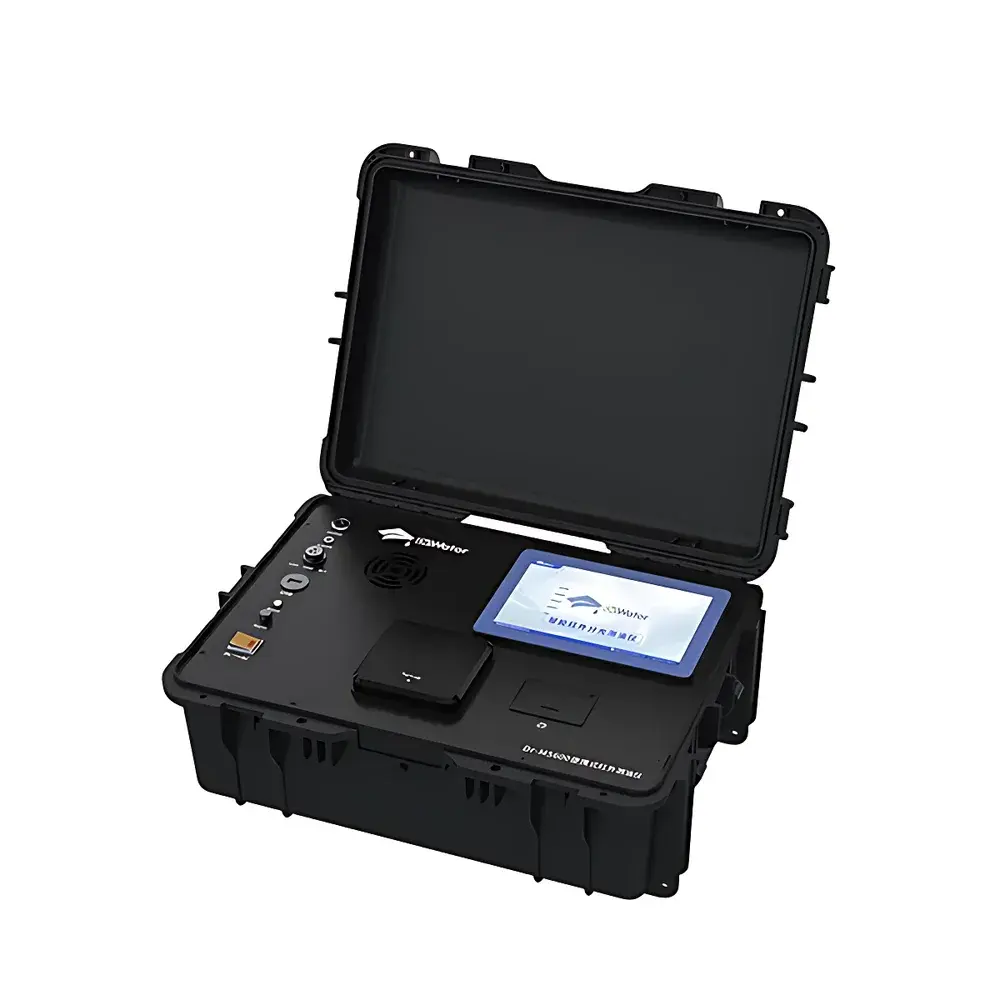
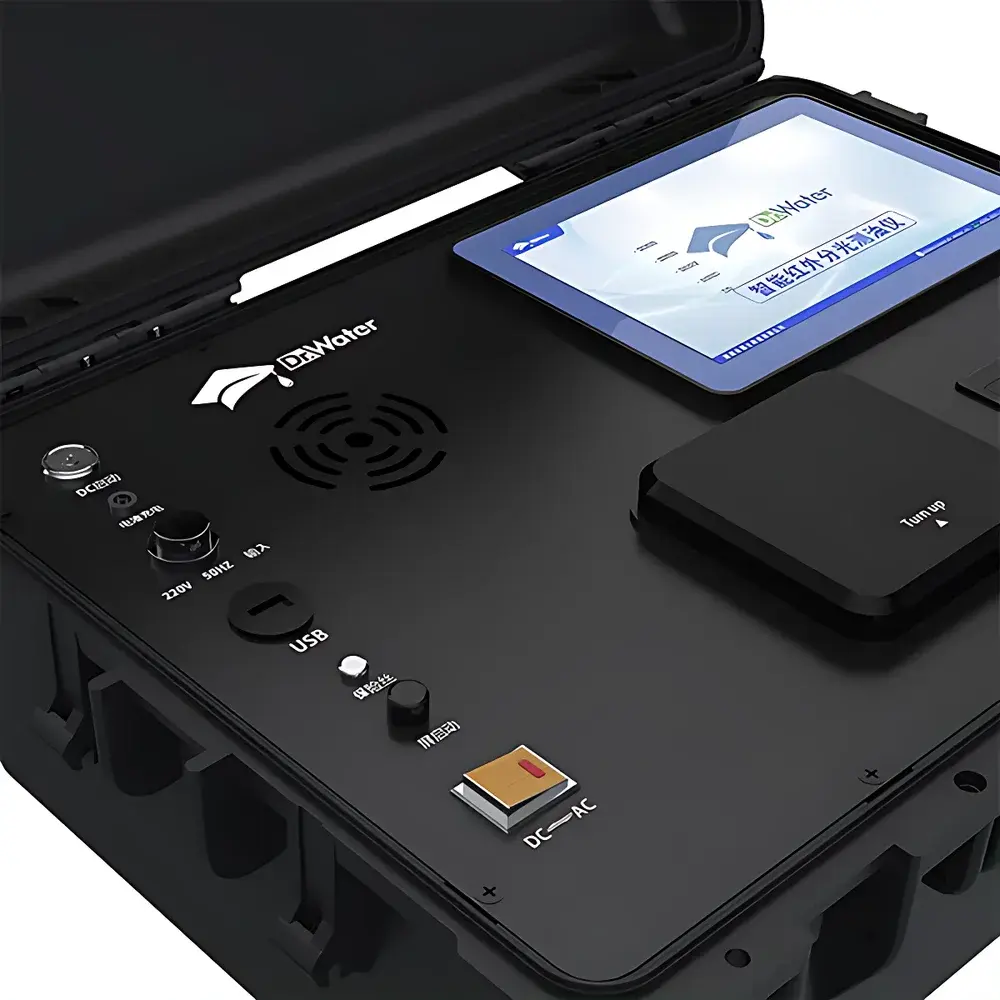
Dr-M5600 Portable Infrared Oil-in-Water Analyzer by DoctorWater
| Brand | DoctorWater |
|---|---|
| Origin | Hunan, China |
| Model | Dr-M5600 |
| Instrument Type | Portable |
| Measurement Principle | Infrared Spectrophotometry (Fourier-transform-free dispersive IR) |
| Measurement Range | 0.0–800 mg/L (oil in water) |
| Detection Limit | 3SD ≤ 0.03 mg/L (based on 11 blank measurements) |
| Wavenumber Accuracy | ±1 cm⁻¹ |
| Absorbance Resolution | 0.0001 AU |
| Scan Speed | Full-spectrum acquisition in 30 seconds |
| Wavenumber Range | 2400–3400 cm⁻¹ |
| Absorbance Range | 0.0000–2.0000 AU |
| Repeatability | RSD ≤ 0.5% (20–80 mg/L standard), RSD ≤ 5% (0.2 mg/L sample) |
| Linearity | R > 0.999 |
| Calibration | Preloaded EPA- and HJ-compliant calibration curves |
| Power Supply | Integrated rechargeable Li-ion battery + AC 220 V |
| Display | 10.1″ capacitive touchscreen |
| Data Output | Thermal printer + USB interface |
Overview
The Dr-M5600 Portable Infrared Oil-in-Water Analyzer is an EPA- and Chinese national standard-compliant instrument engineered for precise, field-deployable quantification of hydrocarbon contaminants in aqueous, gaseous, and solid matrices. It operates on the principle of dispersive infrared spectrophotometry—specifically optimized for the three critical absorption bands defined in HJ 637–2018 (2930 cm⁻¹, 2960 cm⁻¹, and 3030 cm⁻¹), corresponding to C–H stretching vibrations in aliphatic, methyl, and aromatic hydrocarbons. Unlike Fourier-transform-based systems, the Dr-M5600 employs a high-stability, imported stepping-motor-driven grating monochromator with real-time wavelength correction, delivering spectral fidelity without moving interferometers. Its optical architecture features post-dispersion absorption detection—where light is first separated by wavenumber and then measured at discrete bands—ensuring superior baseline stability and reduced thermal drift during extended field operation. The analyzer supports dual extraction solvents (perchloroethylene and carbon tetrachloride), fully satisfying method flexibility requirements under HJ 637–2018, HJ 1077–2019 (stack gas油烟/oil mist), and HJ 1051–2019 (soil petroleum hydrocarbons).
Key Features
- 10.1″ high-resolution capacitive touchscreen with intuitive GUI, enabling full instrument control—including calibration, scanning, reporting, and data export—without external PCs.
- Modular dual-solvent system with automatic solvent recognition logic; seamless switching between perchloroethylene (C₂Cl₄) and carbon tetrachloride (CCl₄) ensures compliance with evolving regulatory solvent restrictions.
- Multi-pathlength cell holder accommodating 0.5 cm, 1 cm, 2 cm, and 4 cm matched quartz cuvettes—enabling optimal signal-to-noise ratio across low-concentration (e.g., groundwater) and high-concentration (e.g., refinery effluent) applications.
- Electro-optically modulated broadband IR source eliminates mechanical chopper wear, reduces thermal load on optics, and extends source lifetime beyond 10,000 hours.
- Piroelectric thermosensitive detector capturing both “light-on” and “light-off” signals for real-time zero-point auto-compensation—critical for maintaining absorbance accuracy under variable ambient temperature conditions (10–35 °C operating range).
- Integrated thermal printer with timestamped report generation; supports immediate hardcopy output of current measurement, calibration verification, and spectral overlays.
- Dual-power architecture: 12 V / 8,000 mAh Li-ion battery (≥6 hours continuous operation) + universal AC input (100–240 V, 50/60 Hz); certified per IEC 61000-4-2 (ESD) and IEC 61000-4-3 (radiated immunity).
Sample Compatibility & Compliance
The Dr-M5600 is validated for direct analysis of liquid-phase extracts from water (surface, groundwater, wastewater), soil (via Soxhlet or ultrasonic extraction), stack gas condensates (per HJ 1077–2019), and cooking fume particulates. It meets all instrumental performance criteria outlined in HJ 637–2018 Section 7 (instrumental precision, linearity, detection limit verification) and supports GLP-aligned audit trails via timestamped internal memory (≥10,000 records). While not FDA 21 CFR Part 11-certified out-of-the-box, its data integrity framework—including immutable measurement logs, operator ID tagging, and password-protected method editing—facilitates validation for ISO/IEC 17025-accredited laboratories. All spectral acquisitions are stored in vendor-neutral .csv format with metadata headers (wavenumber, absorbance, date/time, operator ID, solvent ID, pathlength), ensuring interoperability with LIMS and third-party chemometric software.
Software & Data Management
Embedded firmware v3.2 includes preloaded calibration models for oil-in-water, oil-in-soil, and stack gas oil mist—each traceable to NIST SRM 2781 (mineral oil) and in-house reference materials characterized by GC-FID. No manual curve construction is required; users select matrix type and solvent, and the system applies the appropriate algorithm (e.g., tri-band subtraction per HJ 637–2018 Annex B). Spectral scans (2400–3400 cm⁻¹, 1 cm⁻¹ resolution) are stored with raw absorbance values and can be exported via USB 2.0 to external drives for offline PCA or PLS regression. Firmware updates are delivered via encrypted .bin files through USB—no internet connectivity required, preserving air-gapped lab security. Audit logs record every parameter change, measurement initiation, and calibration event with microsecond timestamps and SHA-256 hash integrity checks.
Applications
- Regulatory monitoring of effluent discharge permits (EPA Method 1664 equivalent, adapted to HJ 637–2018)
- Leak detection and plume delineation in industrial site characterization (petrochemical, steel, power generation)
- Wastewater treatment plant influent/effluent oil load tracking and process optimization
- Stack emission compliance testing for food service establishments (HJ 1077–2019)
- Soil screening at brownfield sites prior to remediation (HJ 1051–2019)
- Method development and inter-laboratory comparison studies in environmental research institutions
- Field-based rapid assessment during emergency spill response (e.g., riverine oil spills)
FAQ
Does the Dr-M5600 comply with U.S. EPA Method 1664?
No—it is designed and validated exclusively for Chinese national standards (HJ 637–2018, HJ 1077–2019, HJ 1051–2019). While its spectral methodology overlaps conceptually with EPA 1664, it does not meet the specific solvent purity, calibration verification, or QC frequency requirements mandated by EPA.
Can the instrument quantify individual hydrocarbon classes (e.g., aliphatics vs. aromatics)?
Yes—its full-spectrum scan mode (2400–3400 cm⁻¹ at 1 cm⁻¹ intervals) enables qualitative spectral interpretation and semi-quantitative deconvolution using user-defined reference spectra, though quantitative class separation requires orthogonal confirmation (e.g., GC-MS).
Is routine maintenance required beyond solvent replacement and cuvette cleaning?
Annual optical alignment verification and detector sensitivity check are recommended; no lamp replacement is needed within the first 5 years of typical use due to electro-optical modulation design.
How is data integrity ensured during battery-powered operation?
All measurements are written to non-volatile flash memory before display; power-loss recovery preserves unsaved spectra and pending reports, with automatic resumption upon restart.
What is the maximum allowable turbidity or suspended solids concentration in water samples?
Samples must be filtered through 0.45 µm membrane prior to extraction; unfiltered samples with >10 NTU turbidity may cause scattering artifacts in the 2900–3000 cm⁻¹ region, requiring centrifugation or phase separation prior to analysis.
Related Products







