
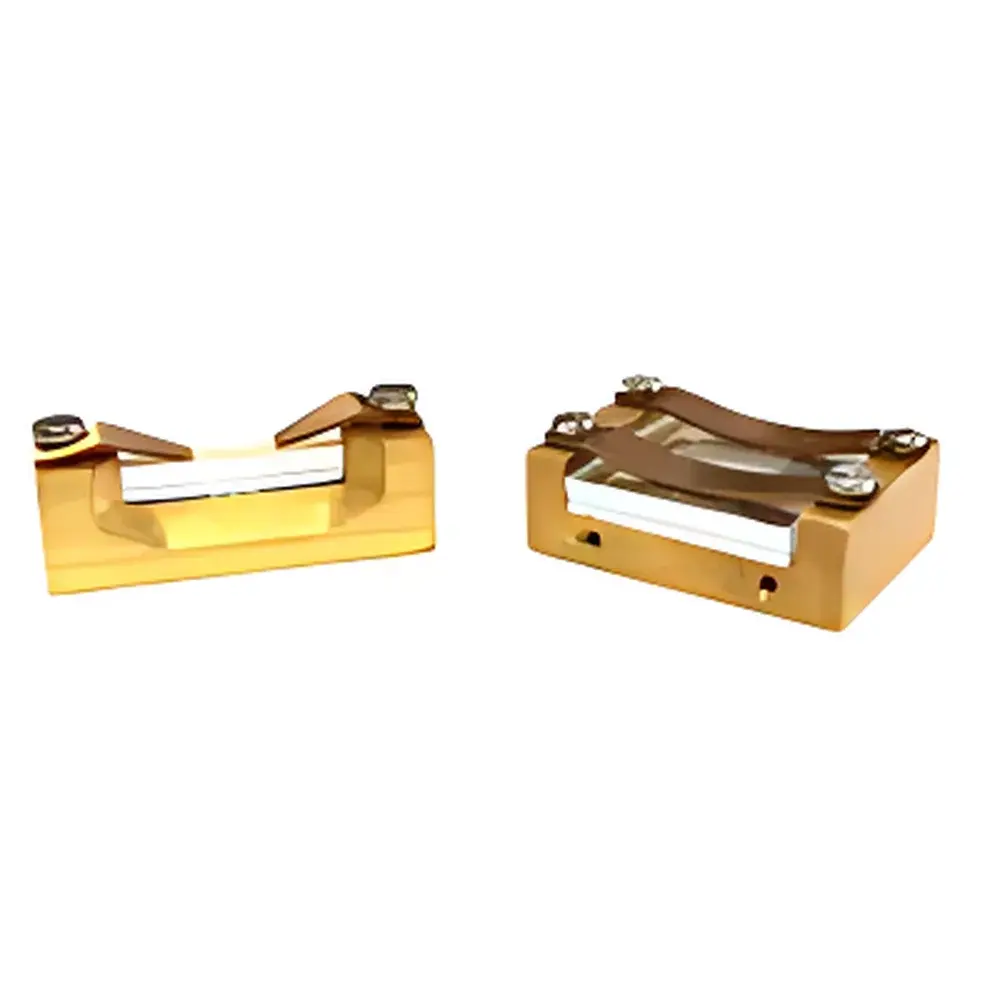
Covesion SHG8-1 Periodically Poled Lithium Niobate (PPLN) Crystal
| Brand | Covesion |
|---|---|
| Origin | United Kingdom |
| Model | SHG8-1 |
| Application | Second Harmonic Generation (SHG) |
| Pump Wavelength | 976–984 nm |
| Output Wavelength | 488–492 nm |
| Grating Period | 5.00, 5.04, 5.08 µm |
| Operating Temperature Range | 160–200 °C |
| Crystal Length | 1 mm |
| Aperture | 0.5 × 0.5 mm |
| Surface Flatness | <λ/4 |
| Parallelism | ±5 arcmin |
| Surface Quality | 20–10 scratch-dig |
| Coating | AR-coated for pump and signal bands |
| Compliance | ISO 10110 optical manufacturing standards, RoHS-compliant substrate processing |
Overview
Covesion SHG8-1 is a high-precision, periodically poled lithium niobate (PPLN) crystal engineered for efficient second harmonic generation (SHG) in the visible spectrum. As a nonlinear optical medium, PPLN enables quasi-phase-matched (QPM) frequency conversion by leveraging periodic domain inversion within the ferroelectric LiNbO3 lattice. This crystal operates via electric-field-induced domain reversal—applied at ~22 kV/mm for several milliseconds—to establish stable, sub-micron-scale grating periods (here: 5.00–5.08 µm) that satisfy momentum conservation between pump and harmonic waves. The SHG8-1 variant is specifically optimized for 976–984 nm diode or fiber laser pumping, producing high-brightness 488–492 nm output—ideal for applications requiring compact, solid-state blue light sources without external cavity complexity. Its 1 mm interaction length and 0.5 × 0.5 mm clear aperture balance conversion efficiency with beam quality preservation under tightly focused Gaussian illumination.
Key Features
- Single-crystal PPLN wafer fabricated using Covesion’s proprietary high-reproducibility poling process, supporting domain periods from 4.5 µm to 33 µm with <±0.02 µm period uniformity across the aperture
- Multi-period grating architecture integrated into one monolithic chip—enables coarse wavelength selection via spatial beam positioning and fine tuning via temperature control (160–200 °C)
- Optically polished surfaces meeting ISO 10110-3 specifications: surface flatness <λ/4 @ 633 nm, parallelism ±5 arcmin, surface quality 20–10 scratch-dig
- Dual-band anti-reflection (AR) coatings deposited via ion-beam sputtering—optimized for both pump (976–984 nm) and SHG (488–492 nm) wavelengths, achieving R < 0.2% per surface
- Compatible with standard oven-based temperature controllers (e.g., Thorlabs TED200C, Melles Griot 85RC) and custom-designed Peltier or resistive heating fixtures for thermal stability <±0.05 °C
- Pre-characterized performance data provided with each unit—including measured SHG efficiency vs. temperature curve and spectral acceptance bandwidth (Δλeff ≈ 0.2 nm @ 1064 nm equivalent)
Sample Compatibility & Compliance
The SHG8-1 crystal is designed for integration into OEM laser modules, laboratory-grade OPO systems, and metrology platforms requiring stable, narrowband blue emission. It accepts collimated or mildly focused input beams (M² < 1.3 recommended) with peak intensities up to 10 MW/cm² (for pulsed operation) or <5 kW/cm² (CW). All crystals are processed in an ISO Class 7 cleanroom environment and undergo 100% visual inspection, interferometric flatness verification, and spectral transmission testing (200–5000 nm). Substrate material complies with IEC 62474:2012 (RoHS) and REACH Annex XIV restrictions. No hazardous substances are introduced during poling or coating; final product documentation includes full traceability to raw LiNbO3 boule lot number and poling batch ID.
Software & Data Management
While the SHG8-1 is a passive optical component, its operational parameters are fully supported by Covesion’s free PPLN Designer Suite—a MATLAB-based modeling tool compliant with IEEE Std 1789-2015 for nonlinear optics simulation. Users can input pump wavelength, pulse duration, beam radius, and temperature to compute expected SHG efficiency, walk-off angle, and thermal dephasing limits. Exportable reports include phase-matching curves, acceptance bandwidth maps, and thermal lensing estimates. For regulated environments (e.g., ISO 13485 medical device manufacturing or FDA 21 CFR Part 11–governed analytical instrumentation), Covesion provides audit-ready calibration certificates with uncertainty budgets traceable to NPL (UK) reference standards.
Applications
- Visible laser source extension: Efficient generation of 488 nm light for flow cytometry, confocal microscopy, and holographic display systems—eliminating reliance on bulky argon-ion lasers
- Quantum optics: Pumping of SPDC sources for entangled photon pair generation at telecom-compatible wavelengths (e.g., 1550 nm → 775 nm + 775 nm)
- Gas sensing: Enabling dual-comb spectroscopy in the blue–UV region via sum-frequency mixing with tunable IR sources
- Industrial metrology: Stabilized blue reference lines for interferometric displacement sensors and optical clock distribution networks
- OPO seeding: Serving as a robust, alignment-insensitive seed source for picosecond OPOs targeting 3–5 µm mid-IR output
FAQ
What is the damage threshold for SHG8-1 under nanosecond pulsed operation?
For 10 ns pulses at 1064 nm equivalent fluence, the specified LIDT is ≥ 0.5 J/cm² (tested per ISO 21254-2). At 980 nm, derating to 0.35 J/cm² is recommended due to increased two-photon absorption.
Can SHG8-1 be used for continuous-wave (CW) SHG?
Yes—however, CW conversion efficiency is highly sensitive to thermal gradients. Stable operation requires active temperature stabilization with 1 kW/cm² while avoiding thermal lensing.
Is custom poling available for non-standard grating periods?
Yes. Covesion offers bespoke PPLN fabrication with periods from 4.2 µm to 35 µm, including chirped, fan-out, and multi-section designs. Typical lead time is 8–12 weeks from design freeze.
Do you provide mounting solutions compatible with standard kinematic stages?
All SHG8-1 crystals ship mounted in Covesion’s thermally isolated, kinematic-compatible Cu–Invar carriers (part # TC-SHG8), featuring SM1-threaded housing and ±0.5° tip/tilt adjustability.
How is phase-matching bandwidth affected by crystal temperature drift?
At 180 °C, the SHG8-1 exhibits a thermal tuning coefficient dλ/dT ≈ 0.028 nm/°C. A ±0.1 °C fluctuation introduces ~0.003 nm center-wavelength shift—well within typical diode laser linewidths (<0.01 nm).






