
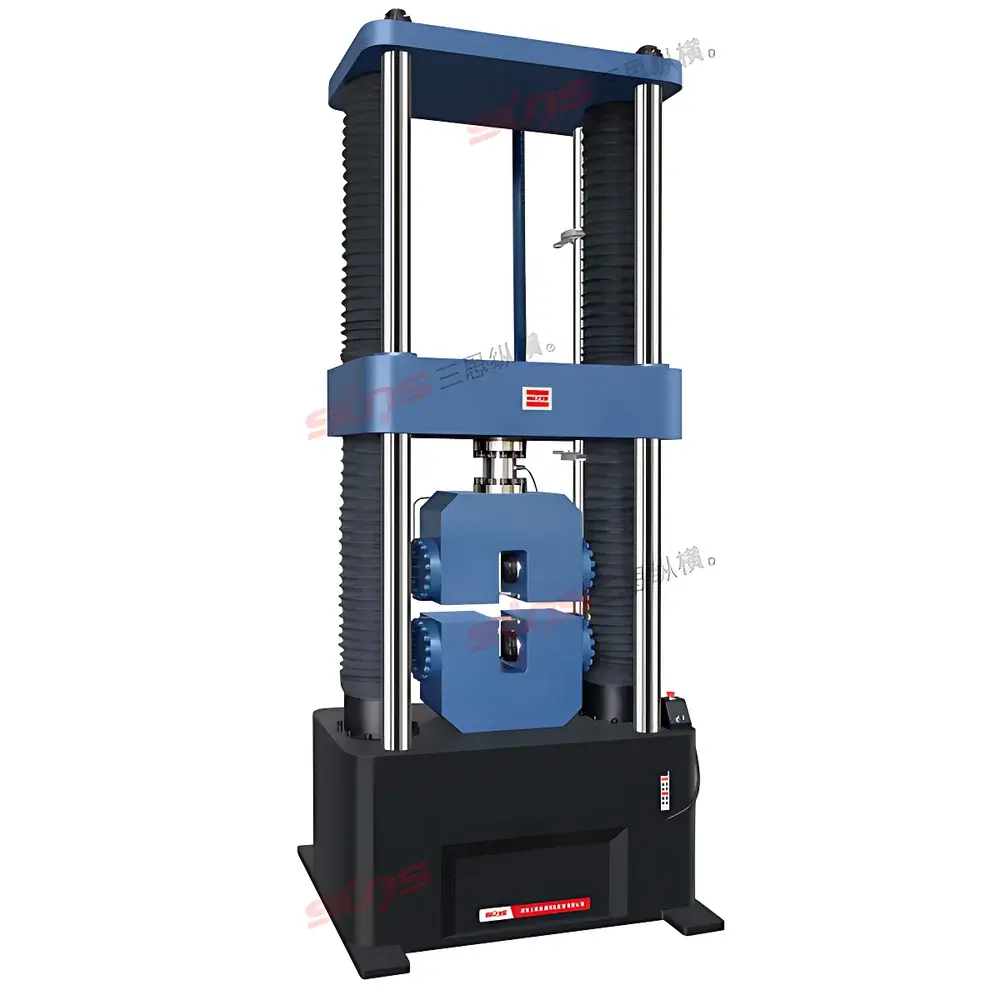
SUNS UTM5106 1000 kN Microcomputer-Controlled Electromechanical Universal Testing Machine
| Brand | SUNS |
|---|---|
| Origin | Guangdong, China |
| Manufacturer Type | Direct Manufacturer |
| Country of Origin | China |
| Model | UTM5106 |
| Instrument Type | Electromechanical Universal Testing Machine |
| Load Capacity Range | 0.02 N to 600 kN |
| Load Accuracy | ±0.5% of reading |
Overview
The SUNS UTM5106 is a high-capacity, microcomputer-controlled electromechanical universal testing machine engineered for precision mechanical property characterization of metallic, polymeric, composite, and ceramic materials under tension, compression, bending, and shear loading conditions. Operating on the principle of closed-loop servo-controlled displacement and force feedback, the system delivers traceable, repeatable, and standards-compliant mechanical test data across a wide dynamic range—from ultra-low forces (0.02 N) up to 1000 kN nominal capacity. Its modular architecture supports integration with environmental chambers, extensometers, video extensometry, and hydraulic wedge or flat-face hydraulic grips—enabling full compliance with international static mechanical testing protocols including ASTM E4, E8/E8M, E9, E290, ISO 6892-1, ISO 7500-1, and GB/T 228.1–2021. Designed for laboratory and industrial QA/QC environments, the UTM5106 meets Class 0.5 accuracy requirements per ISO 7500-1 and JJG 475–2008, ensuring metrological integrity in force, displacement, and strain measurement channels.
Key Features
- High-stability dual-flange load cell with 0.5-class accuracy from 0.4% F.S., minimal sensitivity to off-axis loads, torsion, or bending moments, and 150% overload tolerance without permanent deformation
- Precision servo drive system featuring imported servo motor and drive, low-noise (<50 dB(A)) operation, high-rigidity ball screw transmission, and synchronous belt reduction for smooth crosshead motion
- Hydraulic flat-face grip system (optional) with adjustable working pressure up to 30 MPa, flange-mount interface, and position-hold capability at any stroke—optimized to prevent specimen edge damage during clamping
- Ultra-high resolution displacement measurement: 0.04 µm resolution over full travel; position error ≤ ±0.5% of reading
- Strain measurement capability via extensometer input (0.4–100% F.S.), with relative error ≤ ±0.5% of reading and 500,000-count A/D resolution, fixed across entire range
- CNC-machined structural components ensuring alignment conformity to ASTM E1012-14 and JJG 475–2008 coaxiality specifications (≤ 0.15 mm deviation)
- Multi-mode closed-loop control: stress rate (0.005–5% FS/s), strain rate (0.005–5% FS/s), and displacement rate (0.005–200 mm/min), each with defined accuracy envelopes per rate threshold
Sample Compatibility & Compliance
The UTM5106 accommodates specimens ranging from miniature coupons (e.g., ASTM E8M subsize tensile bars) to large-scale structural components, supported by configurable test space options: upper-space (for tensile-dominant applications), lower-space (for integration with environmental chambers), and dual-zone (upper-tension/lower-compression) configurations. Minimum specimen length for flat-face hydraulic grip use is 360 mm to ensure safe load transfer and alignment stability. The system complies with national and international standards for verification, calibration, and application—including GB/T 16491–2008 (general requirements), JJG 475–2008 (verification regulation), GB/T 228.1–2021 (tensile testing), GB/T 7314–2010 (compression), and GB/T 232–2010 (bending). Force sensor calibration certificates are traceable to national metrology institutes and conform to JJG 475 requirements.
Software & Data Management
The embedded Windows-based control and analysis software provides real-time graphical monitoring, multi-channel synchronized data acquisition (force, displacement, extensometer strain, temperature if interfaced), and automated test sequence execution. All raw data files are saved in ASCII-compatible formats (.csv, .txt) with metadata headers including timestamp, operator ID, calibration IDs, and environmental conditions. Audit trails record all parameter modifications, test start/stop events, and user logins—supporting GLP and GMP documentation requirements. Export functionality includes PDF reports compliant with ISO/IEC 17025 reporting guidelines, and optional integration with LIMS platforms via OPC UA or TCP/IP protocols. Software validation documentation (IQ/OQ) is available upon request for regulated industries.
Applications
- Mechanical qualification of structural steels, aluminum alloys, titanium, and high-strength composites per aerospace (AMS, MIL-STD) and automotive (SAE J2334) specifications
- Quality assurance of welded joints, castings, and forged components through standardized tensile, compression, and bend testing
- R&D evaluation of novel materials including shape-memory alloys, additive-manufactured parts, and fiber-reinforced polymers
- Calibration reference testing for secondary force standards laboratories operating under ISO/IEC 17025 accreditation
- Long-term creep and relaxation studies when coupled with environmental enclosures and high-resolution extensometry
FAQ
What is the maximum load capacity of the UTM5106, and what does “1000 kN” signify?
The UTM5106 is rated for a nominal static load capacity of 1000 kN (approximately 102 metric tons force), representing its design upper limit for safe, repeatable testing under standard ambient conditions.
Does the system support ASTM E1012-14 coaxiality verification?
Yes—the mechanical structure, manufactured using CNC machining and validated post-assembly, achieves coaxiality ≤ 0.15 mm per ASTM E1012-14 methodology, confirmed during factory acceptance testing.
Is the load cell calibrated and certified to national metrological standards?
Each unit ships with a factory calibration certificate traceable to China’s National Institute of Metrology (NIM), compliant with JJG 475–2008, and includes uncertainty budgets for force measurement across its operational range.
Can the UTM5106 be integrated with third-party environmental chambers?
Yes—standardized mounting interfaces and programmable I/O ports enable seamless integration with commercial temperature/humidity chambers, corrosion cabinets, or vacuum systems for elevated- or cryogenic-temperature testing.
What safety certifications does the system meet?
The electrical subsystem conforms to IEC 61000-6-2 (immunity) and IEC 61000-6-4 (emission) standards; mechanical guarding and emergency stop circuits comply with ISO 13857 and GB/T 15706 requirements.



