
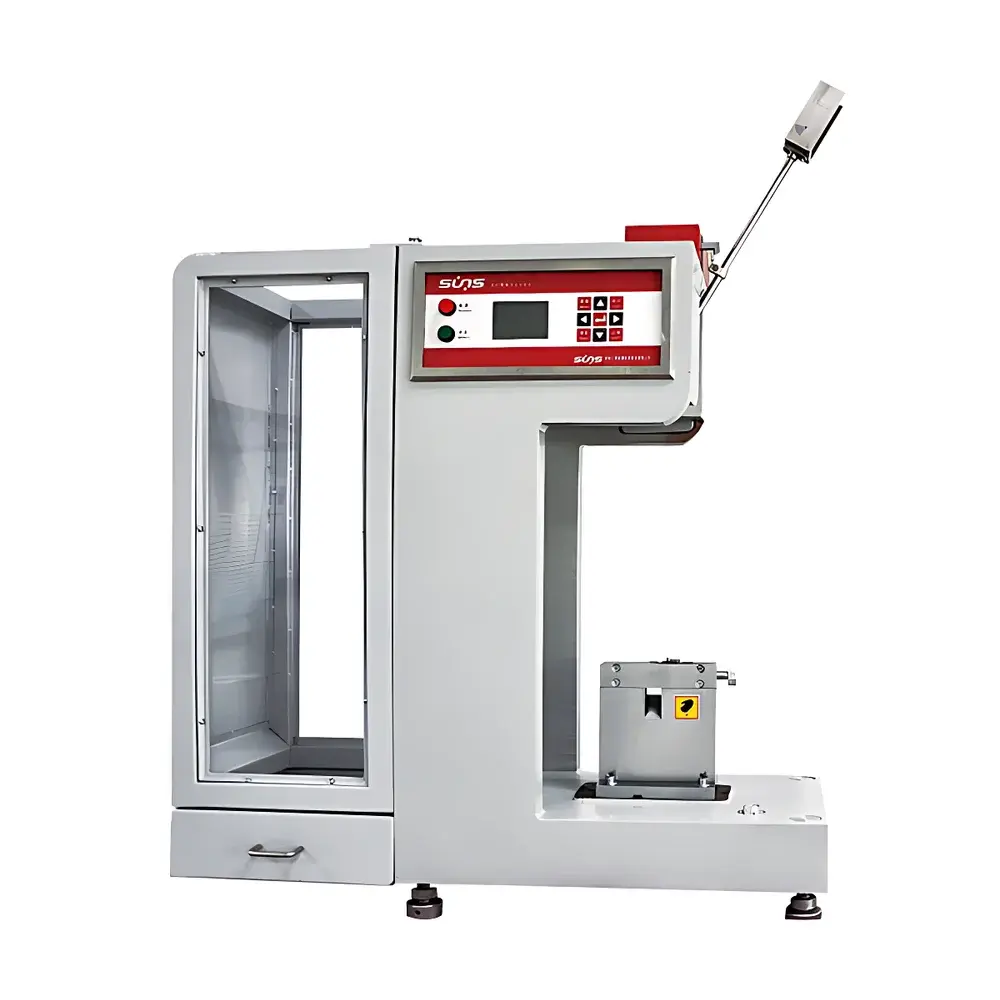
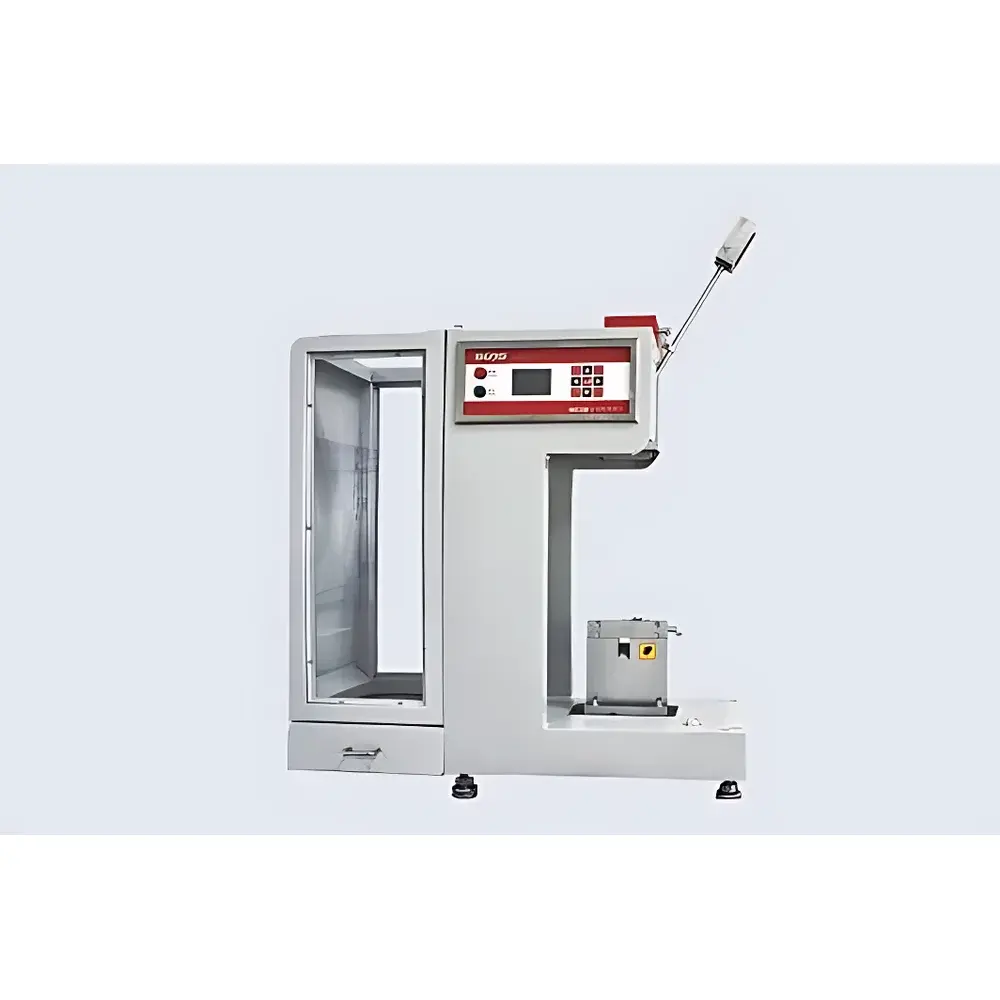
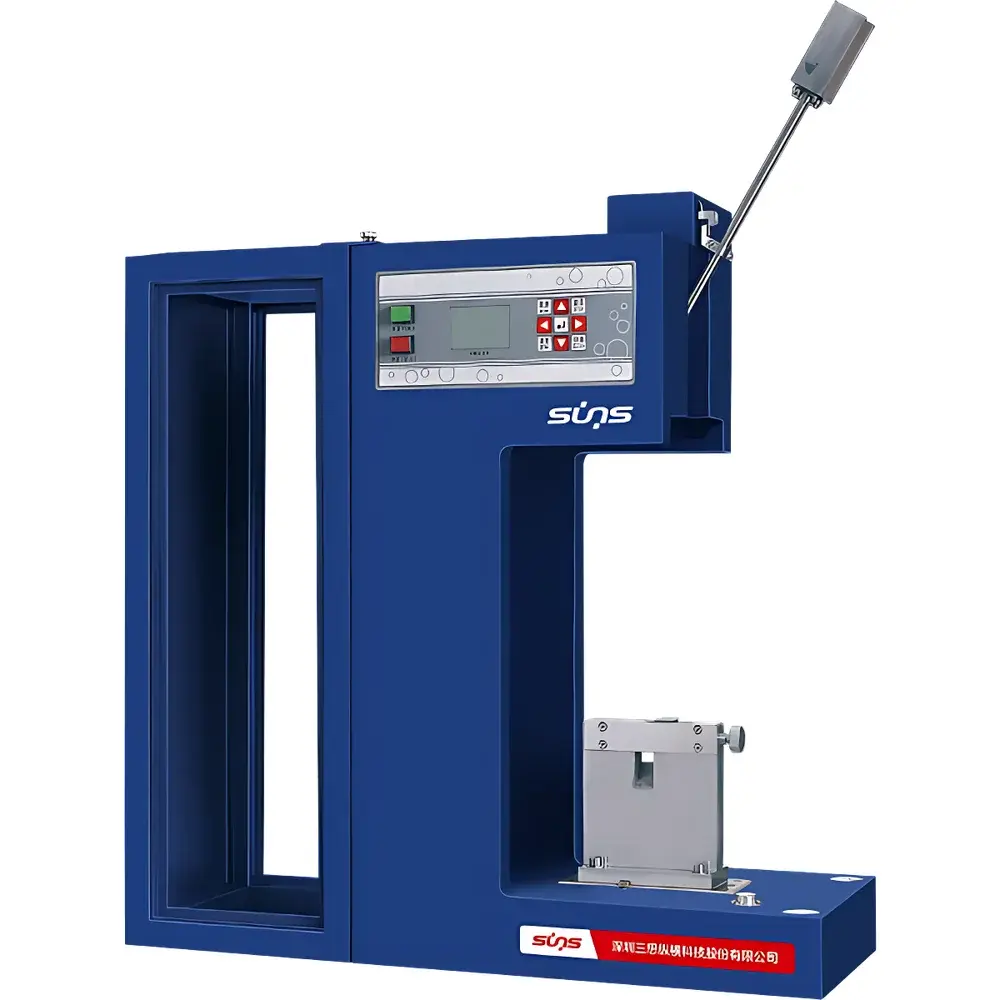
SUNS Feilong Series Plastic Pendulum Impact Testing Machine
| Brand | SUNS |
|---|---|
| Origin | Guangdong, China |
| Manufacturer Type | Manufacturer |
| Product Category | Domestic |
| Model | Feilong Series |
| Pricing | Upon Request |
Overview
The SUNS Feilong Series Plastic Pendulum Impact Testing Machine is a precision-engineered instrument designed for standardized Charpy and Izod impact testing of rigid plastics, thermosetting resins, fiber-reinforced composites, electrical insulating materials, ceramics, and industrial flooring materials. Based on the fundamental principle of pendulum impact energy absorption, the system measures the energy required to fracture a notched or unnotched specimen under controlled impact loading—either in simply supported beam (Charpy) or cantilever beam (Izod) configuration. This mechanical test quantifies material toughness and notch sensitivity, serving as a critical quality control parameter in polymer formulation, production validation, and regulatory compliance workflows across automotive, construction, electronics, and medical device manufacturing sectors.
Key Features
- High-precision imported ball bearings minimize rotational friction losses in the pendulum shaft assembly, ensuring optimal energy transfer consistency across repeated tests.
- Shaftless optical encoder eliminates mechanical hysteresis and pointer drag errors associated with traditional analog dials—delivering direct digital acquisition of angular displacement and real-time kinetic energy calculation.
- Modular pendulum system supports rapid interchange of impact hammers (e.g., 1 J, 2.75 J, 5 J, 7.5 J, 15 J, 25 J, 50 J configurations) and corresponding anvil supports, enabling seamless adaptation to diverse specimen geometries and standard requirements.
- Integrated safety enclosure with interlocked mesh guard meets ISO 13857 and IEC 61496-1 functional safety guidelines—automatically disabling the release mechanism when the guard is open.
- Backlit LCD display provides real-time, high-resolution readout of absorbed impact energy (in J), impact velocity (m/s), and pendulum angle—eliminating parallax and interpolation errors inherent in analog scale reading.
- Embedded microcontroller implements automatic energy loss correction algorithms based on air resistance, bearing torque, and pivot friction models—calibrated per ASTM D6110 Annex A1 and ISO 179-1 Clause 8.3.
- Non-volatile memory with power-loss recovery retains calibration coefficients, test history, and user settings—ensuring continuity during unexpected shutdowns.
Sample Compatibility & Compliance
The Feilong Series accommodates specimens conforming to standardized dimensions defined in GB/T 1043–2008 (Charpy), GB/T 1843–2008 (Izod), ISO 179–2010, ISO 180–2000, and GB/T 18743–2002 (for thermoplastic piping). It supports both machined and injection-molded specimens—including rectangular bars (e.g., 80 × 10 × 4 mm), notched variants (A- or B-type notch per ISO 179), and tubular sections up to Ø110 mm OD. The machine is validated for use in GLP-compliant laboratories and supports audit-ready documentation for ISO/IEC 17025 accreditation. All firmware and calibration routines comply with traceable metrological practices aligned with JJG 145–2007 (Chinese National Verification Regulation for Pendulum Impact Machines).
Software & Data Management
While the base configuration operates via embedded firmware and local LCD interface, optional PC-based software (SUNS ImpactSuite v3.x) enables full data export in CSV, XML, and PDF formats—including statistical summaries (mean, SD, CV%), pass/fail flagging against specification limits, and graphical trend analysis. The software supports 21 CFR Part 11-compliant electronic signatures, role-based access control, and audit trail logging for regulated environments. Calibration certificates include uncertainty budgets calculated per GUM (JCGM 100:2008) and are issued with NIST-traceable reference standards.
Applications
- Quality assurance of polypropylene (PP), polycarbonate (PC), ABS, POM, and PET injection-molded components.
- Evaluation of aging effects (thermal, UV, hydrolytic) on impact performance of engineering thermoplastics.
- Validation of flame-retardant additives and filler dispersion homogeneity in composite matrices.
- Batch release testing for electrical insulation housings per IEC 60695-1-10.
- Research-grade comparative studies of biodegradable polymers (e.g., PLA, PHA) under standardized impact conditions.
- Failure mode analysis of ceramic tiles and cast stone used in architectural applications.
FAQ
What standards does this machine support out-of-the-box?
It natively complies with GB/T 1043–2008, GB/T 1843–2008, ISO 179–2010, ISO 180–2000, and GB/T 18743–2002—requiring no hardware modification for standard-conforming tests.
Is it possible to upgrade to automated specimen handling or robotic notching integration?
Yes—SUNS offers modular automation kits including motorized specimen positioning stages and API-compatible interfaces for integration with third-party notch milling systems (e.g., ISO 2818-compliant notching units).
How is calibration traceability ensured?
Each unit ships with a factory calibration certificate referencing certified reference pendulums calibrated against national primary standards at the China National Institute of Metrology (NIM), with uncertainty ≤ ±0.8% (k=2).
Does the system support multi-language UI and reporting?
The embedded display supports English and Chinese; PC software adds German, French, Spanish, and Japanese language packs via localized resource files.
Can test data be exported directly to LIMS platforms?
Yes—via configurable ODBC drivers and HL7-compliant XML schema mapping, enabling bidirectional synchronization with major laboratory information management systems.



