
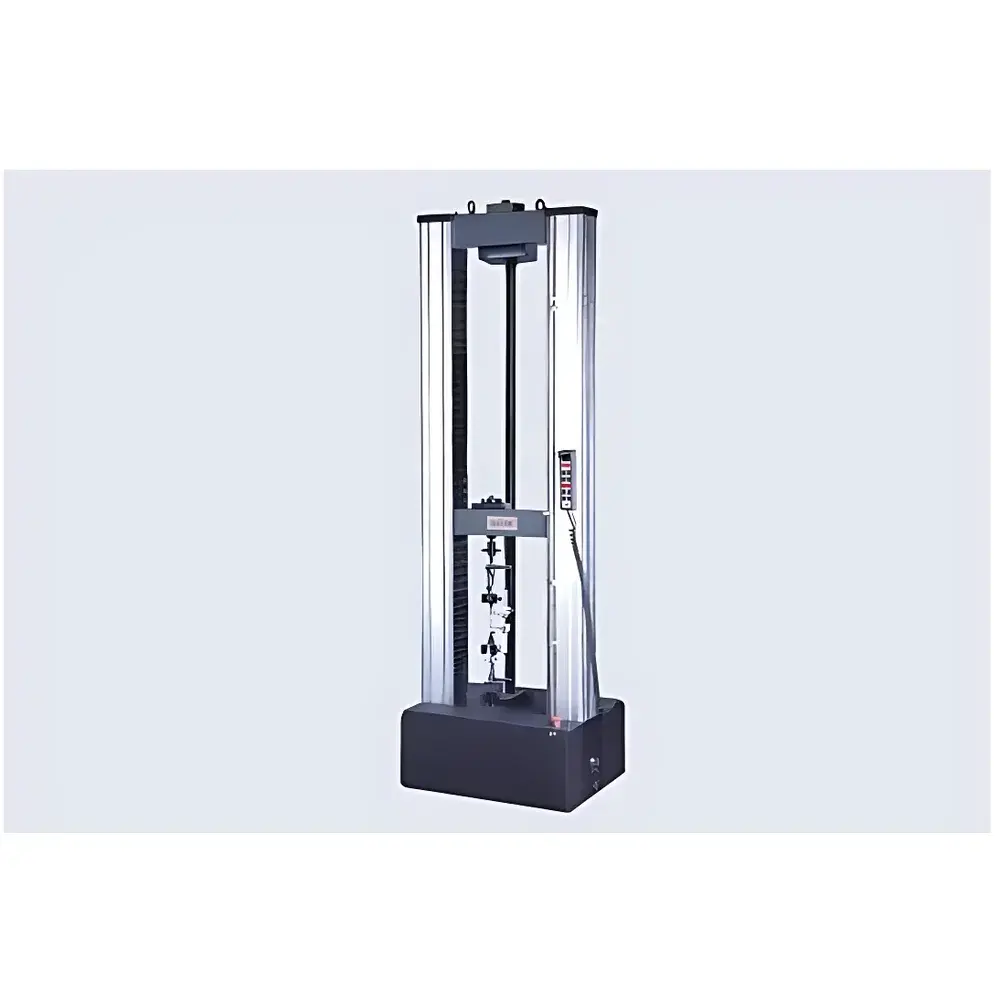
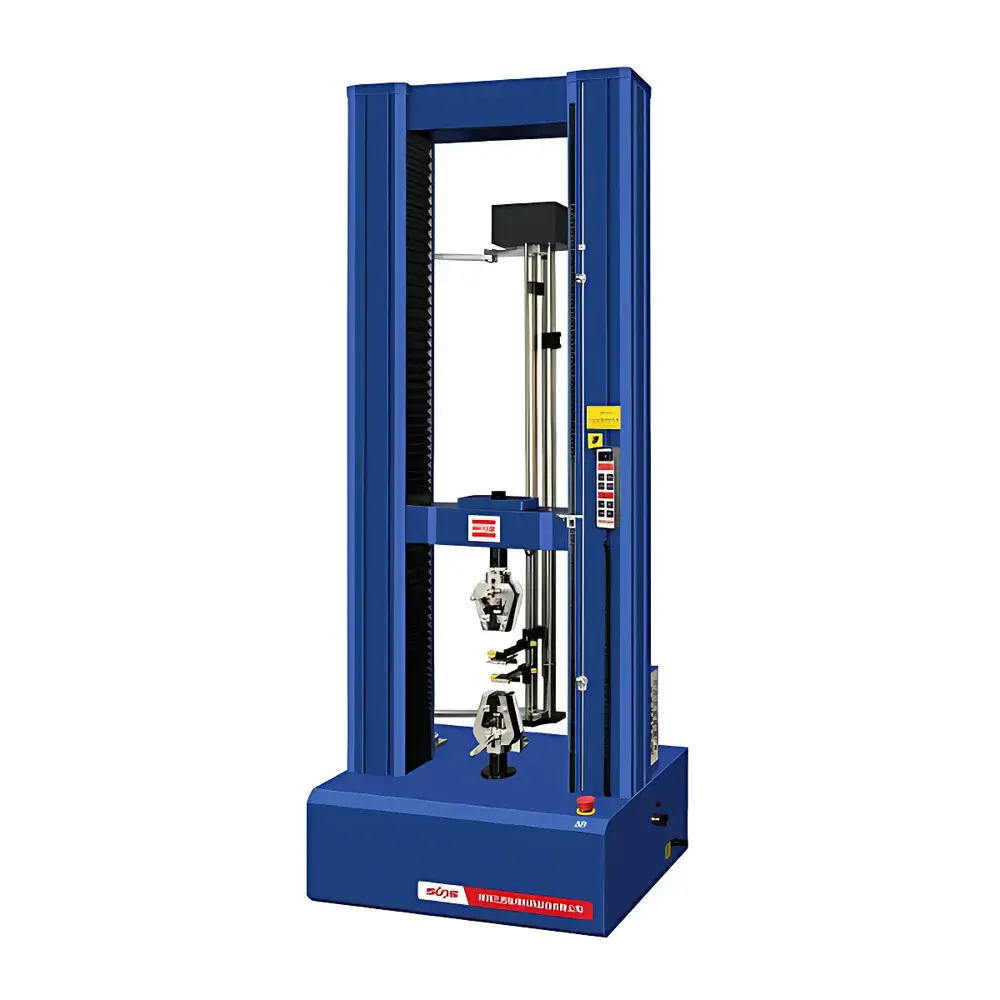
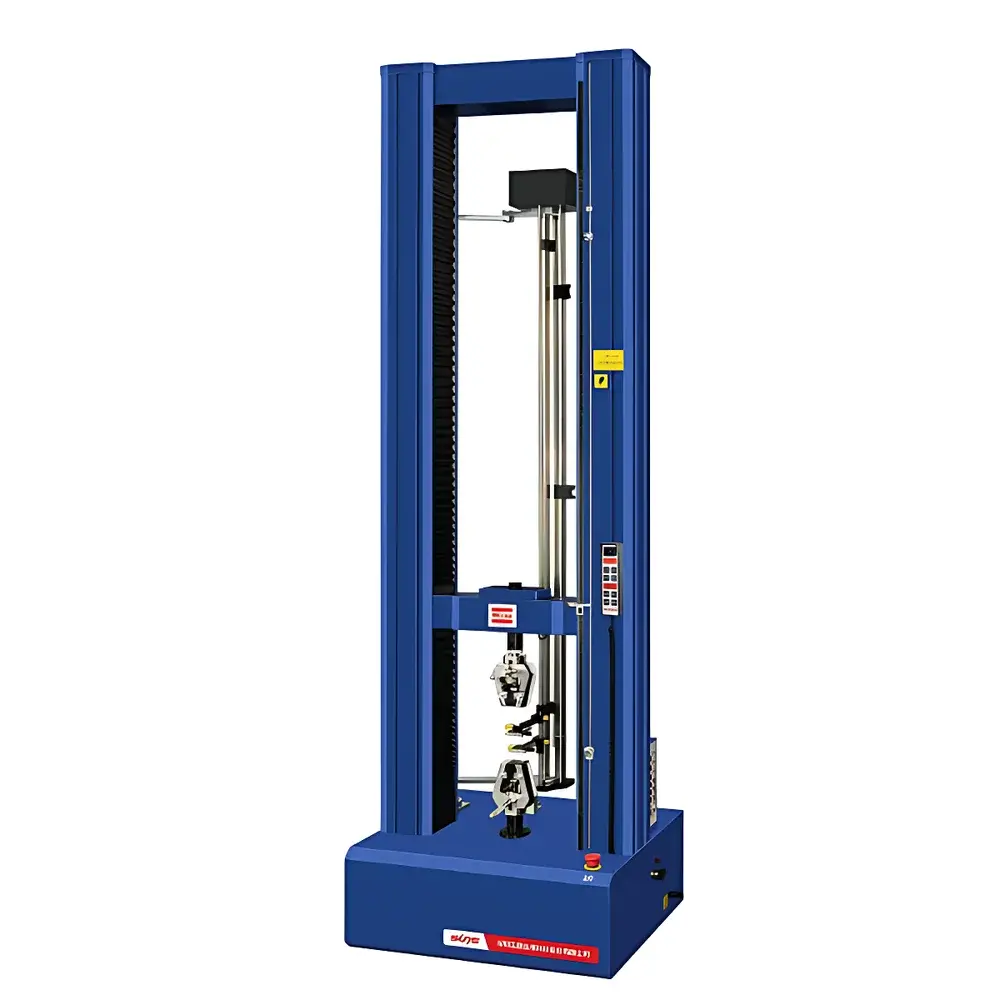
SUNS SUNS Rubber Tensile Testing Machine
| Brand | SUNS |
|---|---|
| Origin | Shenzhen, China |
| Manufacturer Type | Direct Manufacturer |
| Instrument Type | Electromechanical Tensile Testing Machine |
| Max Test Force Range | 1 kN to 10 kN |
| Force Accuracy Class | 0.5 |
| Effective Stroke | 900 mm |
| Displacement Resolution | 0.001 mm |
| Max Test Speed | 500 mm/min |
| Large-Deformation Measurement Range | 10 mm to 800 mm |
| Large-Deformation Accuracy | ±0.5% FS |
| Large-Deformation Resolution | 0.008 mm |
Overview
The SUNS Rubber Tensile Testing Machine is an electromechanical universal testing system engineered for high-fidelity mechanical characterization of highly extensible polymeric materials—including natural and synthetic rubbers, thermoplastic elastomers (TPEs), silicone gels, foams, and flexible composites. It operates on the principle of controlled uniaxial force application via a precision servo-motor-driven crosshead, coupled with synchronized load cell feedback and high-resolution displacement transduction. Designed in accordance with ISO 527-2, ASTM D412, ASTM D638, and GB/T 528 standards, this system delivers traceable, repeatable tensile, tear, peel, and adhesion strength measurements under ambient or conditioned environmental conditions. Its structural rigidity, low thermal drift load frame, and dual-sensor architecture (load + large-deformation) ensure metrological integrity across extreme elongation regimes—critical for capturing nonlinear viscoelastic behavior, strain-hardening onset, and ultimate failure modes in soft elastomers.
Key Features
- Modular force capacity configuration: Selectable 1 kN, 5 kN, or 10 kN load cells calibrated to ISO 7500-1 Class 0.5 accuracy (±0.5% of full scale), with automatic sensor recognition and zero-point stabilization.
- Dual-mode displacement measurement: High-precision encoder-based crosshead position tracking (0.001 mm resolution) integrated with optical or clip-on extensometer subsystem for true specimen strain acquisition over 10–800 mm range.
- Large-deformation measurement system: Non-contact or mechanical extensometer with ±0.5% FS accuracy and 0.008 mm resolution—optimized for materials exhibiting >300% elongation at break without slippage or misalignment.
- Programmable test control: Closed-loop speed control from 0.001 mm/min to 500 mm/min; pre-defined test methods for tensile modulus, yield point, breaking strength, elongation at break, and permanent set per ISO 37 and ASTM D395.
- Rigid two-column load frame with reinforced aluminum alloy construction, designed to minimize deflection under dynamic loading and support long-term calibration stability.
- Integrated safety interlocks including emergency stop, overload protection, upper/lower limit switches, and real-time force/displacement anomaly detection.
Sample Compatibility & Compliance
The SUNS Rubber Tensile Testing Machine accommodates standard dumbbell-shaped, ring, strip, and dog-bone specimens per ISO 37, ASTM D412 Type A/C, and GB/T 528. Gripping options include pneumatic, wedge, roller, and rubber-faced clamps—each engineered to prevent premature slippage or localized stress concentration during high-strain testing. The system supports environmental chamber integration (−70 °C to +250 °C) for temperature-dependent modulus and hysteresis evaluation. All hardware and firmware comply with CE Machinery Directive 2006/42/EC, EMC Directive 2014/30/EU, and RoHS 2011/65/EU. Data acquisition meets GLP/GMP audit requirements with optional 21 CFR Part 11-compliant software modules for electronic signatures, audit trails, and user access controls.
Software & Data Management
The system runs on SUNS TestMaster™ v5.x—Windows-based control and analysis software compliant with ISO 17025 documentation requirements. It provides real-time plotting of stress–strain, force–displacement, and creep/recovery curves; automated calculation of tensile strength, Young’s modulus (secant/tangent), elongation at yield and break, tear resistance (kN/m), and peel adhesion (N/mm). Raw data exports in CSV, XML, and PDF formats support third-party statistical packages (e.g., JMP, Minitab) and LIMS integration. Calibration certificates are digitally embedded and timestamped; all test records retain metadata including operator ID, environmental conditions, calibration status, and instrument configuration history.
Applications
- Quality control of raw rubber compounds and vulcanized products in tire, sealant, and medical device manufacturing.
- R&D validation of novel elastomer formulations—assessing filler dispersion effects, crosslink density impact, and aging-induced embrittlement.
- Comparative evaluation of adhesive bond integrity in rubber-to-metal or rubber-to-fabric laminates.
- Regulatory submission testing for FDA 510(k) or ISO 10993 biocompatibility assessments requiring mechanical performance under simulated physiological strain.
- Accelerated life-cycle simulation via cyclic loading protocols (e.g., DIN 53504 S2) to quantify fatigue resistance and hysteresis loss.
FAQ
What standards does this machine support for rubber tensile testing?
It fully supports ISO 527-2, ASTM D412, ASTM D638, ISO 37, GB/T 528, and DIN 53504—covering specimen geometry, test speed, conditioning, and reporting requirements.
Can the system measure true strain beyond 500% elongation?
Yes—the large-deformation extensometer maintains ±0.5% FS accuracy up to 800 mm travel, enabling reliable strain measurement for ultra-elastic materials such as silicone elastomers and hydrogels.
Is calibration traceability provided?
Each load cell includes an accredited calibration certificate traceable to NIM (China National Institute of Metrology) or equivalent national metrology institutes, with annual recalibration intervals recommended per ISO/IEC 17025.
Does the software support multi-user environments with role-based permissions?
Yes—TestMaster™ supports hierarchical user accounts (Administrator, Technician, Reviewer) with configurable access rights, electronic signature workflows, and immutable audit logs compliant with FDA 21 CFR Part 11.
What maintenance is required to sustain measurement accuracy?
Routine verification using certified reference weights and displacement standards every 3 months; annual full recalibration of load cell, encoder, and extensometer subsystems is recommended for GxP-regulated environments.



