
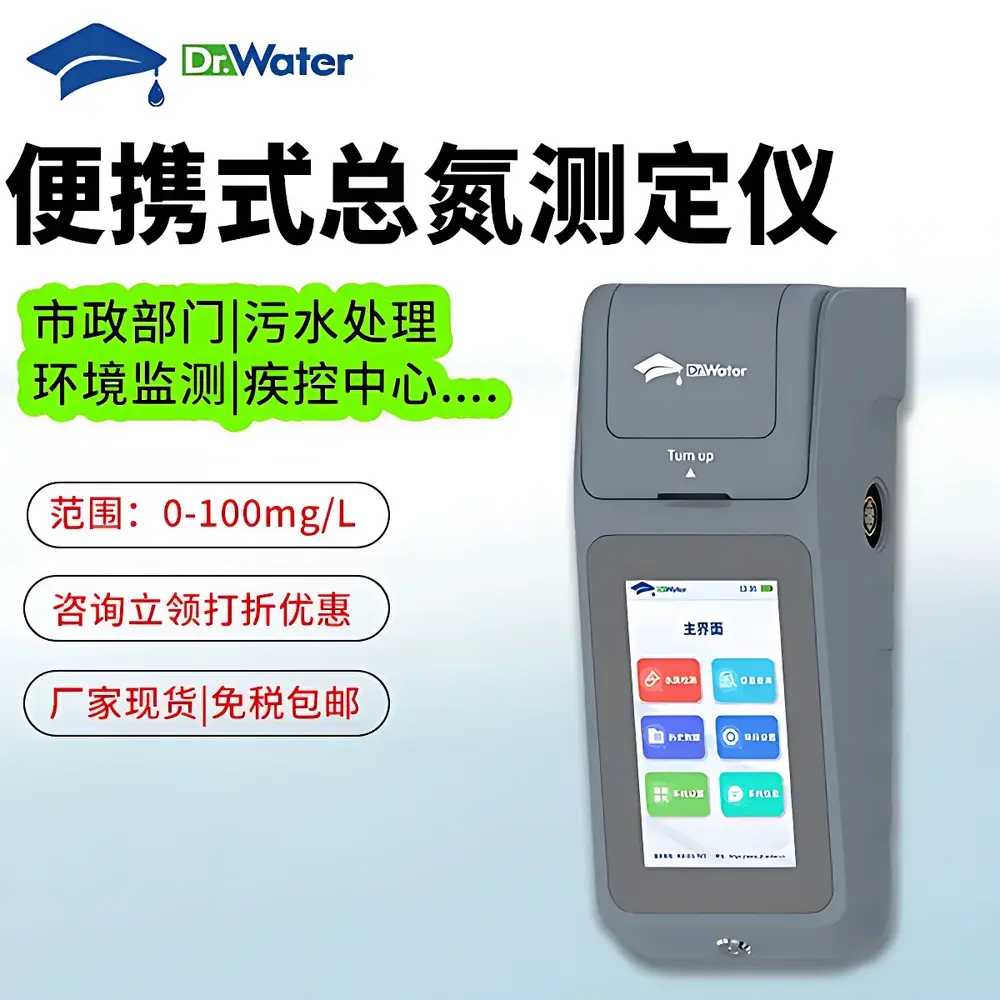
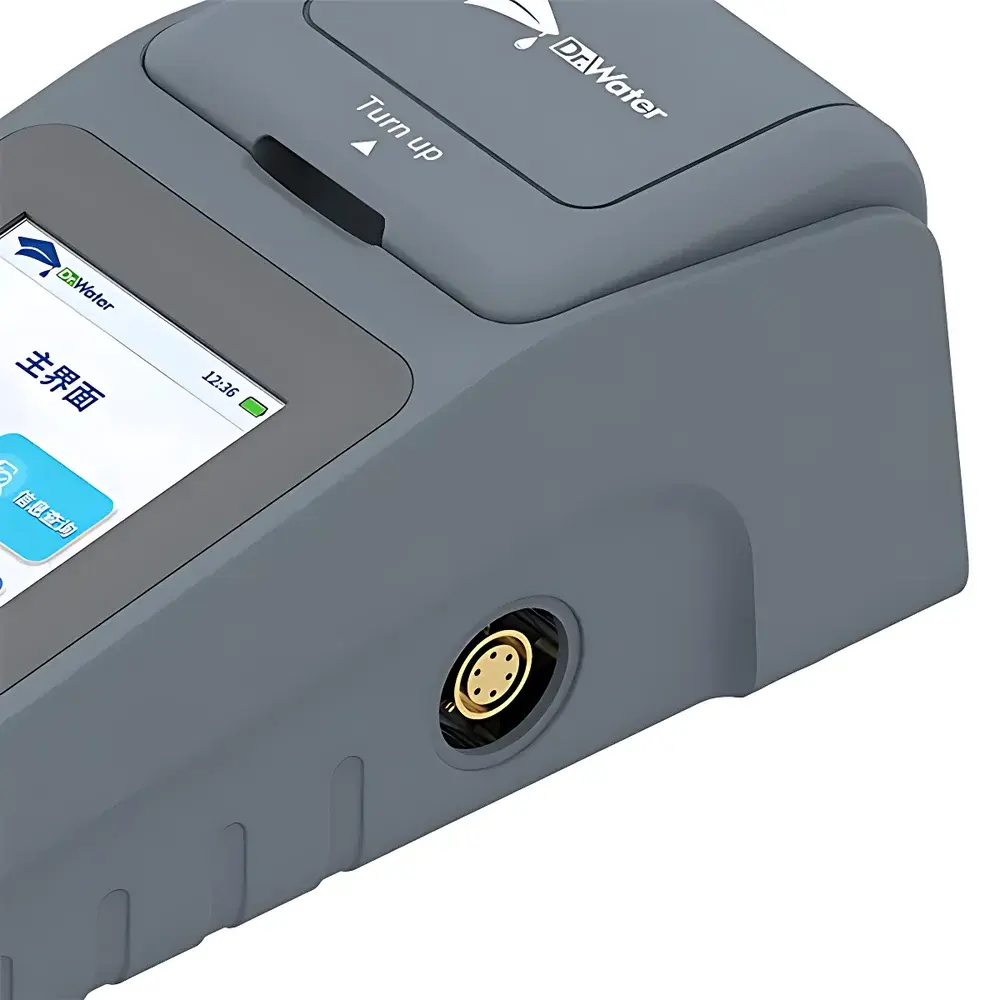
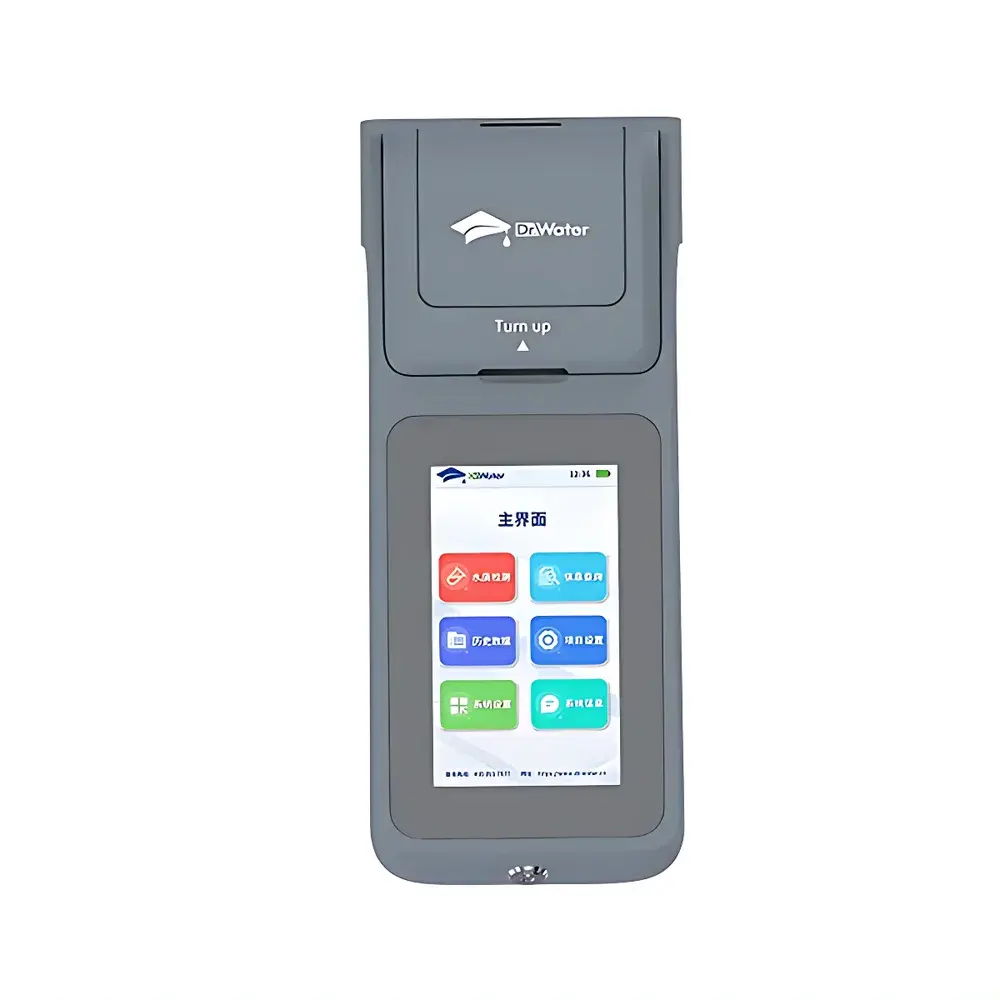
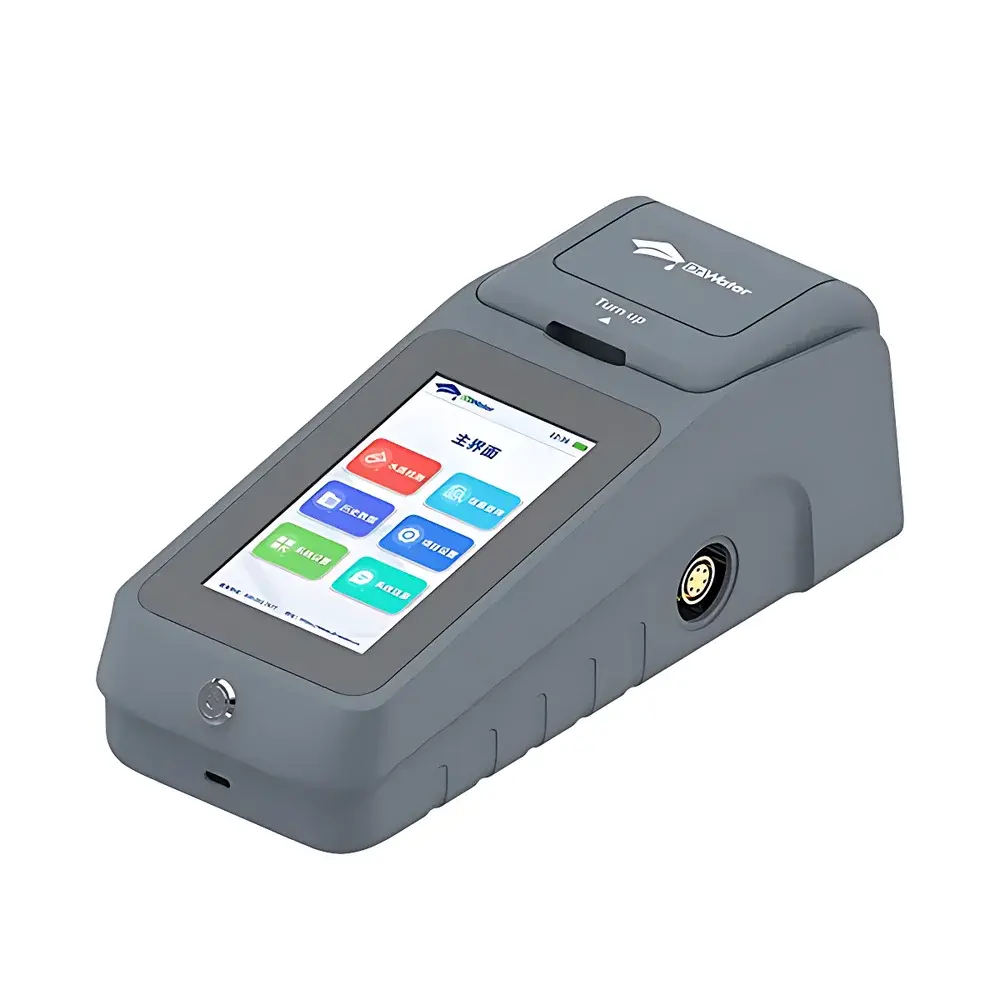
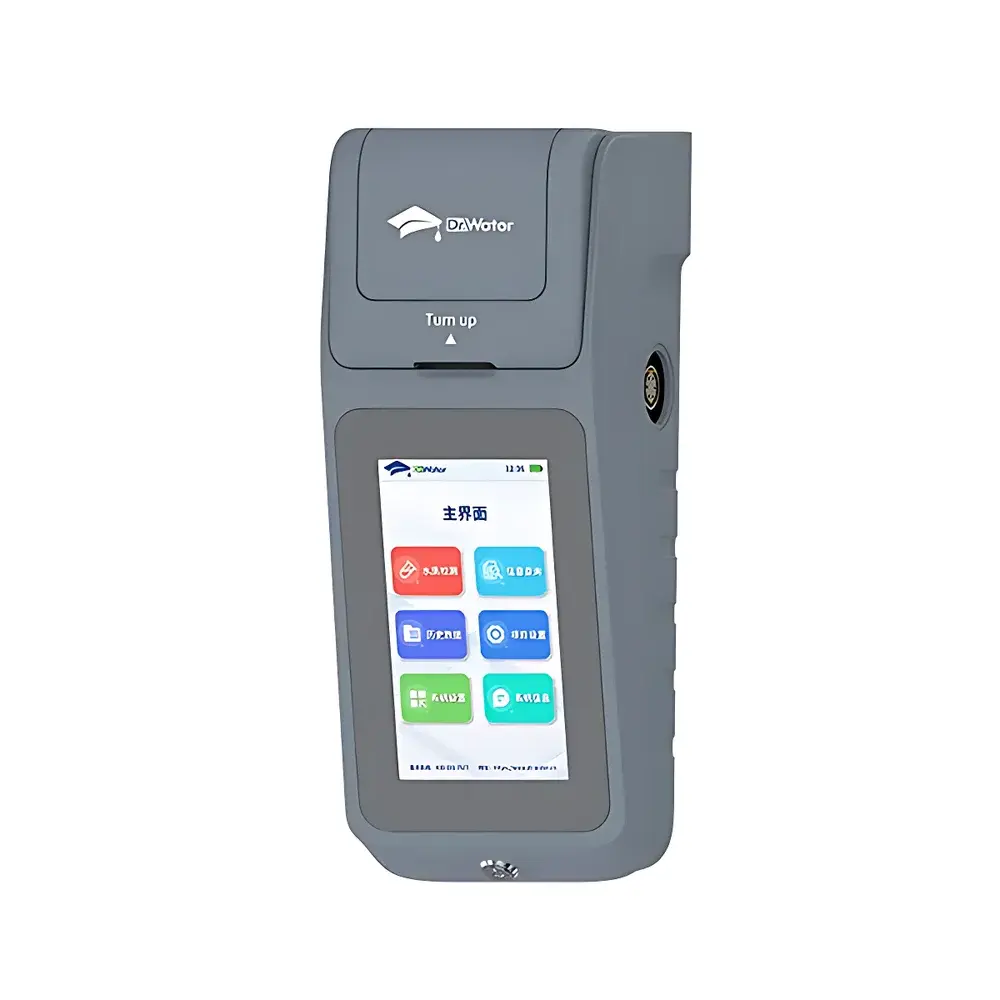
Dr-T9905 Portable Total Nitrogen Analyzer by DoctorWater
| Brand | DoctorWater |
|---|---|
| Model | Dr-T9905 |
| Type | Portable/Water Quality Analyzer |
| Detection Principle | Dual-Mode Photometric & Electrochemical |
| Measurable Parameters | COD (2–20,000 mg/L), Ammonia-N, Total Phosphorus, Total Nitrogen, Heavy Metals, pH, Dissolved Oxygen, Conductivity, Turbidity, Temperature, ORP, TDS, Chlorophyll-a, Phycocyanin, SS, Residual Chlorine, Oil-in-Water, Salinity |
| Wavelength Range | 340–900 nm |
| Wavelength Accuracy | ±1 nm |
| Wavelength Repeatability | <0.2 nm |
| Spectral Bandwidth | 4 nm |
| Transmittance Error | ±0.5% |
| Transmittance Repeatability | ≤0.2% T |
| Absorbance Resolution | 0.001 Abs |
| Optical Stability | ≤±0.005 Abs/20 min |
| Pre-stored Calibration Curves | 600 |
| Data Storage Capacity | 1,000,000 records |
| Display | 5-inch HD capacitive touchscreen |
| Power Supply | Rechargeable Li-ion battery + AC adapter |
| Compliance | GB 11893–1989 (Total Phosphorus), GB/T 11894–1989 (Total Nitrogen), ISO 7027, ASTM D5810, EPA Method 351.2 (adapted) |
Overview
The Dr-T9905 Portable Total Nitrogen Analyzer by DoctorWater is an integrated field-deployable water quality testing platform engineered for multi-parameter analysis in compliance with national and internationally referenced environmental standards. It employs dual-mode detection architecture—combining precision photometry (based on absorbance spectroscopy across 340–900 nm) with electrochemical sensing—to deliver quantitative measurements of total nitrogen (TN), chemical oxygen demand (COD), ammonia-nitrogen (NH₃-N), total phosphorus (TP), heavy metals (via ion-selective electrodes or colorimetric derivatization), pH, dissolved oxygen (DO), conductivity, turbidity, ORP, TDS, chlorophyll-a, phycocyanin, suspended solids (SS), residual chlorine, oil-in-water, and salinity. The instrument’s optical core features a fiber-optic coupled detection system with imported cold-light source (rated lifetime >100,000 hours), ensuring long-term spectral fidelity and minimal thermal drift. Its design adheres to the measurement principles outlined in GB/T 11894–1989 (alkaline potassium persulfate digestion UV spectrophotometric method for total nitrogen) and supports method adaptation for EPA 351.2 and ISO 11908–2 (water quality — determination of total nitrogen — automated methods). This enables trace-level TN quantification in complex matrices—including wastewater, groundwater, surface water, reclaimed water, and aquaculture effluents—without laboratory-grade infrastructure.
Key Features
- Dual optical detection modes: 360° rotatable tube-based photometry and fixed-cuvette photometry, enabling flexible sample handling and minimized cross-contamination.
- Dedicated electrochemical detection station with interchangeable digital electrodes (pH, DO, ORP, conductivity, ion-selective sensors), supporting simultaneous multi-sensor readouts.
- High-resolution 5-inch capacitive touchscreen with intuitive graphical interface; English-language firmware available upon configuration.
- Optical performance certified to ≤±0.005 Abs/20 min stability, ±1 nm wavelength accuracy, and <0.2 nm wavelength repeatability—meeting ISO 8577 and DIN EN ISO 7027 requirements for turbidimetric and colorimetric instruments.
- Pre-loaded library of 600 validated calibration curves, covering standard methods for COD (dichromate reflux), TN (persulfate digestion + UV detection), TP (ammonium molybdate spectrophotometry), and heavy metal speciation (e.g., Cr(VI), Cu²⁺, Pb²⁺).
- Onboard data management: 1,000,000 measurement records stored with timestamp, GPS metadata (optional external module), operator ID, and method version tagging.
- Robust mechanical construction: ABS polymer housing rated IP67 for dust/water ingress protection; chemically resistant to acids, alkalis, and organic solvents per ASTM D543.
Sample Compatibility & Compliance
The Dr-T9905 accommodates liquid samples from diverse environmental and industrial sources—including municipal wastewater, industrial discharges (e.g., electroplating, pulp & paper, pharmaceutical effluents), groundwater monitoring wells, drinking water distribution systems, and aquaculture ponds. Sample volumes range from 1–50 mL depending on assay protocol. All photometric assays follow standardized digestion and color development steps aligned with GB/T 11894–1989 (total nitrogen), GB 11914–1989 (COD), and GB/T 11893–1989 (total phosphorus). Electrochemical modules comply with ISO 7888 (conductivity), ISO 5814 (dissolved oxygen), and ASTM D1293 (pH). Instrument validation documentation supports GLP-compliant field use and audit-ready data integrity under ISO/IEC 17025:2017 clause 7.7 (uncertainty estimation) and US FDA 21 CFR Part 11 (electronic records and signatures) when configured with audit-trail-enabled firmware.
Software & Data Management
Data acquisition, calibration, and reporting are managed via embedded firmware with real-time statistical processing (mean, SD, CV%, linear regression). Measurement results support concentration, absorbance, or transmittance readout modes. Calibration workflows include single-point zeroing, multi-point linear/nonlinear curve fitting, and slope/intercept verification. Raw spectral scans (340–900 nm) and time-series electrode outputs are exportable via USB 2.0 as CSV or XML files compatible with LIMS platforms (e.g., LabWare, STARLIMS). Optional Bluetooth thermal printer provides on-site hardcopy reports with QR-coded traceability. Firmware updates are delivered via secure HTTPS endpoint and digitally signed to ensure integrity.
Applications
- Field-based regulatory compliance monitoring for municipal wastewater treatment plants (WWTPs) and industrial pretreatment facilities under China’s “Discharge Standard of Pollutants for Municipal Wastewater Treatment Plants” (GB 18918–2002).
- Rapid screening of eutrophication indicators (TN, TP, chlorophyll-a) in lake and reservoir management programs.
- QA/QC in pharmaceutical water systems (PW, WFI) per USP and EU Annex 1 guidelines.
- Process control in electroplating and metal finishing operations where TN and heavy metal concentrations impact rinse water recycling efficiency.
- Educational laboratories requiring pedagogically structured, CE-marked instrumentation for environmental chemistry coursework.
- Emergency response units conducting post-flood or spill assessment where portable, battery-powered multi-analyte capability is critical.
FAQ
Does the Dr-T9905 support EPA-approved methods for total nitrogen analysis?
Yes—the instrument implements alkaline potassium persulfate digestion followed by UV spectrophotometric detection, consistent with adaptations of EPA Method 351.2 and ISO 11908–2.
Can calibration curves be customized or imported?
Users may edit existing curves or upload new ones via USB using the provided curve editor tool; all modifications are logged with user ID and timestamp.
Is GPS geotagging supported natively?
GPS metadata is not built-in but can be added via optional Bluetooth GNSS receiver (e.g., u-blox NEO-M8N) with NMEA 0183 output integration.
What is the battery life under continuous photometric operation?
Up to 12 hours at ambient temperature (25°C) with backlight enabled and one measurement every 90 seconds.
How is data integrity ensured during field use?
All measurements include automatic timestamping, operator login credentials, method ID, and electronic signature fields; audit trail logs are retained for ≥18 months.







