
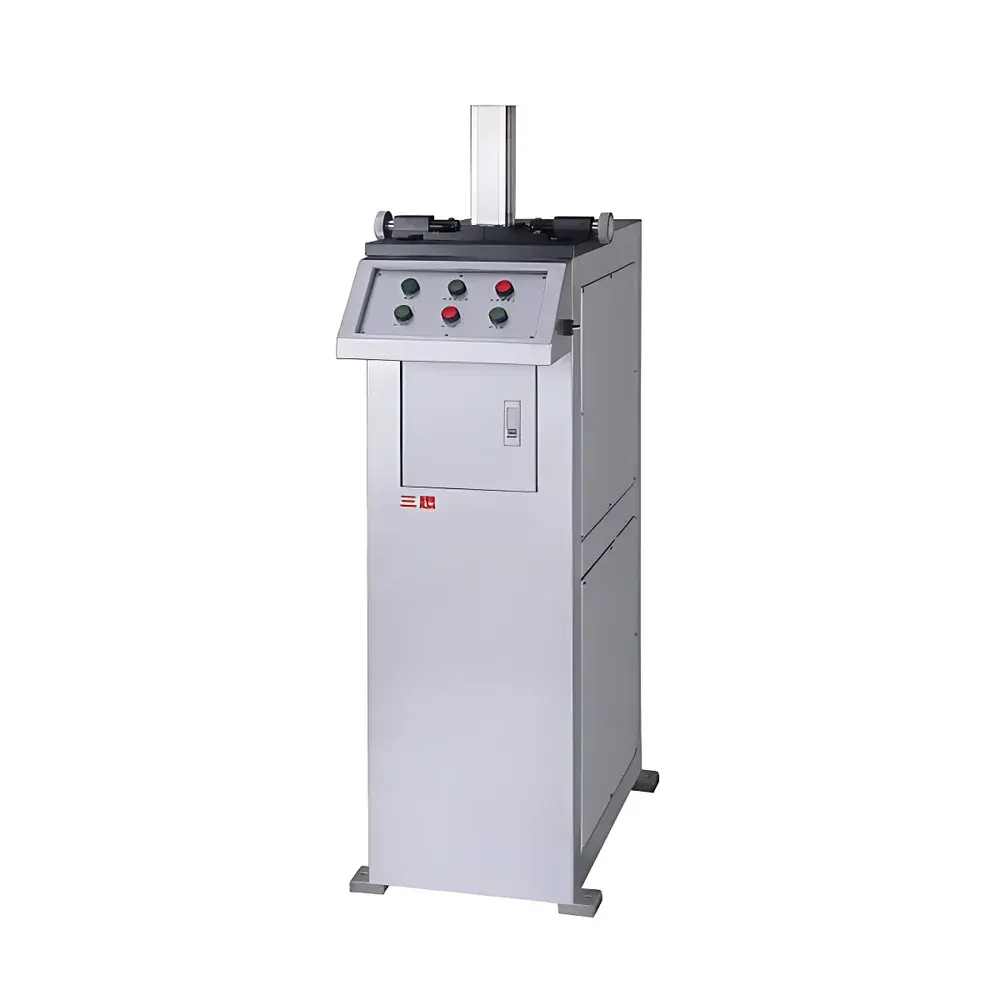
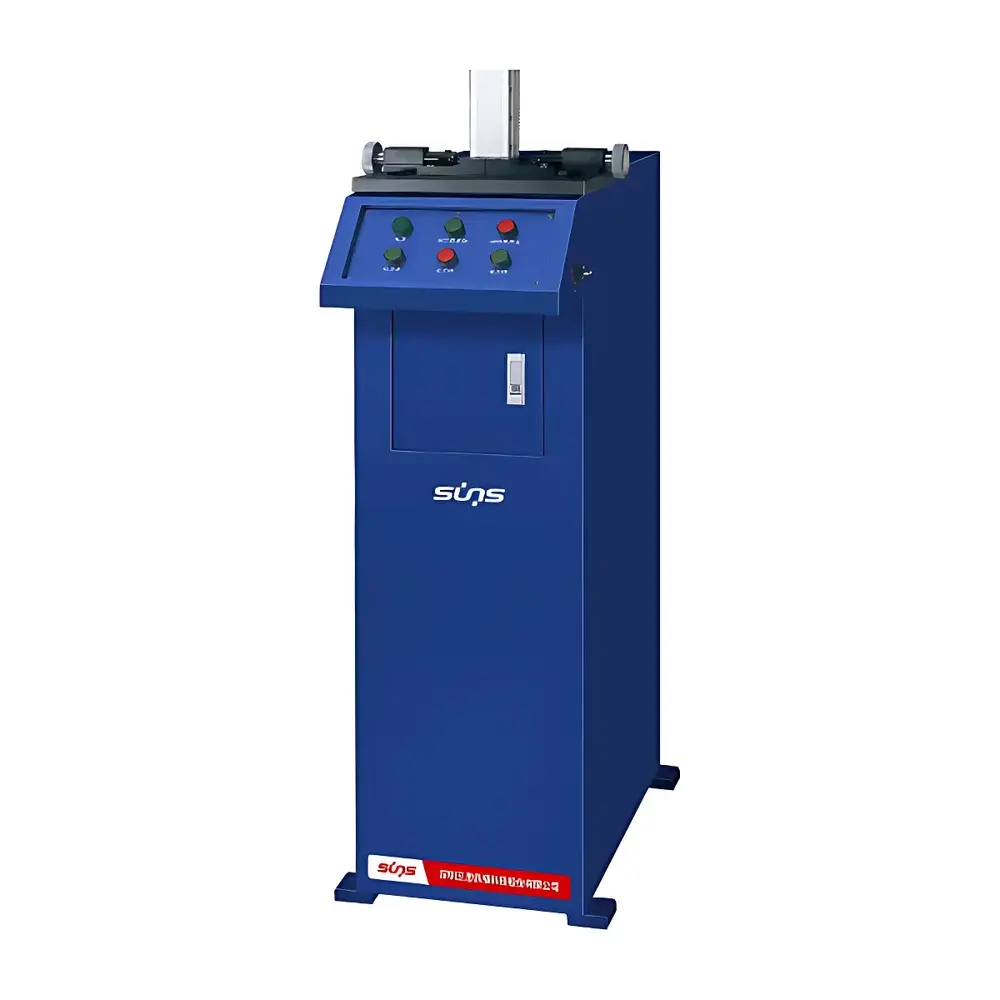
SUNS QTM3000 Charpy Impact Specimen Notching Machine
| Brand | SUNS |
|---|---|
| Origin | Guangdong, China |
| Manufacturer Type | Direct Manufacturer |
| Country of Origin | China |
| Model | QTM3000 |
| Quotation | Upon Request |
| Specimen Dimensions | 10×10 (or 7.5×7.5, 5×5) ×55 mm |
| V-Notch | Depth 2 mm, Angle 45°±2°, Radius r = 0.25 mm±0.025 mm |
| U2-Notch | Depth 2 mm, Width 2 mm, Radius r = 1 mm±0.05 mm |
| U3-Notch | Depth 3 mm, Width 2 mm, Radius r = 1 mm±0.05 mm |
| U5-Notch | Depth 5 mm, Width 2 mm, Radius r = 1 mm±0.05 mm |
| Broach Stroke | 340±10 mm |
| Broaching Speed | 2–3 m/min (stepless adjustment) |
| Lubrication System | Circulating oil supply with adjustable flow rate |
| Hydraulic Oil | L-HM46 or equivalent |
| Hydraulic Oil Capacity | ~20 L |
| Power Consumption | 500 W |
| Voltage | 3-phase 5-wire 380 V / 50 Hz ±10% |
| Overall Dimensions | 430 mm × 750 mm × 1250 mm |
| Net Weight | ~200 kg |
Overview
The SUNS QTM3000 Charpy Impact Specimen Notching Machine is a precision-engineered broaching system designed for the consistent and repeatable preparation of standardized notches in metallic impact test specimens. It operates on the principle of linear broaching—where a hardened, profiled cutting tool (broach) is drawn through the specimen under controlled hydraulic force—to produce geometrically accurate V- or U-type notches required for instrumented (oscillographic) Charpy impact testing. The machine meets dimensional and surface finish requirements specified in key international standards including ISO 148-1:2016, ASTM E23-23, GB/T 229-2020, and DIN 50115, ensuring compatibility with pendulum impact testers used in quality control, materials R&D, and third-party certification laboratories. Its robust mechanical architecture and closed-loop hydraulic actuation enable high reproducibility across batches—critical for generating statistically valid KCV, KCU, and dynamic fracture toughness data.
Key Features
- High-performance broach fabricated from W18Cr4V high-speed tool steel, optimized for hardness, wear resistance, and thermal stability during continuous operation;
- Industrial-grade hydraulic system incorporating components from globally recognized suppliers, delivering stable thrust force and precise stroke control within ±10 mm tolerance;
- Integrated circulating lubrication system with adjustable oil flow to simultaneously cool, lubricate, and flush the broach cutting edge and guide bushings—reducing thermal distortion and extending tool life while maintaining Ra ≤ 1.6 µm surface roughness in notch flanks;
- Welded structural frame built from standardized angle and channel steel sections, engineered for rigidity and vibration damping; front panel and enclosure constructed from powder-coated sheet metal for corrosion resistance and service accessibility;
- Electrical control cabinet equipped with CE-compliant PLC-based logic controllers, safety-rated emergency stop circuitry, and overload protection conforming to IEC 60204-1;
- Stepless broaching speed regulation (2–3 m/min) via variable-frequency drive, enabling process optimization for varying material hardness and notch geometry.
Sample Compatibility & Compliance
The QTM3000 accommodates standard Charpy specimens measuring 10×10×55 mm, as well as reduced-section variants (7.5×7.5×55 mm and 5×5×55 mm), supporting both V-notch (ISO/ASTM/GB compliant) and three U-notch configurations (U2, U3, U5 per DIN 50115). All notch profiles are machined to strict geometric tolerances: V-notch radius tolerance of ±0.025 mm and U-notch radius tolerance of ±0.05 mm ensure compliance with calibration traceability requirements for accredited testing laboratories. The machine supports GLP/GMP-aligned documentation practices through optional audit-trail-capable control logs (when integrated with external SCADA systems), and its mechanical repeatability supports adherence to ISO/IEC 17025 clause 6.4.3 regarding equipment suitability for intended use.
Software & Data Management
While the QTM3000 operates as a standalone electromechanical system without embedded PC-based software, its control interface provides real-time status feedback—including stroke position, cycle count, and hydraulic pressure—and supports RS-485 Modbus RTU communication for integration into centralized lab management platforms. Optional digital retrofit kits enable timestamped operation logging, cycle parameter archiving, and remote diagnostics. All operational parameters comply with FDA 21 CFR Part 11 readiness guidelines when deployed with validated third-party data acquisition modules, facilitating electronic record retention for regulatory submissions.
Applications
- Preparation of notched specimens for Charpy impact testing in metallurgical QA/QC workflows;
- Production of reference specimens for inter-laboratory round-robin studies under ISO 5725;
- Supporting failure analysis investigations requiring precise notch geometry correlation with fractographic evaluation;
- Calibration verification of pendulum impact testers per ISO 148-3:2021 Annex B;
- Routine specimen conditioning in foundries, rolling mills, and aerospace component manufacturers subject to AS9100 or EN 9100 audit requirements.
FAQ
What standards does the QTM3000 support for notch geometry verification?
It complies with dimensional specifications defined in ISO 148-1:2016 (V-notch), ASTM E23-23 (V-notch), GB/T 229-2020 (V- and U-notches), and DIN 50115 (DVM-type U-notches).
Is the broach replaceable, and are spare broaches available for different notch types?
Yes—modular broach holders accept interchangeable V-, U2-, U3-, and U5-profile broaches; all are available as genuine SUNS OEM spares with certified metrology reports.
Does the machine require compressed air or external coolant supply?
No—it uses only hydraulic power and an internal oil-lubrication circuit; no external utilities beyond 380 V AC power are required.
Can the QTM3000 be validated for ISO/IEC 17025 accreditation?
Yes—its mechanical repeatability, traceable tooling, and documented maintenance procedures align with ISO/IEC 17025:2017 clause 6.4.1; full validation packages (IQ/OQ/PQ) are available upon request.
What is the recommended maintenance interval for hydraulic oil and filtration?
Hydraulic oil should be replaced every 1,500 operating hours or biannually, whichever occurs first; the filter element must be inspected quarterly and replaced if clogged or after 1,000 hours.



