
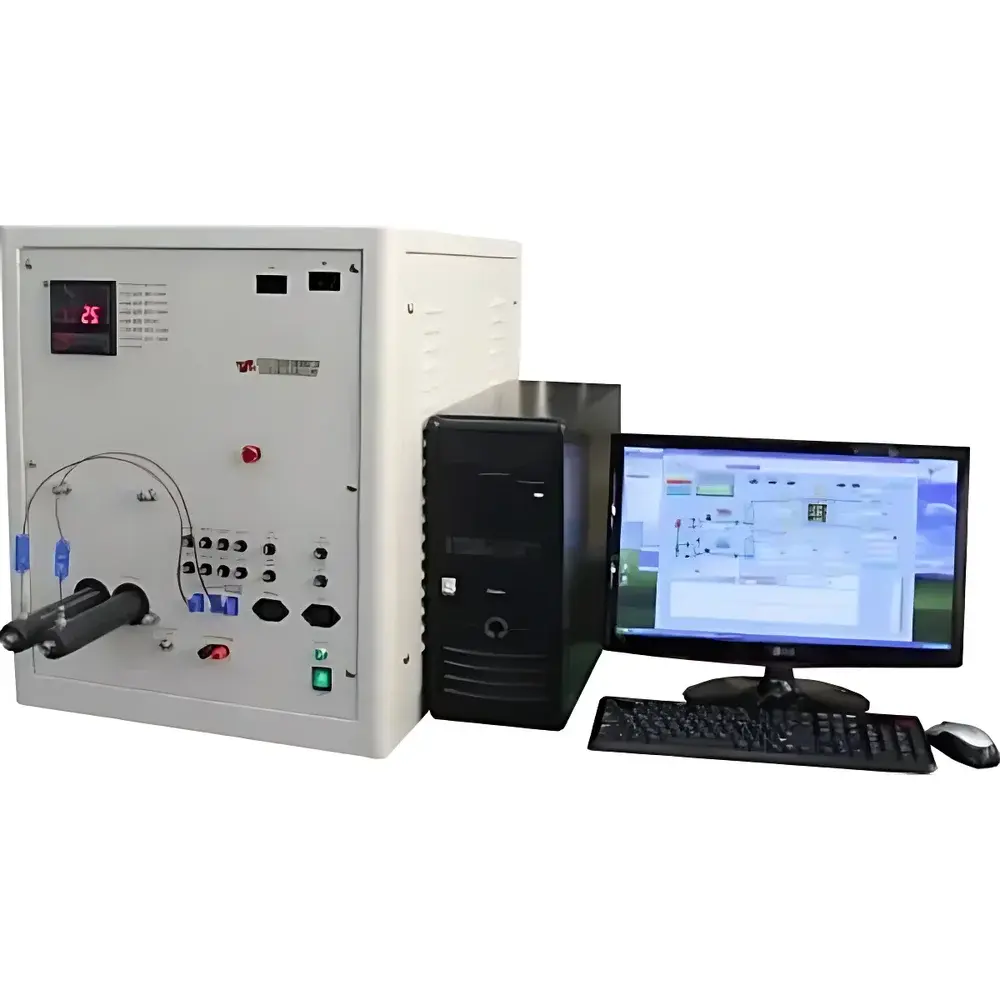
AIWEI PEMFC Fuel Cell Test Station
| Brand | AIWEI |
|---|---|
| Origin | Tianjin, China |
| Manufacturer Type | Authorized Distributor |
| Product Category | Domestic |
| Model | PEMFC Fuel Cell Test Station |
| Instrument Type | Electrochemical Workstation |
| Channel Count | Single-Channel |
| Current Range | ±80 A / ±240 A |
Overview
The AIWEI PEMFC Fuel Cell Test Station is a purpose-built, single-channel electrochemical workstation engineered for rigorous performance evaluation and durability testing of proton exchange membrane fuel cells (PEMFCs) under controlled, reproducible operating conditions. It implements a full-stack electrochemical and gas-management architecture grounded in fundamental principles of electrochemical kinetics, mass transport, and thermal-fluid dynamics. Designed for laboratory-scale R&D and quality assurance workflows, the system integrates precision current/voltage control, multi-point gas flow regulation, humidification management, backpressure modulation, and real-time thermodynamic monitoring — all synchronized via a deterministic LabVIEW-based control environment. Its architecture supports standardized polarization curve acquisition, constant-current/constant-voltage operation, cyclic loading protocols, and transient response analysis — enabling compliance with ASTM D6335, ISO 8528-10, and IEC 62282-2 test methodologies for stationary and portable PEMFC systems.
Key Features
- High-power electronic load module: dual-range operation at ±80 A / 15 V (400 W) and ±240 A / 150 V (1200 W), capable of zero-voltage discharge for cathode flooding diagnostics.
- Integrated gas delivery subsystem featuring mass flow controllers (MFCs) for anode (H₂, N₂: 500 or 1000 sccm) and cathode (air, O₂, N₂: 2000 or 5000 sccm) with independent thermal compensation and digital setpoint resolution ≤0.5% FS.
- Temperature-regulated bubbling-type humidification system with dual-sensor feedback (gas inlet temperature + water bath temperature), high-temperature float-level switch, and selectable wet-mode / bypass-mode operation to decouple relative humidity from stoichiometric ratio.
- Automated deionized water replenishment with level-triggered solenoid injection, eliminating manual refilling during extended tests (>100 h).
- Dynamic backpressure control up to 3.5 bar absolute, utilizing proportional-pressure valves with <2 kPa pressure drop at maximum flow; supports differential pressure regulation across cell inlet/outlet for both H₂ and air streams.
- In-line preheater with SUS 316 stainless steel tubing (¼” OD), direct gas temperature control (±0.5 °C accuracy), and configurable placement upstream of anode/cathode manifolds.
- Condensate management system with auto-drain water trap, passive heat sink, and active cooling fan to maintain stable dew point and prevent liquid accumulation in downstream components.
Sample Compatibility & Compliance
The station accommodates standard PEMFC membrane electrode assemblies (MEAs) with active areas of 5 cm², 10 cm², 25 cm², 50 cm², and 100 cm². Compatible hardware includes single- or triple-serpentine graphite flow fields (POCO grade) with machined land/channel geometry and integrated busbar mounting features. All fluidic interfaces conform to ISO 8573-1 Class 4 purity standards for compressed gases. The system’s data acquisition and control logic are structured to support GLP-compliant audit trails, including timestamped parameter logging, operator ID tagging, and protocol versioning — facilitating alignment with FDA 21 CFR Part 11 requirements when paired with validated LabVIEW runtime environments.
Software & Data Management
Control and data acquisition are executed through a modular LabVIEW application framework supporting real-time visualization of voltage, current, temperature gradients, pressure differentials, and MFC setpoints. The software provides built-in test templates for polarization sweeps, chronoamperometry, accelerated stress tests (ASTs), and step-load profiling. Raw DAQ data is saved in TDMS format with metadata embedding (test ID, operator, ambient conditions, calibration timestamps). Optional EIS integration enables frequency-domain characterization from 10 mHz to 10 kHz, with simultaneous HFR (high-frequency resistance) extraction and ohmic loss mapping synchronized to IV curves. Export modules support CSV, MATLAB .mat, and HDF5 formats for post-processing in Python, MATLAB, or commercial electrochemical analysis suites.
Applications
- PEMFC performance benchmarking against DOE targets (e.g., power density, voltage efficiency, H₂ utilization)
- Accelerated degradation studies under variable humidity, temperature, and load cycling profiles
- Validation of novel catalyst layers, ionomer formulations, and diffusion media under realistic gas stoichiometries
- System-level interaction analysis between humidification control, backpressure response, and water management stability
- Pre-certification testing per UL 1741, CSA C22.2 No. 107.1, and GB/T 20042 series standards
- Support for hybrid system integration studies involving DC-DC converters and balance-of-plant controllers
FAQ
What PEMFC active areas does this station support?
Standard configurations support MEAs from 5 cm² to 100 cm², with mechanical adaptability for POCO graphite bipolar plates in single- or triple-serpentine flow field patterns.
Is the system compatible with third-party impedance analyzers?
Yes — the station provides isolated analog output channels and TTL synchronization triggers, enabling hardware-level integration with external potentiostats or frequency response analyzers for advanced EIS.
Can the humidification system operate without external water supply?
No — while the station includes automatic DI water injection, it requires connection to a reservoir (minimum 2 L capacity) with gravity-fed or low-pressure pump feed.
Does the software support automated pass/fail evaluation against user-defined thresholds?
Yes — custom logic blocks can be configured in LabVIEW to evaluate voltage decay rates, HFR drift, or pressure deviation limits and generate annotated pass/fail reports.
What calibration documentation is provided?
NIST-traceable calibration certificates are supplied for all MFCs, pressure transducers, and temperature sensors, with recalibration intervals specified per ISO/IEC 17025 guidelines.






