
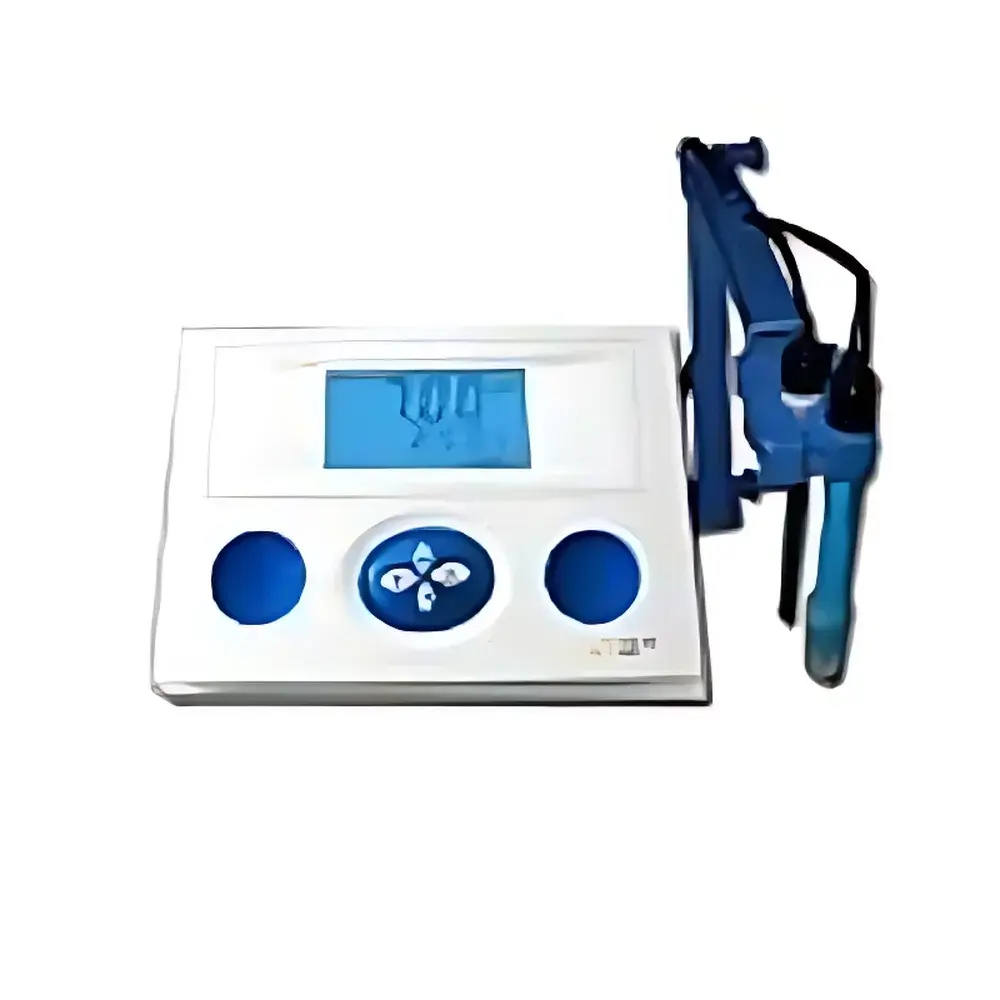
Chu Ding Technology PHS-3E Microprocessor-Controlled Digital pH Meter
| Brand | Chu Ding Technology |
|---|---|
| Origin | Shanghai, China |
| Model | PHS-3E |
| Accuracy Class | 0.01 |
| pH Range | (-2.00 to 18.00) pH |
| mV Range | ±1999 mV |
| Temperature Range | (0.0 to 99.9) °C |
| pH Resolution | 0.01 pH |
| mV Resolution | 1 mV |
| Temperature Resolution | 0.1 °C |
| pH Accuracy | ±0.01 pH ±1 digit |
| mV Accuracy | ±1 mV ±1 digit |
| Temperature Accuracy | ±0.3 °C ±1 digit |
| Input Impedance | 1 × 10¹² Ω |
| Drift Stability | ±0.01 pH ±1 digit / 3 h |
| Compatible Electrode | E-201-C pH Composite Electrode |
| Temperature Sensor | T-818-B-6 |
Overview
The Chu Ding Technology PHS-3E is a microprocessor-controlled digital pH meter engineered for precision electrochemical measurement in routine laboratory environments. It operates on the fundamental principle of potentiometric pH determination—measuring the potential difference between a pH-sensitive glass electrode and a stable reference electrode in aqueous solution, referenced to the standard hydrogen electrode (SHE) scale. Designed to meet ISO 8655-4 and IUPAC pH measurement guidelines, the PHS-3E delivers traceable, reproducible results across a wide pH range (–2.00 to 18.00), supporting both acidic and strongly alkaline applications common in pharmaceutical formulation, wastewater analysis, and quality control of buffer solutions. Its high input impedance (1 × 10¹² Ω) minimizes loading effects on high-resistance electrodes—critical for accurate measurement with aged or low-ionic-strength samples. The instrument supports dual-mode operation: direct pH/temperature or mV/temperature readout, enabling not only acidity assessment but also redox potential (Eh) evaluation and ion activity monitoring when paired with appropriate ion-selective electrodes.
Key Features
- 0.01-class accuracy certified per GB/T 11165–2022 (Chinese national standard equivalent to ISO 7888 for pH meters), ensuring metrological compliance in regulated settings
- Large dual-line LCD display with blue backlight for enhanced legibility under variable ambient lighting conditions
- Simultaneous real-time display of pH (or mV) and temperature—eliminating manual cross-referencing during calibration or sample analysis
- Two-point calibration protocol (using standard buffers at pH 4.01, 6.86, and/or 9.18) with automatic slope calculation and offset verification
- Manual and automatic temperature compensation (ATC) via integrated T-818-B-6 thermistor sensor (±0.3 °C accuracy), supporting measurements from 0.0 to 60.0 °C sample temperature
- Front-panel electrode status diagnostic function—monitors asymmetry potential and resistance to flag degraded or contaminated electrodes prior to measurement
- Low-profile recessed BNC and mini-DIN connectors reduce electrolyte creep and improve corrosion resistance in humid or aggressive chemical environments
- Robust housing design compliant with IP20 ingress protection—suitable for benchtop use in GLP-compliant laboratories and industrial QC labs
Sample Compatibility & Compliance
The PHS-3E is validated for use with standard aqueous and mildly buffered solutions across pH –2.00 to 18.00. It accommodates E-201-C combination pH electrodes—featuring a Ag/AgCl reference system, low-resistance ceramic junction, and pH-sensitive lithium-aluminosilicate glass membrane—optimized for general-purpose applications including process water, fermentation broths, cleaning validation swabs, and titration endpoints. While not designed for non-aqueous solvents (e.g., ethanol, DMSO) or highly viscous suspensions without dilution, its high input impedance enables reliable readings in low-conductivity samples such as deionized water or ultrapure rinse solutions. The instrument conforms to electromagnetic compatibility requirements per GB/T 18268.1–2010 (equivalent to IEC 61326-1) and meets safety standards per GB 4793.1–2007 (IEC 61010-1). Documentation includes factory calibration certificate traceable to NIM (National Institute of Metrology, China).
Software & Data Management
As a standalone benchtop instrument, the PHS-3E does not feature onboard data logging or USB connectivity. However, its analog output (0–20 mA or 4–20 mA optional via external module) and stable DC signal enable integration into SCADA systems or centralized LIMS via analog-to-digital converters. All calibration events—including date/time stamp, buffer IDs, slope (%), and offset (mV)—are retained in non-volatile memory for audit purposes. The unit supports GLP-aligned recordkeeping: users may manually log calibration records using standardized lab notebooks referencing internal instrument ID and serial number. For facilities requiring 21 CFR Part 11 compliance, third-party data acquisition software (e.g., LabVIEW or custom Python scripts with RS232 adapters) can be deployed to capture timestamped readings and generate electronic signatures—though native electronic audit trails are not embedded.
Applications
- Quality assurance testing of pharmaceutical excipients and final dosage forms per USP and EP 2.2.3
- pH monitoring in bioreactor feed streams and harvest buffers during upstream processing
- Environmental compliance testing of effluent discharge per EPA Method 150.1 and ISO 10523
- Educational laboratories for teaching electrochemical fundamentals, calibration theory, and uncertainty propagation
- Food safety labs verifying acidification efficacy in canned goods (FDA 21 CFR 114) and dairy product stability
- Chemical manufacturing QC for catalyst slurries, surfactant formulations, and etchant bath control
FAQ
What is the recommended calibration frequency for routine use?
For daily operation in a controlled lab environment, two-point calibration before first use and after electrode replacement is required; recalibration is advised if drift exceeds ±0.02 pH over 3 hours or when measuring critical samples.
Can the PHS-3E measure pH in non-aqueous solvents?
No—it is validated only for aqueous and aqueous-organic mixtures with conductivity >50 µS/cm; use requires specialized electrodes and empirical correction factors beyond manufacturer specifications.
Is the E-201-C electrode compatible with hot samples above 60 °C?
No—the maximum operating temperature for the E-201-C is 60 °C; prolonged exposure above this threshold accelerates glass membrane hydration and reference junction clogging.
Does the instrument support automatic buffer recognition?
No—buffer values must be manually entered during calibration; auto-recognition is not implemented in firmware.
How is measurement uncertainty estimated for the PHS-3E?
Combined standard uncertainty (k=2) is typically ±0.02 pH under optimal conditions, derived from contributions of calibration error (±0.005 pH), instrument resolution (±0.005 pH), temperature compensation error (±0.005 pH), and electrode asymmetry (±0.005 pH).




