
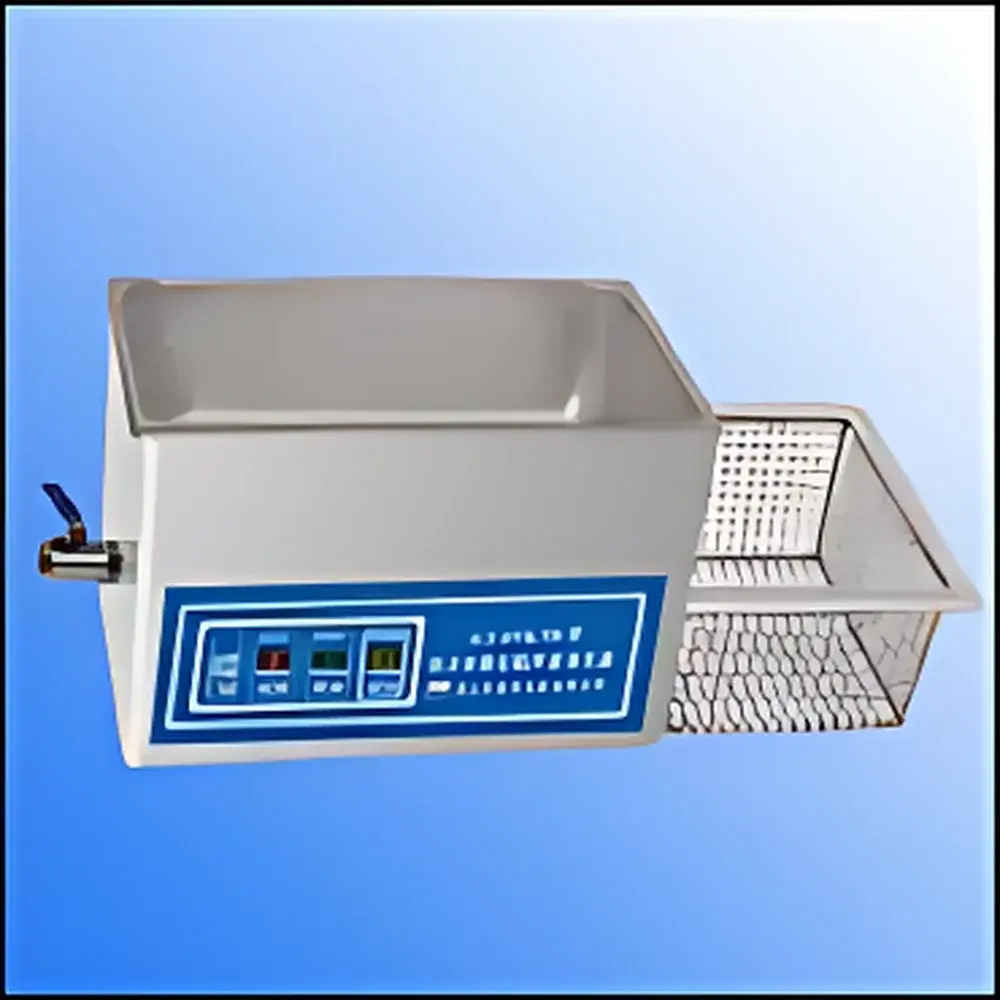
Chu Ding KQ-500VDE Benchtop Dual-Frequency Digital Ultrasonic Cleaner
| Brand | Chu Ding |
|---|---|
| Origin | Shanghai, China |
| Model | KQ-500VDE |
| Dimensions (L×W×H) | 530×320×380 mm |
| Tank Internal Dimensions (L×W×H) | 500×300×150 mm |
| Capacity | 22.5 L |
| Adjustable Ultrasonic Frequencies | 28 kHz |
| Ultrasonic Power Output | 500 W |
| Power Adjustment Range | 40–100 % |
| Heating Power | 1000 W |
| Temperature Control Range | 20–80 °C |
| Stainless Steel Mesh Basket | Yes |
| Sound-Dampening Lid | Yes |
| Drain Valve | Yes |
| Construction | 304 Stainless Steel Tank & Housing |
| Control System | Microprocessor-Based Digital Interface |
| Safety Features | Low-Level Liquid Protection, Over-Temperature Cutoff |
Overview
The Chu Ding KQ-500VDE Benchtop Dual-Frequency Digital Ultrasonic Cleaner is engineered for laboratories requiring high-precision, repeatable cleaning across diverse sample types and contamination profiles. Utilizing piezoelectric transducer technology operating at two independently selectable frequencies—28 kHz for robust macro-particle removal and 45 kHz for finer particulate and sub-micron contaminant dislodgement—the system delivers controlled cavitation energy distribution within the cleaning bath. Unlike single-frequency units, dual-frequency operation mitigates standing wave formation and ensures uniform energy density across the entire tank volume, significantly improving cleaning consistency—especially critical for delicate optics, microfluidic components, precision machined parts, and biological substrates. The unit integrates a fully digital microprocessor control architecture with real-time feedback loops for ultrasonic output, temperature regulation, and timing accuracy—enabling compliance with method-defined protocols in GLP, ISO/IEC 17025, and ASTM D2601-22 (Standard Practice for Cleaning and Degreasing of Metals Prior to Testing). Its compact benchtop footprint (530 × 320 × 380 mm) and 22.5 L stainless steel tank make it suitable for QC labs, R&D facilities, and university teaching environments where space efficiency and operational reliability are paramount.
Key Features
- Dual-frequency ultrasonic generation (28 kHz and 45 kHz) with independent frequency selection and simultaneous or alternating mode capability
- 500 W total ultrasonic power output, distributed across multiple high-efficiency piezoelectric transducers (50 W per transducer)
- Precision digital temperature control (20–80 °C ±1 °C) with 1000 W heating element and PID-based regulation
- Programmable cleaning cycles: adjustable duration (1–999 min), power level (40–100 %), and temperature setpoint with auto-hold function
- Integrated safety systems: automatic shutdown on low liquid level detection, over-temperature cutoff, and dry-run protection
- 304 stainless steel tank and housing with seamless deep-drawn construction; corrosion-resistant, non-porous, and compliant with ISO 15195 (laboratory equipment material requirements)
- Sound-dampening hinged lid with integrated gasket reduces ambient noise to ≤65 dB(A) at 1 m distance—meeting OSHA 29 CFR 1910.95 workplace exposure guidelines
- Drain valve with quick-connect fitting enables safe, residue-free solution exchange without manual tipping or siphoning
Sample Compatibility & Compliance
The KQ-500VDE accommodates a broad range of sample geometries and materials—including glassware (vials, cuvettes, chromatography columns), metal components (surgical instruments, calibration standards), ceramics, silicon wafers, and polymer-based labware—without compromising structural integrity. Its dual-frequency cavitation profile minimizes pitting and surface erosion on soft metals (e.g., aluminum, brass) and brittle substrates (e.g., quartz, borosilicate). All wetted surfaces meet USP material compatibility criteria for laboratory use. The unit supports validation documentation packages required under FDA 21 CFR Part 11 (electronic records and signatures) when paired with validated SOPs and audit-trail-enabled data logging software. It conforms to IEC 61000-6-3 (EMC emissions) and IEC 61010-1 (safety requirements for electrical equipment for measurement, control, and laboratory use).
Software & Data Management
While the KQ-500VDE operates via an embedded microcontroller interface with LED-based parameter display, it supports optional RS-232 or USB-to-serial connectivity for integration into centralized lab management systems. Third-party software (e.g., LabVIEW-compatible drivers or custom Python scripts using PySerial) can log timestamped parameters—including actual bath temperature, elapsed time, selected frequency, and power percentage—for traceability and process reproducibility. All settings are retained in non-volatile memory after power cycling, eliminating reconfiguration between runs. For regulated environments, users may implement electronic batch records aligned with Annex 11 (EU GMP) or ALCOA+ principles through external documentation workflows.
Applications
- Pre-analytical sample preparation: removal of organic residues from HPLC vials, GC liners, and autosampler needles
- Surface decontamination of electron microscopy grids and TEM specimens prior to coating
- De-gassing of solvents and mobile phases to eliminate bubble formation in flow-based systems
- Cell lysis and homogenization support for proteomics workflows (e.g., protein extraction from tissue lysates)
- Ultrasonic-assisted solvent extraction of plant metabolites and environmental analytes
- Removal of photoresist residues and etch byproducts from semiconductor wafers during R&D prototyping
- Validation of cleaning efficacy per ISO 15883-5 (washer-disinfectors) and ASTM E2556-21 (verification of cleaning processes)
FAQ
What is the difference between 28 kHz and 45 kHz operation, and how do I select the appropriate frequency?
28 kHz generates larger, more energetic cavitation bubbles suited for heavy particulates and tenacious organic films. 45 kHz produces smaller, higher-density bubbles ideal for fine particles, micro-contaminants, and delicate surfaces. Selection depends on substrate hardness, contaminant type, and required surface finish.
Does the unit include calibration documentation or traceable certificates?
Factory calibration certificates for temperature and timer accuracy are available upon request. Users must perform periodic verification per ISO/IEC 17025 Clause 6.6 using NIST-traceable thermometers and stopwatches.
Can this cleaner be used with flammable solvents?
No. The KQ-500VDE is designed exclusively for aqueous or water-miscible solutions. Use in flammable solvent environments violates IEC 61010-1 explosion safety requirements and voids warranty.
Is the stainless steel mesh basket compatible with ultrasonic cavitation at full power?
Yes. The 304 stainless steel basket is arc-welded and stress-relieved to withstand sustained 500 W operation without resonance-induced fatigue or deformation.
How often should the ultrasonic tank be descaled or maintained?
Descaling with 5–10 % citric acid solution is recommended every 200 operating hours or when visible mineral buildup occurs. Transducer performance should be verified annually using acoustic emission monitoring per ASTM E1192.



