
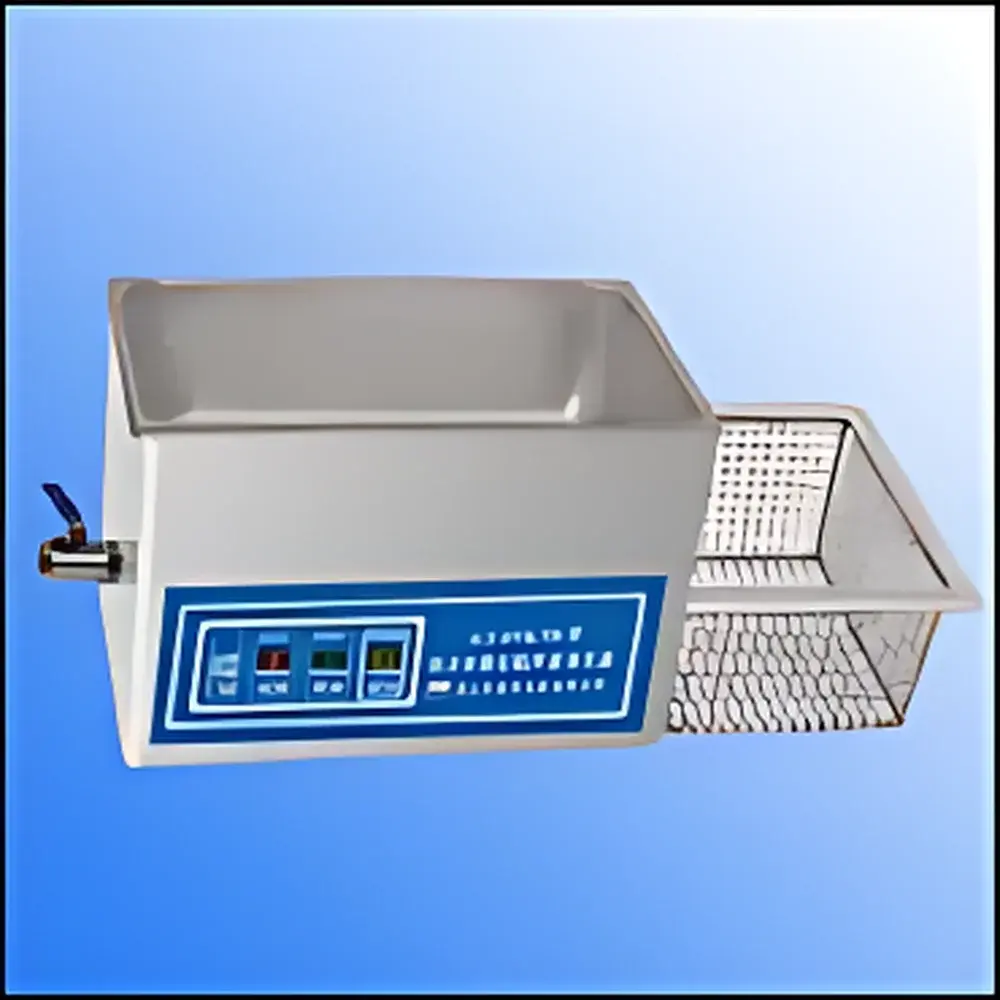
Chu Ding KQ-100DE Digital Ultrasonic Cleaner
| Brand | Chu Ding Technology |
|---|---|
| Origin | Shanghai, China |
| Model | KQ-100DE |
| Dimensions (W×D×H) | 320×174×280 mm |
| Tank Interior (L×W×H) | 300×150×100 mm |
| Capacity | 4 L |
| Ultrasonic Frequency | 40 kHz |
| Ultrasonic Power Output | 100 W |
| Power Adjustment Range | 40–100 % |
| Heating Power | 600 W |
| Temperature Control Range | 20–80 °C |
| Timer Range | 1–480 min |
| Features | Stainless steel mesh basket, sound-dampening lid, drain valve, digital LED display with real-time monitoring of temperature, power, time, and fault status |
Overview
The Chu Ding KQ-100DE Digital Ultrasonic Cleaner is a benchtop laboratory instrument engineered for precision cleaning, degassing, dispersion, emulsification, and cell disruption in research, quality control, and analytical laboratories. It operates on the principle of high-frequency ultrasonic cavitation—where 40 kHz acoustic energy generates microscopic vacuum bubbles in liquid media that rapidly collapse, producing localized shockwaves and microstreaming. This physical mechanism enables non-contact, uniform removal of particulate contaminants, organic residues, and biofilms from delicate substrates—including optical components, semiconductor wafers, surgical instruments, glassware, and biological samples—without mechanical abrasion or chemical aggression. The unit integrates transducer arrays directly into the stainless-steel tank base, ensuring stable energy coupling and consistent acoustic field distribution across the 4 L working volume. Its compact footprint (320 × 174 × 280 mm) and sealed, sound-dampened enclosure meet ISO 14644-1 Class 7 cleanroom-compatible operational requirements for low-noise environments.
Key Features
- Digital LED interface with simultaneous real-time display of set/actual temperature, ultrasonic power level (%), elapsed operating time, and remaining timer duration
- Programmable parameters: ultrasonic duration (1–480 min), heating temperature (20–80 °C), and power output (40–100 %)
- Integrated safety monitoring system with visual indicators for over-temperature, over-voltage, over-current, and low-water-level conditions
- Stainless steel (304 grade) tank interior formed by deep-drawn stamping; corrosion-resistant and compliant with ASTM A240 standards
- Removable stainless steel mesh basket fabricated via argon arc welding for structural integrity and uniform sample support
- Acoustic isolation lid with elastomeric sealing gasket reduces operational noise to ≤55 dB(A) at 1 m distance, meeting OSHA 29 CFR 1910.95 workplace exposure limits
- Drain valve positioned at tank bottom for rapid, residue-free solution exchange—critical for multi-step cleaning protocols requiring solvent transitions
- Microcontroller-based firmware with non-volatile memory retains user-defined settings and logs cumulative operational hours (up to 999,999 h) for maintenance scheduling and GLP traceability
Sample Compatibility & Compliance
The KQ-100DE accommodates a broad range of sample types and geometries: glass vials, metal fixtures, ceramic substrates, polymer molds, microfluidic chips, and tissue culture plates up to 120 mm in diameter. Its 300 × 150 × 100 mm tank interior permits immersion of standard ANSI/SLAS-format microplates without obstruction. The unit complies with IEC 61000-6-3 (EMC emissions) and IEC 61000-6-2 (immunity), and its heating and timing functions satisfy the functional safety criteria outlined in ISO/IEC 17025:2017 clause 6.4.3 for equipment used in accredited testing laboratories. While not certified for medical device reprocessing under ISO 15883, it supports preparatory cleaning steps aligned with AAMI ST79 Annex D and USP guidelines for reusable instrument decontamination prior to sterilization.
Software & Data Management
The KQ-100DE operates autonomously via embedded firmware with no external PC dependency. All operational data—including start/stop timestamps, temperature profiles, power modulation sequences, and fault event logs—are stored in internal EEPROM with timestamped entries. Cumulative runtime tracking enables predictive maintenance planning per ISO 55001 asset management principles. Though lacking USB or Ethernet connectivity, the device supports audit-ready documentation through manual logbook entry using displayed parameters. For labs implementing 21 CFR Part 11 compliance, the unit may be integrated into broader electronic lab notebook (ELN) workflows via operator-recorded digital logs referencing unique session IDs derived from the serial number and timestamp.
Applications
- Pre-analytical sample preparation: removal of residual solvents from HPLC vials and GC autosampler trays
- Surface activation of PDMS microfluidic devices prior to plasma bonding
- Extraction of intracellular metabolites from lysed bacterial cultures (e.g., E. coli, S. cerevisiae)
- Degassing of viscous polymer solutions (e.g., SU-8, photoresists) to eliminate void formation during spin coating
- Cleaning of electron microscopy grids and TEM specimen holders to minimize carbon contamination
- Disaggregation of nanoparticle agglomerates in colloidal suspensions for DLS and zeta potential analysis
- Routine decontamination of pipette tips, forceps, and tweezers in biosafety Level 2 (BSL-2) containment areas
FAQ
What is the recommended cleaning solution for use with the KQ-100DE?
Aqueous alkaline detergents (pH 9–11) or low-surface-tension ethanol/water mixtures are optimal. Avoid halogenated solvents unless confirmed compatible with 304 stainless steel and the unit’s seals.
Can the KQ-100DE operate without heating enabled?
Yes. Heating is fully independent of ultrasonic activation; the unit supports cold sonication only, critical for thermolabile samples such as proteins or plasmid DNA.
Is the stainless steel mesh basket autoclavable?
Yes—the 304 stainless steel basket withstands standard 121 °C, 15 psi autoclave cycles; however, repeated sterilization may accelerate surface passivation and reduce long-term cavitation efficiency.
How often should the tank water be changed during continuous operation?
For reproducible results, replace the bath fluid after each use or every 8 hours of cumulative operation to prevent accumulation of suspended particulates and dissolved organics that attenuate acoustic energy.
Does the KQ-100DE meet CE or UL safety certification requirements?
The unit conforms to general safety principles of IEC 61010-1 (Laboratory Equipment), but formal CE marking or UL listing is not held; end users must verify local regulatory acceptance based on risk assessment per ISO 14971.



