
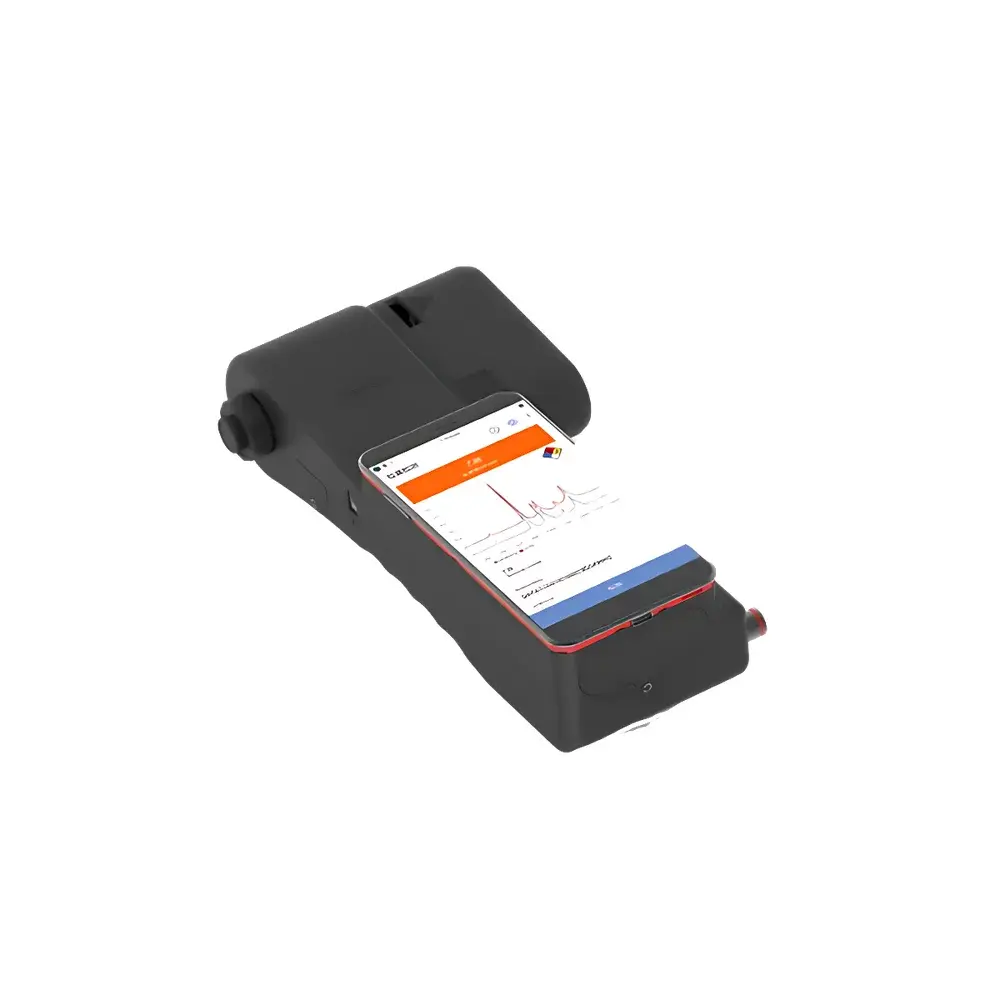
CloudOptek T1 Handheld Nuclear-Biological-Chemical (NBC) Integrated Detection System
| Brand | CloudOptek |
|---|---|
| Origin | Beijing, China |
| Manufacturer Type | Original Equipment Manufacturer (OEM) |
| Product Category | Domestic |
| Model | T1 |
| Instrument Type | Portable Raman Spectrometer with Integrated Radiation & Explosives Detection |
| Detection Modalities | Scintillation-based Gamma/Neutron Radiation Monitoring |
Overview
The CloudOptek T1 Handheld Nuclear-Biological-Chemical (NBC) Integrated Detection System is an engineered field-deployable analytical platform designed for first responders, border security personnel, and hazardous materials (HAZMAT) teams requiring simultaneous, real-time tri-modal threat assessment. Unlike conventional single-modality instruments, the T1 integrates three complementary physical detection principles into a single ergonomic handheld form factor: scintillation-based ionizing radiation detection (gamma and fast neutron), fluorescence quenching–based trace explosives screening, and confocal spatially coupled Raman spectroscopy for molecular identification. Its architecture adheres to the operational paradigm of “screen-then-identify”: rapid non-intrusive primary screening via radiation and fluorescence channels triggers secondary confirmatory analysis using Raman spectroscopy—enabling decision-making within seconds under dynamic field conditions. The system operates without sample preparation, external calibration standards, or consumables, and maintains measurement integrity across ambient temperature (−10 °C to 50 °C), humidity (10–90% RH non-condensing), and moderate vibration environments typical of mobile deployment.
Key Features
- Triple-sensor fusion architecture: Independent yet synchronized operation of NaI(Tl)/He-3 scintillation detector (radiation), polymer-based fluorescent sensor array (explosives), and 785 nm diode laser–driven Raman spectrometer (chemical ID)
- Radiation channel: <2 s response time for moving radioactive sources; configurable dose rate alarm thresholds (0.1–100 µSv/h); cumulative dose logging with ISO 4037-compliant energy compensation
- Explosives screening: Sub-nanogram sensitivity to nitroaromatics (e.g., TNT, DNT), nitramines (RDX), and peroxides (HMTD) via reversible fluorescence quenching; wipe/suction sampling compatible; no false positives from common interferents (e.g., cosmetics, lotions, food residues)
- Raman module: Confocal optical design with spatial direct coupling; spectral range 200–2500 cm⁻¹; resolution ≤8 cm⁻¹; acquisition time <5 s per spectrum; detection limit: 5% v/v acetone (5 µL liquid) or 5 mg solid residue
- Onboard AI-assisted spectral deconvolution: Hybrid algorithm combining peak-matching (NIST RMF library, >12,000 entries) with multivariate curve resolution (MCR) for quantitative estimation of up to three-component mixtures
- Ruggedized IP65-rated magnesium alloy chassis; 2.8 kg total mass; 8-hour battery life (Li-ion, hot-swappable); MIL-STD-810G shock/vibration certified
Sample Compatibility & Compliance
The T1 supports non-contact and minimally invasive sampling protocols compliant with international CBRN field response guidelines. Solid samples (powders, crystals, residues) are analyzed in situ using the integrated solid-sampling cap; liquids (aqueous/organic solvents, suspensions) require only 5 µL volume placed on the hydrophobic quartz window. For explosives screening, surface wipes (cellulose or polyester swabs) or headspace air sampling (via built-in micro-pump) are validated per ASTM E2412 and ICAO Annex 17 Appendix D. Radiation measurements conform to IEC 60846-1:2014 for portable survey meters. All firmware and data handling modules support audit-ready GLP/GMP-aligned metadata tagging—including operator ID, GPS coordinates, timestamp (UTC-synced), environmental parameters, and instrument self-diagnostic logs.
Software & Data Management
The T1 runs CloudOptek’s proprietary NBC-Suite v3.2 firmware, featuring a touchscreen GUI optimized for gloved operation. Spectral data, radiation dose logs, and fluorescence event timestamps are stored locally in encrypted SQLite3 databases (AES-256). Wireless export (Wi-Fi 5 / Bluetooth 5.0) enables secure transmission to central command systems via TLS 1.3–secured API endpoints. The software includes FDA 21 CFR Part 11–compliant electronic signature capability, role-based access control (RBAC), and immutable audit trails for all user actions and result modifications. Remote firmware updates and spectral library expansions are delivered through CloudOptek’s ISO 27001–certified cloud infrastructure.
Applications
- Border and customs inspection: Simultaneous radiation portal monitoring + explosive trace detection + illicit chemical verification without baggage opening
- Urban search and rescue (USAR): Rapid identification of radiological dispersal devices (RDDs), improvised explosive devices (IEDs), and industrial toxicants (e.g., organophosphates, cyanides) at incident scenes
- Military CBRN reconnaissance: Forward-deployed unit-level threat characterization with geotagged reporting for joint operational picture (JOP) integration
- Pharmaceutical and fine chemical manufacturing: In-line verification of raw material identity and purity (per USP and Ph. Eur. 2.2.48)
- Environmental emergency response: Field quantification of petroleum hydrocarbons, PCBs, and pesticide residues in soil/water matrices
FAQ
Does the T1 require annual recalibration by a certified lab?
No. The system employs factory-traceable internal reference standards (silicon Raman peak at 520.7 cm⁻¹, cobalt-60 gamma line at 1173.2 keV) and performs automated daily self-checks. Full metrological validation is recommended every 24 months per ISO/IEC 17025:2017.
Can the Raman module identify unknown substances not in its library?
Yes. The hybrid algorithm generates structural descriptors (functional group fingerprints, bond order estimates) and reports similarity scores against the full NIST RMF database; novel compounds trigger manual review mode with raw spectral export (CSV, JCAMP-DX).
Is the fluorescence explosives sensor reusable after exposure?
Yes. The conjugated polymer film undergoes full optical recovery within 60 seconds post-exposure under ambient airflow; lifetime exceeds 10,000 detection cycles per sensor cartridge.
How does the system handle mixed radiation fields (e.g., gamma + neutron)?
The dual-detector configuration (NaI(Tl) + He-3 proportional tube) enables real-time pulse-shape discrimination (PSD) and simultaneous dose rate reporting for each component, referenced to ICRP Publication 116 radiation weighting factors.
What regulatory documentation is provided with shipment?
Each unit ships with a Certificate of Conformance (CoC), Factory Calibration Report (traceable to NIM Beijing), CE Declaration of Conformity (2014/30/EU EMC Directive), and RoHS 2011/65/EU compliance statement.




