
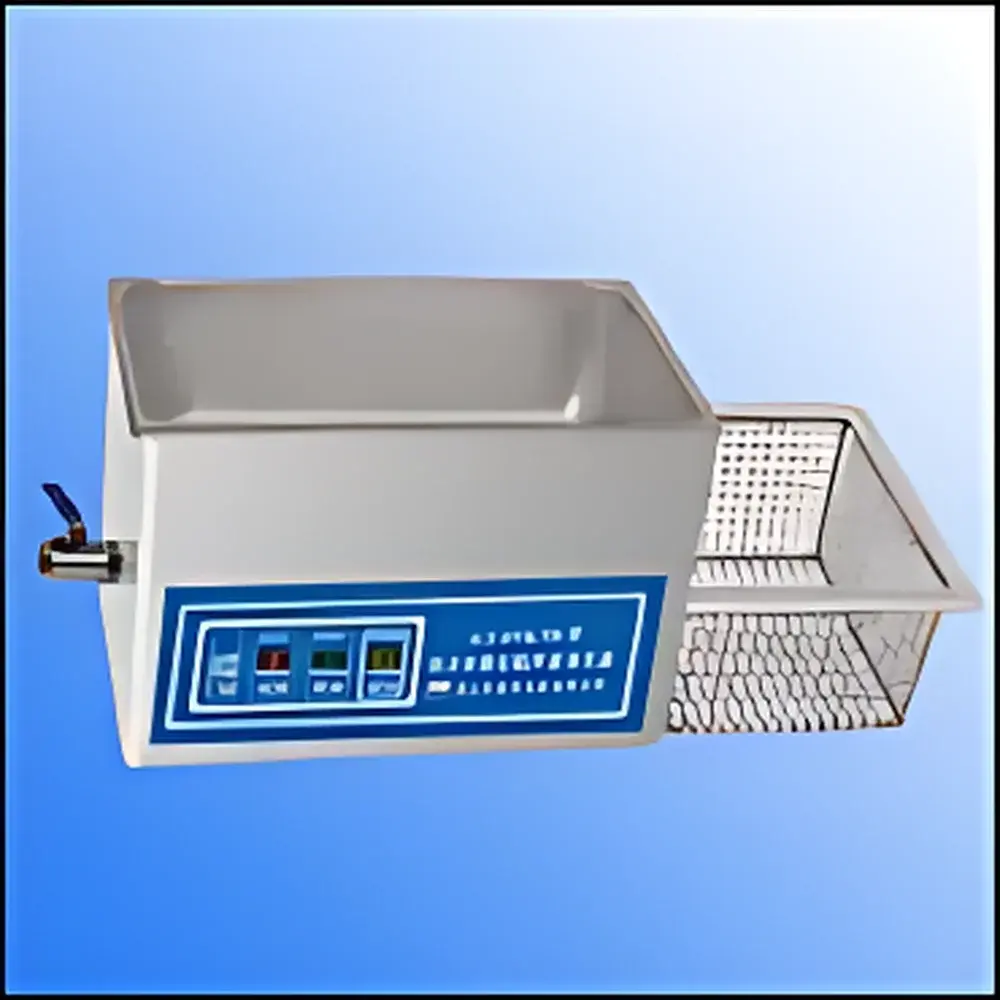
Chu Ding KQ-300DE / KQ-300DB / KQ-300DV Benchtop Digital Ultrasonic Cleaner
| Brand | Chu Ding |
|---|---|
| Origin | Shanghai, China |
| Model | KQ-300DE / KQ-300DB / KQ-300DV |
| Capacity | 10 L |
| Ultrasonic Frequency | 40 kHz |
| Ultrasonic Power | 300 W |
| Power Adjustment Range | 40–100 % |
| Heating Power | 600 W (KQ-300DB & KQ-300DE/DV) |
| Temperature Control Range | 20–80 °C |
| Timer Range | 1–480 min |
| Tank Dimensions (L×W×H) | 300×240×150 mm |
| External Dimensions (L×W×H) | 320×264×340 mm (KQ-300DE), 320×264×320 mm (KQ-300DB), 410×350×380 mm (KQ-300DV) |
Overview
The Chu Ding KQ-300DE, KQ-300DB, and KQ-300DV are precision-engineered benchtop digital ultrasonic cleaners designed for reproducible, high-efficiency cleaning in academic laboratories, quality control environments, and R&D facilities. These units operate on the principle of piezoelectric ultrasonic cavitation: a 40 kHz transducer array generates high-frequency mechanical vibrations transmitted through liquid media, inducing controlled microbubble formation and collapse (cavitation) that dislodges particulate contaminants, organic residues, and biofilms from surfaces without mechanical abrasion. Each transducer delivers 50 W of focused acoustic energy, resulting in a total nominal output of 300 W across the 10 L stainless steel tank (300 × 240 × 150 mm internal). The integrated digital control system enables precise regulation of ultrasonic intensity (40–100% adjustable), heating (20–80 °C, ±1 °C stability), and timing (1–480 minutes), supporting standardized cleaning protocols aligned with ASTM D2609, ISO 13485 surface cleanliness requirements, and GLP-compliant documentation workflows.
Key Features
- Microprocessor-controlled operation with real-time digital display of elapsed time, set time, bath temperature, actual temperature, power level, and cumulative operating hours (up to 999,999 h)
- Stainless steel construction throughout: AISI 304 tank, reinforced housing, and argon-welded stainless mesh basket for corrosion resistance and long-term dimensional stability
- Dual safety architecture: automatic low-level fluid detection, over-temperature, over-voltage, and over-current protection with visual alarm indicators
- Configurable thermal management: KQ-300DB includes 600 W heating; KQ-300DE adds insulated sound-dampening lid; KQ-300DV integrates a sealed volatile solvent recovery system compliant with OSHA 1910.120 and EPA solvent handling guidelines
- Modular design supports routine maintenance: accessible transducer mounting, removable basket, and optional drain valve (standard on DB/DE/DV variants)
- EMC-compliant power supply meeting IEC 61326-1 for laboratory electromagnetic environment compatibility
Sample Compatibility & Compliance
These cleaners accommodate a broad range of sample geometries—including glassware (vials, cuvettes, pipettes), metal components (surgical instruments, calibration standards), ceramic substrates, and polymer-based microfluidic devices—without risk of surface pitting or etching when operated within recommended parameters. The 40 kHz frequency balances penetration depth and cavitation intensity, making it suitable for delicate optics and MEMS devices as well as robust industrial parts. All models conform to CE marking requirements under the EU Machinery Directive 2006/42/EC and Low Voltage Directive 2014/35/EU. The KQ-300DE and KQ-300DV variants support audit-ready operation via timestamped event logging (power-on, start, stop, fault), satisfying FDA 21 CFR Part 11 data integrity prerequisites when paired with validated SOPs.
Software & Data Management
While these models operate via embedded firmware (not PC-connected software), their digital interface provides traceable parameter recording: each cycle stores setpoints (temperature, duration, power), real-time sensor feedback, and fault codes in non-volatile memory. Cumulative runtime tracking enables predictive maintenance scheduling per ISO 13374 condition monitoring standards. For regulated environments, users may integrate external data loggers via RS-232 (optional module) to capture time-stamped temperature and power profiles for IQ/OQ validation reports. The system’s deterministic behavior—repeatable cavitation onset, consistent thermal ramp rates, and stable frequency output—ensures inter-laboratory method transferability per CLSI EP15-A3 guidelines.
Applications
- Pre-analytical sample preparation: removal of residual proteins, lipids, and nucleic acid carryover from HPLC vials, autosampler needles, and electrophoresis combs
- Medical device reprocessing: cleaning of endoscopic channels, dental handpieces, and orthopedic implants prior to sterilization validation (per AAMI ST91)
- Materials science: deburring of sintered metal powders, dispersion of nanomaterials in suspension, and surface activation of carbon fiber substrates
- Electronics manufacturing: flux residue removal from PCB assemblies and ultrasonic-assisted wire bonding surface conditioning
- Pharmaceutical QC: cleaning of dissolution apparatus baskets, tablet friability testers, and stainless steel contact parts in accordance with USP and
FAQ
What is the difference between KQ-300DB, KQ-300DE, and KQ-300DV?
The KQ-300DB includes heating and a drain valve; the KQ-300DE adds a sound-dampening lid for noise reduction; the KQ-300DV incorporates a sealed volatile solvent recovery system for use with flammable or regulated solvents.
Is the ultrasonic frequency fixed at 40 kHz?
Yes—these models utilize a single-frequency 40 kHz transducer array optimized for general-purpose cleaning efficiency and penetration depth across aqueous and mild solvent systems.
Can the unit be used for degassing solutions?
Yes—controlled low-power operation (40–60%) for 5–15 minutes effectively removes dissolved air from HPLC mobile phases, cell culture media, and resin solutions.
Does the stainless steel tank resist corrosion from alkaline or acidic cleaning solutions?
AISI 304 stainless steel provides adequate resistance to pH 2–12 solutions at temperatures ≤60 °C; prolonged exposure to halide-containing or strongly oxidizing agents requires post-cycle rinsing with deionized water.
How is calibration verified for temperature and timer functions?
Temperature accuracy is confirmed using NIST-traceable PT100 probe immersion at tank center; timer accuracy is validated via independent stopwatch measurement over ≥10 consecutive 30-minute cycles, with deviation ≤±0.5%.



