
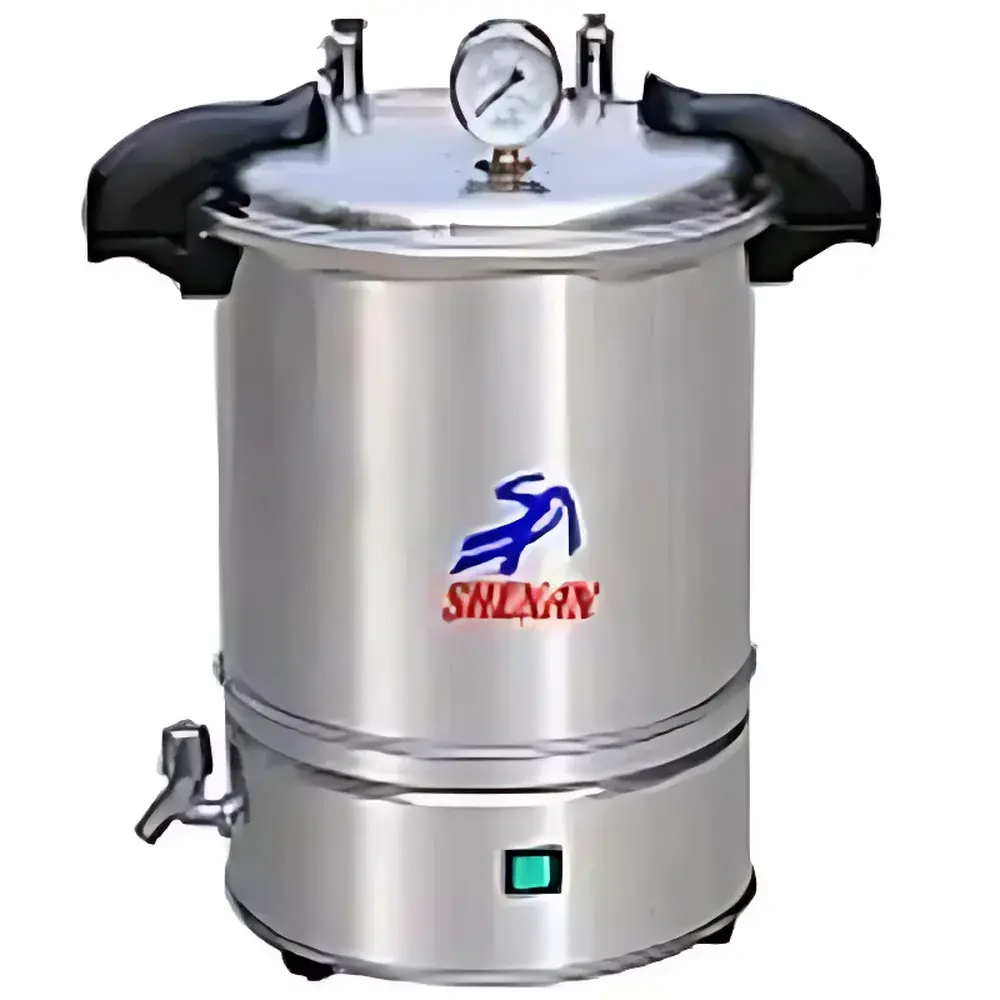
Chu Ding SYQ-DSX-280A Portable Stainless Steel Steam Autoclave
| Brand | Chu Ding |
|---|---|
| Origin | Shanghai, China |
| Manufacturer Type | Authorized Distributor |
| Country of Origin | China |
| Model | SYQ-DSX-280A |
| Capacity | 18 L |
| Power Supply | 220 V, 2 kW |
| Operating Pressure | 0.142 MPa |
| Max Operating Temperature | 126 °C |
| Net Weight | 12 kg |
| Dimensions (W×D×H) | 420 × 420 × 600 mm |
| Heating Method | Electric |
| Safety Features | Pressure-activated lid lock, cold air auto-ejection, self-sealing gasket, dual-scale pressure gauge, displacement-type quick-release lid |
| Compliance | Meets Chinese National Standard for Medical Sterilization (YY/T 0509–2016), equivalent to ISO 17665-1:2019 for steam sterilization process validation |
Overview
The Chu Ding SYQ-DSX-280A is a compact, manually operated portable steam autoclave engineered for reliable gravity-displacement sterilization in resource-constrained or mobile laboratory environments. It operates on the principle of saturated steam under controlled pressure and temperature—specifically at 0.142 MPa (absolute) and 126 °C—to achieve sterility assurance levels (SAL) of ≤10⁻⁶ for heat-stable materials. Unlike large floor-standing autoclaves requiring plumbing or compressed air, this unit functions as a self-contained, electrically heated chamber with integrated safety interlocks. Its design conforms to fundamental sterilization physics: steam penetration into porous loads, condensation-driven microbial inactivation, and validated thermal lethality (F₀ ≥ 15 min for standard loads). The device is intended for non-critical and semi-critical item processing—not for implantables or flash sterilization—and aligns with core principles outlined in ISO 17665-1:2019 and national medical device standards (YY/T 0509–2016).
Key Features
- Displacement-type quick-opening lid mechanism enabling secure, tool-free sealing and rapid access post-cycle
- Self-expanding silicone gasket ensuring consistent steam-tight integrity across repeated thermal cycles
- Integrated pressure-activated safety lock that physically prevents lid opening when internal pressure exceeds 0.01 MPa
- Fail-safe misoperation protection: system refuses pressurization if lid is not fully engaged in correct orientation
- Dual-scale analog pressure gauge (MPa and psi) with Class 1.6 accuracy for real-time monitoring and manual cycle verification
- Automated cold air purge sequence prior to pressurization—critical for eliminating air pockets and ensuring uniform steam saturation
- Stainless steel 304 chamber and outer jacket offering corrosion resistance, mechanical durability, and compliance with cleanroom-compatible surface finish requirements
- Electric heating elements with overtemperature cutoff and grounded chassis for electrical safety per IEC 61010-1
Sample Compatibility & Compliance
The SYQ-DSX-280A is validated for sterilizing wrapped and unwrapped instruments, cotton gauze, glassware, stainless steel tools, culture media (e.g., agar, broth), aqueous pharmaceutical solutions, and food-grade containers. Load configuration must follow gravity-displacement best practices: items placed upright, porous materials loosely packed, and no sealed containers introduced. It does not support vacuum-assisted air removal or steam penetration into lumened devices. Regulatory alignment includes adherence to YY/T 0509–2016 (Chinese standard for small steam sterilizers), which references ISO 17665-1:2019 methodology for cycle development and biological indicator (BI) validation using Geobacillus stearothermophilus spores. While not FDA 510(k)-cleared for U.S. clinical use, its performance parameters meet GLP-compliant lab sterilization requirements for research-grade equipment.
Software & Data Management
This model operates via manual control without embedded microprocessor logic or digital interface. All operational parameters—including timing, pressure ramping, and cooldown—are managed by user observation and mechanical timers. No data logging, USB export, or network connectivity is provided. For laboratories requiring audit trails, external validation documentation (e.g., thermocouple mapping reports, BI logbooks, maintenance records) must be maintained per ISO/IEC 17025 or CAP accreditation guidelines. Optional third-party temperature data loggers (e.g., compliant with ASTM E2810) may be inserted during qualification runs to verify chamber uniformity and F₀ accumulation.
Applications
- Teaching labs in universities and technical colleges for microbiology, biotechnology, and food science instruction
- Field-deployable sterilization in veterinary clinics, rural health posts, or mobile diagnostic units
- Preparation of sterile culture media and reagents in academic and industrial R&D settings
- Decontamination of non-invasive surgical tools and reusable lab consumables in low-throughput facilities
- Validation support for steam sterilization process studies where gravity-displacement kinetics are under investigation
- Compliance with local health authority requirements for basic instrument reprocessing in small-scale healthcare operations
FAQ
What is the maximum validated load volume for effective sterilization?
The 18 L chamber accommodates up to 12 L of porous load (e.g., wrapped instruments or gauze) while maintaining ≥3 min exposure at 126 °C after full air removal.
Can this autoclave be used for liquid media sterilization?
Yes—provided containers are vented or loosely capped, and cycle time is extended to prevent boil-over; recommended hold time is 20–25 min at 121 °C for liquids.
Does it comply with FDA 21 CFR Part 11 for electronic records?
No—this is an analog, non-networked device with no electronic data capture; manual recordkeeping satisfies GLP/GMP documentation requirements.
Is third-party IQ/OQ/PQ validation support available?
Chu Ding provides basic installation and operational checklists; full qualification must be performed by certified biomedical engineers using calibrated thermocouples and biological indicators.
What maintenance intervals are recommended?
Gasket inspection every 50 cycles; pressure gauge calibration annually; chamber interior descaling every 3 months in hard-water regions.
Related Products



