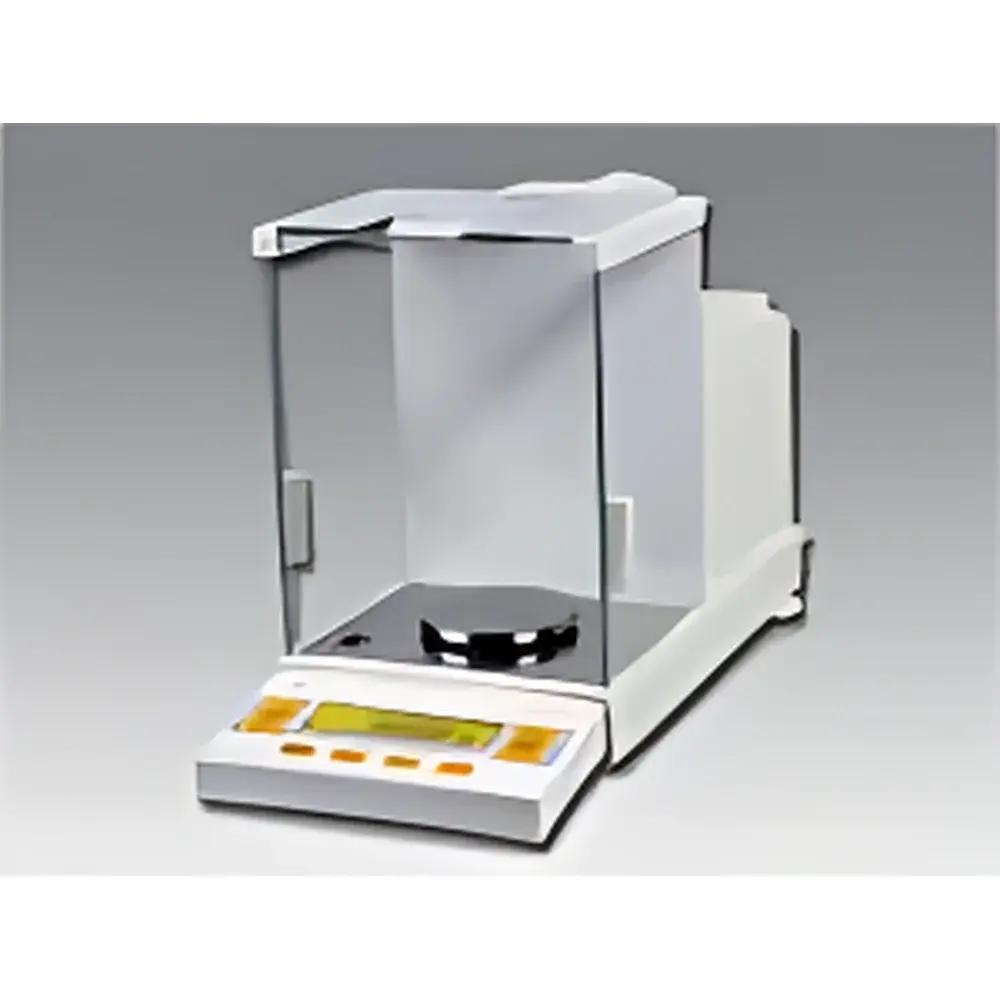
FB323 Automatic Internal Calibration Precision Analytical Balance (0.001 g readability)
| Origin | Shanghai, China |
|---|---|
| Manufacturer Type | Authorized Distributor |
| Country of Origin | China |
| Model | FB323 |
| Price | USD 1,050 (FOB Shanghai) |
| Readability | 1 mg |
| Capacity | 320 g |
| Repeatability | ≤1 mg |
| Linearity | ≤±2 mg |
| Draft Shield Dimensions | 195 × 160 × 235 mm |
| Overall Dimensions | 195 × 445 × 300 mm |
| Pan Diameter | Φ90 mm |
| Interface | RS232 |
| Power Options | AC adapter (100–240 VAC) or 9 V DC battery |
Overview
The FB323 Automatic Internal Calibration Precision Analytical Balance is an entry-level high-reliability analytical balance engineered for routine mass measurement tasks requiring 1 mg readability (0.001 g) and robust repeatability in non-GxP laboratory environments. It operates on electromagnetic force compensation (EMFC) principle — a widely adopted method in modern analytical balances where the restoring force required to maintain zero displacement of the weighing pan is precisely measured and converted into mass output. Unlike strain-gauge-based systems, EMFC technology eliminates mechanical hysteresis, creep, and long-term drift, delivering stable performance across variable ambient conditions. Designed for general-purpose use in academic teaching labs, QC/QA departments in light manufacturing, agricultural testing stations, and vocational training centers, the FB323 delivers consistent accuracy without demanding climate-controlled rooms or vibration-isolated tables.
Key Features
- Electromagnetic force compensation sensor with rear-mounted configuration — optimized for thermal stability and reduced sensitivity to air currents
- Automatic internal calibration system utilizing dual built-in reference masses; initiated manually or scheduled via time-based triggers
- Digital multi-point linearization algorithm applied during factory calibration and user recalibration — corrects nonlinearity across the full 320 g range
- Full-height transparent front-access draft shield (195 × 160 × 235 mm) with no central support column — maximizes working space and simplifies handling of tall or irregular samples
- Integrated 9 V DC battery operation alongside universal AC power supply (100–240 VAC, 50/60 Hz) — enables portable deployment in field labs or temporary setups
- Six-key intuitive front panel with backlit LCD display — supports tare, unit conversion (g, oz, ct, etc.), piece counting, and memory recall of last 10 weight values
- Standard RS232 serial interface compliant with ASCII protocol — compatible with legacy lab printers, PCs, and LIMS data capture systems without driver installation
Sample Compatibility & Compliance
The FB323 accommodates samples up to 320 g with a Φ90 mm stainless-steel weighing pan, suitable for powders, granules, small components, reagent vials, and pre-weighed containers. Its 1 mg readability meets minimum requirements for ASTM E898-22 (Standard Practice for Weighing in Analytical Chemistry) and ISO 9001:2015 clause 7.1.5 (Monitoring and Measuring Resources). While not certified for GLP/GMP-regulated environments requiring full audit trails or 21 CFR Part 11 compliance, the balance supports basic traceability through timestamped RS232 output (when paired with external logging software) and internal calibration event logging (date/time stamp stored in non-volatile memory). It conforms to IEC 61000-6-3 (EMC emission standards) and IEC 61010-1 (safety requirements for electrical equipment).
Software & Data Management
No proprietary software is bundled; however, the RS232 interface transmits real-time weight data in standard ASCII format (e.g., “+000.1234 grn”) at user-selectable baud rates (9600 or 19200 bps). This enables direct integration with Microsoft Excel (via terminal emulation), LabVIEW, Python-based data acquisition scripts, or custom-built QC dashboards. Calibration history — including date, time, and pass/fail status of each internal calibration cycle — is retained in device memory and can be queried via command-line instruction (e.g., “CAL?”). Firmware updates are performed offline using a dedicated USB-to-RS232 converter and manufacturer-provided hex loader utility.
Applications
- Educational laboratories: Student experiments in stoichiometry, solution preparation, and gravimetric analysis
- Raw material inspection in food processing and feed mills — checking batch weights against tolerance limits
- Pharmaceutical R&D support: Weighing excipients, APIs (non-potent), and placebo formulations prior to tablet compression
- Agricultural extension services: Soil sample mass determination for moisture content analysis per ISO 11465
- Small-scale electronics assembly: Counting SMD components (e.g., resistors, capacitors) using built-in piece-counting mode
- Construction materials testing labs: Preparing cement mortar specimens per ASTM C109/C109M
FAQ
Does the FB323 support external calibration with traceable weights?
Yes — the balance accepts external calibration via standard Class M2 or better weights. The procedure is accessible through the service menu and requires manual entry of nominal mass value.
Is the internal calibration fully automatic or user-initiated?
Calibration is manually triggered by the operator (via front-panel key sequence) or programmable to execute at predefined intervals (e.g., every 2 hours), but it does not activate autonomously based on temperature drift.
Can the RS232 output include calibration status or error codes?
No — only real-time weight values are transmitted. Diagnostic information (e.g., overload, draft shield open, calibration failure) appears exclusively on the LCD and is not serially relayed.
What is the warm-up time required for optimal repeatability?
Minimum 30 minutes after power-on under stable ambient conditions (20–25 °C, 5 °C/h temperature fluctuation.
Is the stainless-steel pan removable for cleaning?
Yes — the pan is secured with a quick-release mechanism and may be detached without tools; however, reinstallation must be verified via zero-check and optional recalibration.