
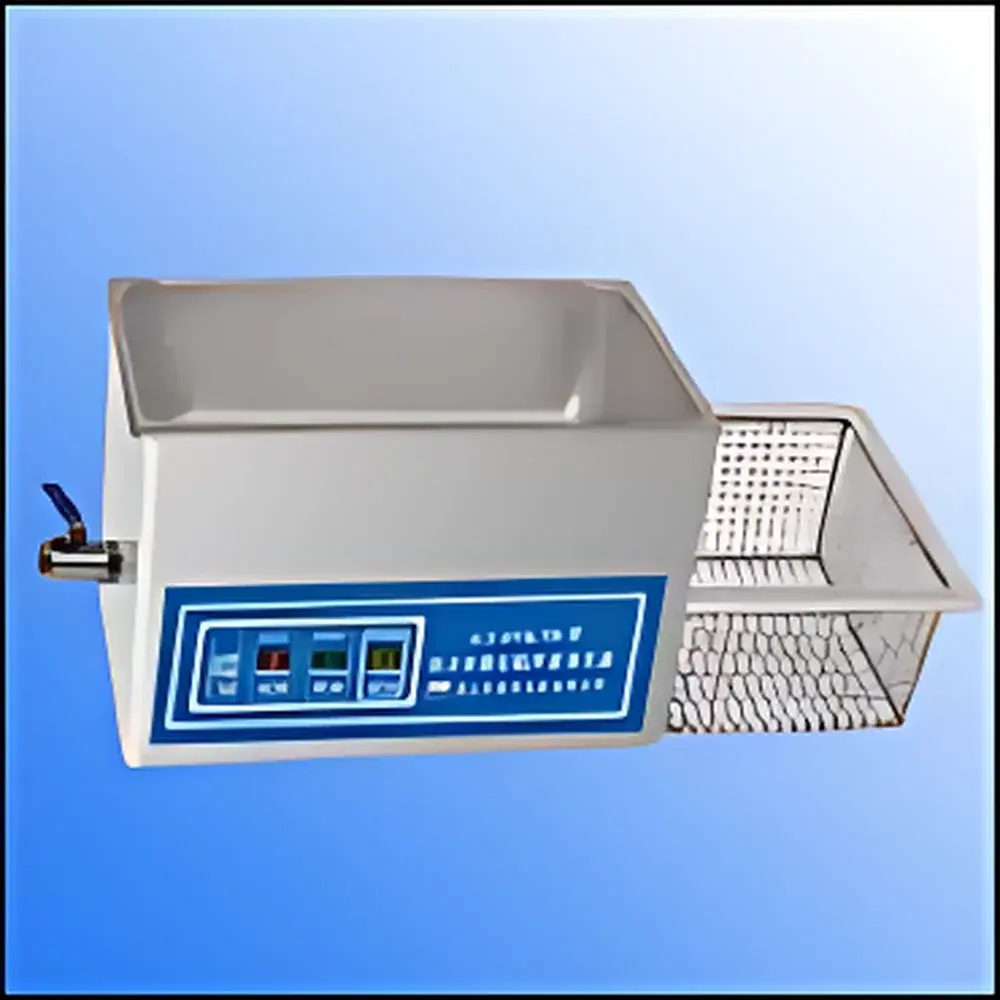
KQ-250DB Desktop Digital Ultrasonic Cleaner (10 L)
| Origin | Shanghai, China |
|---|---|
| Manufacturer Type | Authorized Distributor |
| Origin Category | Domestic (PRC) |
| Model | KQ-250DB |
| Ultrasonic Frequency | 40 kHz |
| Ultrasonic Power Output | 250 W |
| Tank Capacity | 10 L |
| Internal Tank Dimensions | 300 × 240 × 150 mm |
| External Dimensions | 320 × 264 × 320 mm |
| Temperature Control Range | Ambient to 80 °C (adjustable in 1 °C increments) |
| Timer Range | 1–99 minutes (digital preset & memory) |
| Safety Features | Low-level liquid detection, over-temperature/over-voltage/over-current protection, auto-shutdown |
| Standard Accessories | Stainless steel mesh basket with argon-welded frame, drain valve |
| Construction | 304 stainless steel tank and outer housing (except for select entry models), microcontroller-based digital control system |
| Cumulative Operating Time Counter | Up to 999,999 hours |
| Power Transducer Configuration | Five 50 W piezoelectric transducers bonded to tank bottom |
Overview
The KQ-250DB Desktop Digital Ultrasonic Cleaner is an engineered solution for precision cleaning, degassing, dispersion, emulsification, and cell lysis in academic laboratories, R&D facilities, and quality control environments. It operates on the principle of high-frequency ultrasonic cavitation—generating controlled micro-bubbles in aqueous or mild solvent media at a stable frequency of 40 kHz. When these bubbles collapse near solid surfaces, they produce localized shockwaves and micro-jets capable of dislodging sub-micron particulates, biofilms, and organic residues without mechanical abrasion. Designed for repeatable, operator-independent performance, the unit integrates a sealed 10-liter stainless steel tank (300 × 240 × 150 mm internal volume) with five independently monitored 50 W piezoelectric transducers delivering a total acoustic power output of 250 W. Its compact desktop footprint (320 × 264 × 320 mm) and fully digital interface make it suitable for benchtop deployment in ISO Class 5–7 cleanrooms, teaching labs, and regulated analytical workflows where space efficiency and process traceability are critical.
Key Features
- Digital microcontroller-based control system with non-volatile memory for time, temperature, and power settings—retains user configurations after power cycling
- Real-time dual-display: simultaneous readout of setpoint vs. actual bath temperature (range: ambient to 80 °C, ±1 °C accuracy) and elapsed/remaining ultrasonic cycle time (1–99 min)
- Integrated safety architecture including low-fluid level detection, thermal cut-off at 85 °C, over-current and over-voltage monitoring with visual fault indication
- Stainless steel (AISI 304) tank and chassis—electropolished interior surface for corrosion resistance and ease of decontamination
- Argon-welded stainless steel mesh basket (included) optimized for uniform energy distribution and sample support across full tank depth
- Drain valve assembly positioned at tank base for rapid, residue-free solution exchange—compatible with lab-grade waste containment protocols
- Cumulative operational hour counter (up to 999,999 h) supporting preventive maintenance scheduling and GLP-compliant equipment logbooks
- Factory date stamping and firmware revision tracking embedded in system diagnostics—facilitates warranty validation and audit readiness
Sample Compatibility & Compliance
The KQ-250DB accommodates a broad range of sample formats—including glassware (vials, cuvettes, pipette tips), metal components (surgical instruments, optical mounts), ceramic substrates, and polymer-based microfluidic devices—provided immersion-compatible solvents (e.g., DI water, ethanol, isopropanol, or aqueous alkaline detergents) are used. It meets structural and electrical safety requirements per GB 4793.1–2019 (equivalent to IEC 61010-1) for laboratory equipment. While not certified to UL/CSA standards, its design aligns with general principles outlined in ASTM D2603 (Standard Test Method for Sonic Shear Stability of Lubricants) and ISO 13406-2 for ergonomic visual display use. The stainless steel construction supports routine sterilization via vaporized hydrogen peroxide (VHP) or saturated steam (≤121 °C, non-submerged), and complies with material biocompatibility guidelines per USP for extractables testing apparatus.
Software & Data Management
This model operates without external PC connectivity or proprietary software. All parameters are managed locally via a sealed membrane keypad and dual-line LCD display. Settings—including timer duration, heating setpoint, and power activation—are stored in EEPROM with write-protection logic to prevent accidental overwrite. The cumulative runtime counter logs total active ultrasonication hours with second-level resolution, exportable manually for inclusion in instrument qualification (IQ/OQ/PQ) documentation. Audit trails are maintained through visual indicators: low-water alerts, thermal fault codes (E1–E3), and power anomaly flags—each logged with timestamp-equivalent visual persistence per GLP Annex 11 interpretation for non-computerized systems. No data encryption or electronic signature capability is provided; manual recordkeeping is required for FDA 21 CFR Part 11 compliance in regulated QC applications.
Applications
- Pre-analytical sample preparation: removal of contaminants from HPLC vials, GC autosampler trays, and ICP-MS nebulizer components
- Microelectronics: cleaning photomasks, wafer carriers, and bonding fixtures prior to thin-film deposition
- Life sciences: gentle dissociation of adherent cell monolayers, homogenization of tissue lysates, and DNA shearing optimization
- Materials science: dispersion of nanomaterials (e.g., graphene oxide, TiO₂ nanoparticles) in aqueous colloids
- Pharmaceutical QA: cleaning reusable stainless steel filters, filling nozzles, and tablet punch tooling between batches
- Academic instruction: demonstration of cavitation physics, sonochemistry kinetics, and surfactant efficacy evaluation
FAQ
What is the recommended operating fluid for optimal cavitation efficiency?
Deionized water or low-surface-tension aqueous solutions (e.g., 1–5% sodium hydroxide or commercial ultrasonic detergents) are preferred. Avoid halogenated solvents unless confirmed compatible with 304 stainless steel and transducer encapsulation materials.
Can the unit be operated continuously for extended durations?
Yes—thermal management and duty-cycle monitoring allow uninterrupted operation up to 8 hours per session, provided ambient temperature remains below 30 °C and ventilation clearance exceeds 10 cm on all sides.
Is the stainless steel mesh basket autoclavable?
The basket is rated for repeated autoclaving at 121 °C / 15 psi for 20 minutes; however, prolonged exposure above 130 °C may affect weld integrity.
Does the KQ-250DB support remote start/stop or data logging via RS232/USB?
No—this is a standalone, microcontroller-driven instrument with no communication ports or external interface capability.
How frequently should the tank be descaled, and what agent is recommended?
Descaling every 200–300 operating hours using 5–10% citric acid solution (60 °C, 30 min soak) is advised for hard-water environments; rinse thoroughly with DI water afterward.



