
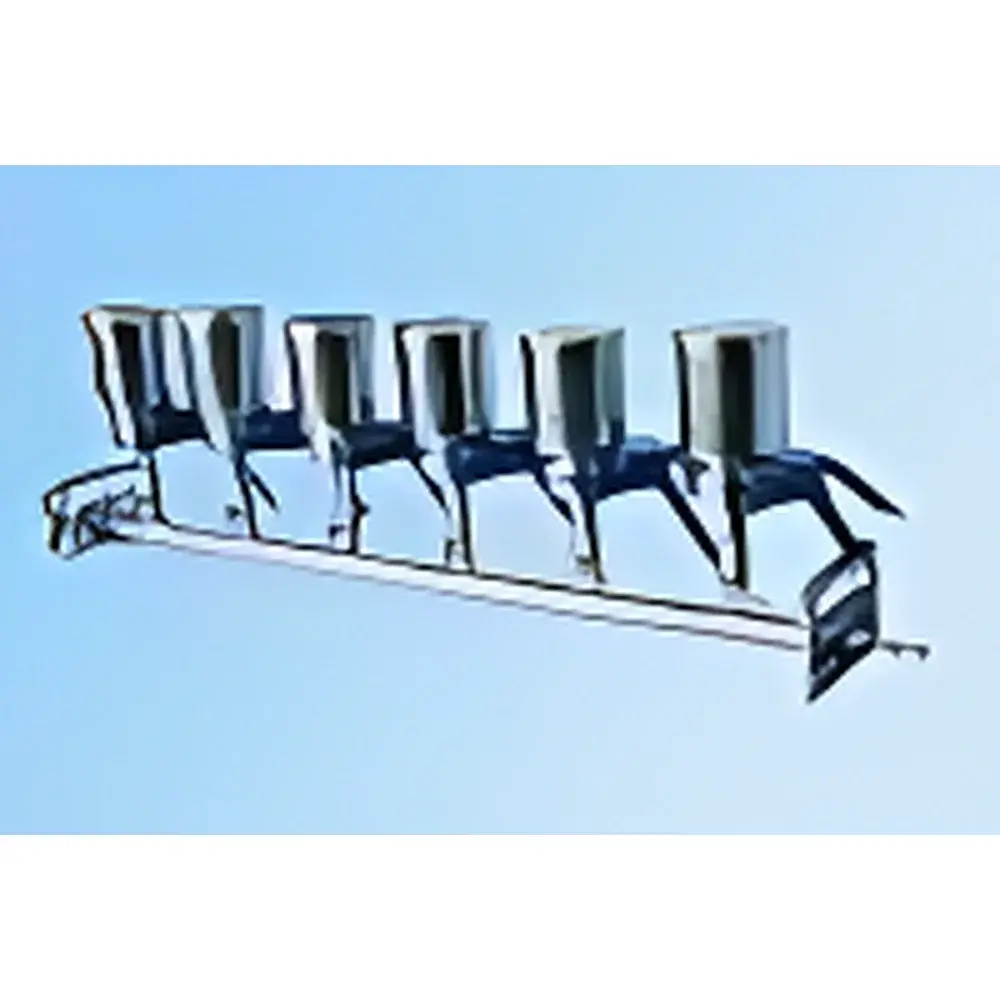
Chu Ding Technology HSF-G6 Six-Position Stainless Steel Vacuum Filtration System (Microbial Testing Filtration Assembly)
| Brand | Chu Ding Technology |
|---|---|
| Origin | Shanghai, China |
| Manufacturer Type | Authorized Distributor |
| Origin Category | Domestic (China) |
| Model | HSF-G6 |
| Price | USD 1,720 (FOB Shanghai) |
Overview
The Chu Ding Technology HSF-G6 Six-Position Stainless Steel Vacuum Filtration System is a precision-engineered, modular vacuum-driven membrane filtration assembly designed for high-throughput, reproducible sample preparation in microbiological testing, environmental analysis, pharmaceutical quality control, and routine laboratory filtration workflows. Unlike traditional borosilicate glass filter funnels or single-position sintered glass filters—whose fragility, thermal instability, and sequential operation limit throughput and introduce contamination risk—the HSF-G6 employs a robust, fully metallic architecture based on ASTM F838-compliant 316L stainless steel. It operates on the principle of negative-pressure-driven membrane filtration: vacuum applied via an external pump draws liquid samples through user-selected membranes seated on precision-machined filter heads, separating particulates, microorganisms, or suspended solids from the filtrate, which collects gravimetrically or volumetrically in standardized receiving flasks. Its design prioritizes analytical integrity, operator safety, and regulatory traceability—making it suitable for applications requiring ISO 11133, USP /, and EU GMP Annex 1-aligned procedures.
Key Features
- Constructive 316L stainless steel construction across all wetted components—including filter cups, filter heads, support rack, ball valves, and mounting brackets—ensuring full resistance to nitric acid, hydrochloric acid (dilute), sodium hydroxide, and common organic solvents per ASTM A240 standards.
- Autoclavable at 121 °C, 15 psi for ≥20 minutes without dimensional drift or surface passivation loss; validated compatibility with dry-heat sterilization up to 180 °C.
- Six independent, parallel filtration channels with individual stainless steel ball valves (DN6, 316L body, PTFE-seated), enabling selective activation, cross-contamination prevention, and staggered processing without system venting.
- Modular aluminum clamping mechanism providing uniform 12–15 N·m torque distribution across all cup-to-head interfaces—guaranteeing leak-free sealing under vacuum pressures up to −95 kPa.
- Integrated vacuum manifold with calibrated pressure relief port and optional inline particulate trap, compatible with standard diaphragm or oil-free scroll vacuum pumps (recommended flow rate: ≥25 L/min at −80 kPa).
Sample Compatibility & Compliance
The HSF-G6 accommodates standard 47 mm or 50 mm diameter membrane filters—including mixed cellulose ester (MCE), polyethersulfone (PES), nylon, polycarbonate (track-etched), and PVDF—enabling method flexibility across bacterial retention (e.g., Pseudomonas aeruginosa, Escherichia coli), particulate quantification (ISO 11929), turbidity reduction, and pre-filtration for HPLC or ICP-MS. All components conform to FDA 21 CFR Part 11 readiness requirements when paired with compliant data loggers: valve actuation timestamps, vacuum pressure logs, and operator ID fields can be captured externally. The system supports GLP/GMP documentation workflows, including equipment qualification (IQ/OQ/PQ), as-built drawings, material traceability certificates (EN 10204 3.1), and cleaning validation protocols per EMA Guideline on Setting Health-Based Exposure Limits.
Software & Data Management
While the HSF-G6 is a hardware-only platform (no embedded electronics or firmware), its mechanical architecture is engineered for seamless integration into digital lab ecosystems. Each filtration channel includes a dedicated vacuum port with standardized 8-mm barbed fitting (DIN 2817), permitting connection to smart vacuum controllers (e.g., KNF VACUUBRAND eco series) that provide real-time pressure logging, event-triggered alerts, and CSV-exportable audit trails. When used with electronic balance interfaces (RS-232/USB) and LIMS-compatible ELN platforms (e.g., LabArchives, Benchling), full chain-of-custody records—including filter lot numbers, sample IDs, filtration duration, final filtrate mass/volume, and operator signature—can be auto-populated. System calibration certificates include uncertainty budgets traceable to NIM (National Institute of Metrology, China) and NIST SRMs.
Applications
- Membrane filtration assays per APHA Standard Methods 9222B/C for total coliforms, fecal coliforms, and E. coli in drinking water, wastewater, and recreational waters.
- Pharmaceutical sterility testing (USP ) and bioburden enumeration (USP ) using 0.45 µm or 0.22 µm pore-size membranes.
- Environmental particulate analysis (e.g., TSS, turbidity precursors) in compliance with EPA Method 160.1 and ISO 11929.
- Preparative filtration prior to elemental analysis (ICP-OES, ICP-MS) where glass leachables must be eliminated—especially for low-level Na, K, Ca, and Si quantification.
- Cell culture supernatant clarification, antibody purification intermediates, and buffer exchange steps in upstream bioprocessing R&D labs.
FAQ
Is the HSF-G6 compatible with aggressive solvents such as acetone or THF?
Yes—316L stainless steel exhibits excellent resistance to aliphatic and aromatic hydrocarbons, ketones, and ethers. However, prolonged exposure to chlorinated solvents (e.g., chloroform, DCM) is not recommended without prior compatibility verification per ASTM D543.
Can I use 25 mm membranes with this system?
No—the HSF-G6 is dimensionally optimized for 47 mm and 50 mm membranes only. Smaller formats require adapter kits (sold separately) and may compromise seal integrity under vacuum.
Does the system include vacuum pump and collection bottles?
The base configuration includes the stainless steel rack, six filter cups, six filter heads, six ball valves, aluminum clamps, and one universal manifold. Vacuum pumps, silicone tubing, and borosilicate or PETG collection flasks are specified as optional accessories.
How is cleaning validation performed?
Cleaning validation follows a three-rinse protocol with conductivity monitoring (≤1.3 µS/cm) and TOC analysis (<10 ppb), supported by documented swab recovery studies per PDA Technical Report No. 29.
What documentation is provided with shipment?
Each unit ships with a Factory Acceptance Test (FAT) report, 316L material certification (EN 10204 3.1), dimensional inspection report, and a user manual compliant with ISO/IEC 17025 Clause 5.4.1.
Related Products



