
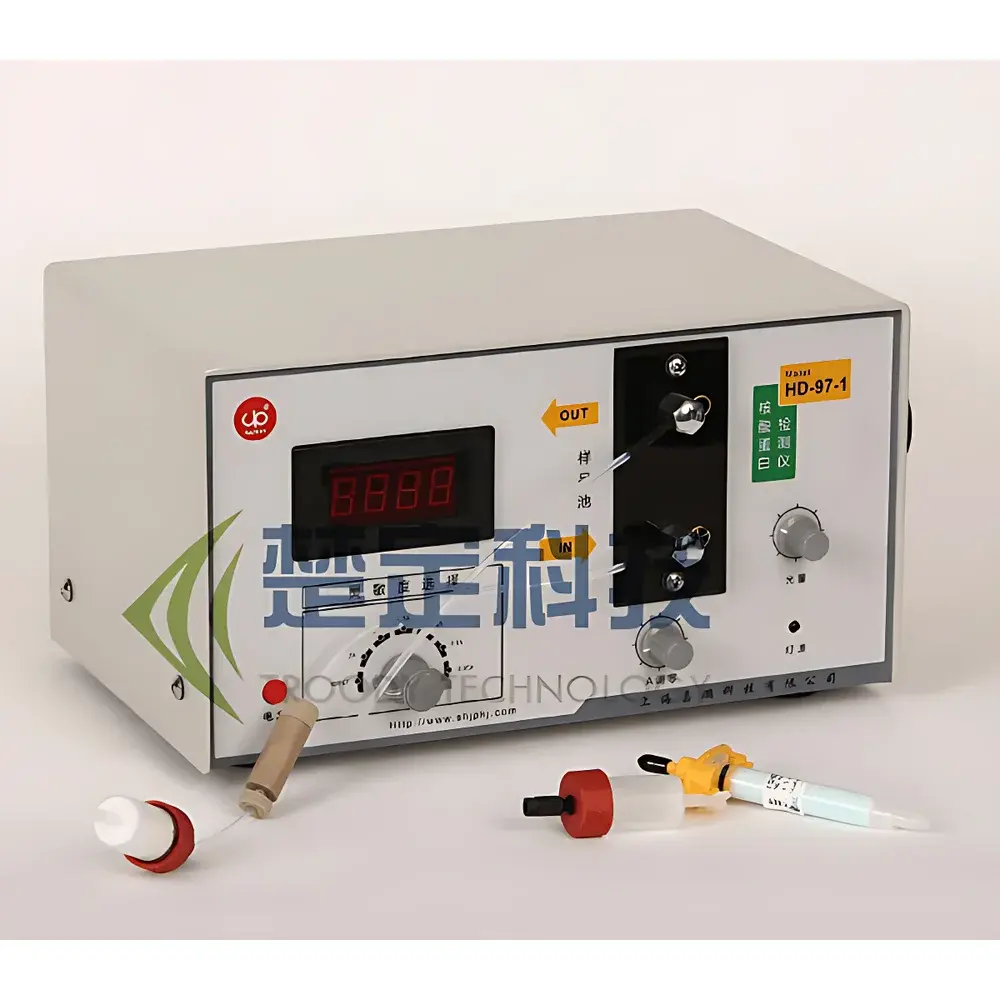
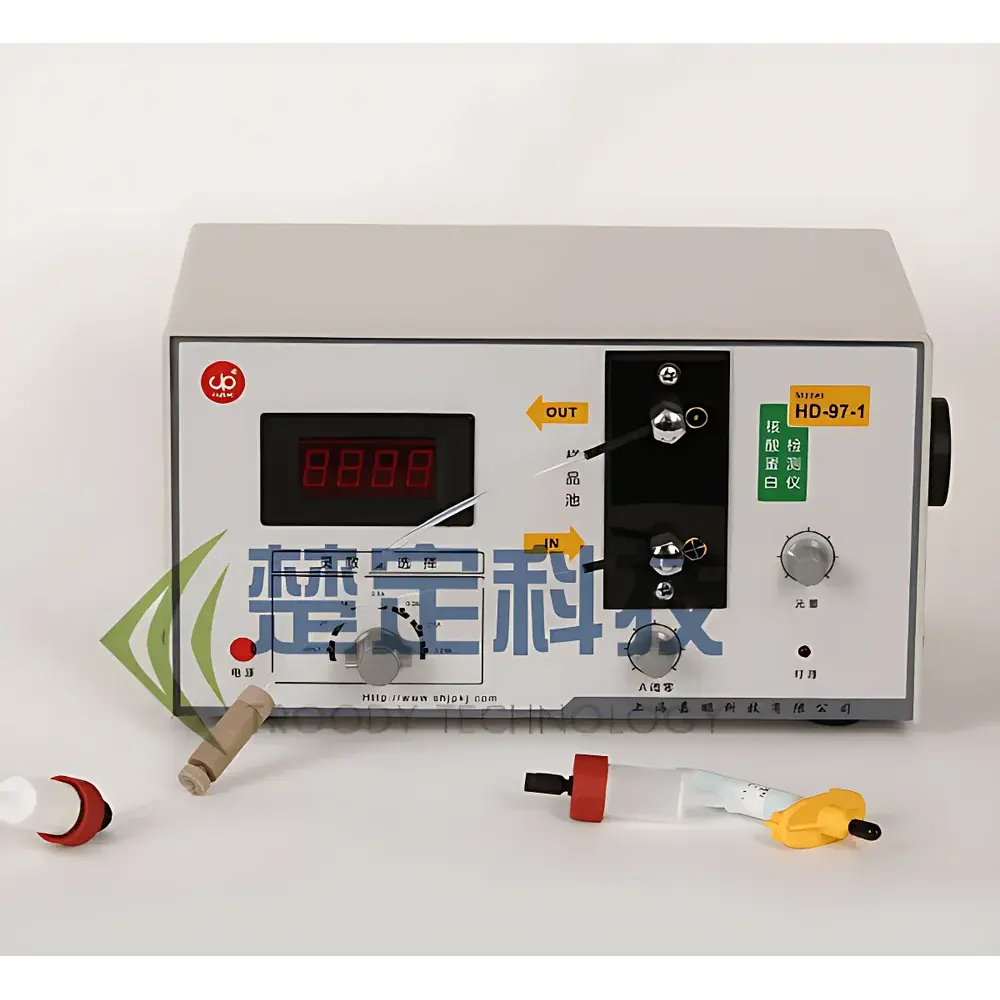
Chu Ding Technology HD-97-1 UV-Vis Detector for Protein and Nucleic Acid Chromatography
| Brand | Chu Ding Technology |
|---|---|
| Origin | Shanghai, China |
| Model | HD-97-1 |
| Instrument Type | Benchtop |
| Wavelength Options | 214 nm, 220 nm, 254 nm, 280 nm, 340 nm |
| Flow Cell | 100 µL volume, 3 mm optical path length |
| Absorbance Range | 0.05 A to 2 A (7 selectable ranges) |
| Display | Triple-channel high-clarity LED display showing real-time OD values |
| Output Interface | USB + RS-232 (COM) |
| Compatibility | Direct mechanical and fluidic interface with GE Healthcare lab-scale chromatography columns (e.g., HiTrap, Tricorn), AKTA systems, and standard 3 mm ID tubing |
| Power Supply | 220 V AC |
Overview
The Chu Ding Technology HD-97-1 UV-Vis Detector is a benchtop absorbance-based analytical instrument engineered for real-time monitoring of biomolecules during liquid chromatography separations. It operates on the principle of ultraviolet-visible absorption spectroscopy, leveraging Beer–Lambert law-based quantification to detect and quantify proteins, nucleic acids, peptides, and enzymes as they elute from chromatographic columns. The detector supports five discrete, user-selectable wavelengths—214 nm (peptide bond), 220 nm (backbone absorption), 254 nm (nucleic acid aromatic bases), 280 nm (tryptophan/tyrosine in proteins), and 340 nm (background/reference)—enabling selective detection across diverse biochemical applications. Its flow-through cuvette (100 µL volume, 3 mm path length) is optimized for low dead-volume integration into FPLC/HPLC workflows and ensures high signal-to-noise ratio and baseline stability under continuous flow conditions ranging from 0.5 to 900 mL/h.
Key Features
- Direct mechanical compatibility with GE Healthcare lab-scale columns (HiTrap, Tricorn, XK series) and AKTA purification systems—no adapters or custom fittings required.
- Triple-channel high-clarity LED display showing simultaneous real-time absorbance (OD) values at user-selected wavelengths, facilitating immediate qualitative assessment and peak tracking.
- Dual-output digital interface: native USB 2.0 and RS-232 (COM) ports ensure seamless integration with third-party data acquisition software, chart recorders, or custom LabVIEW-based control environments.
- Seven-step absorbance range selection (0.05 A to 2 A) with automatic zeroing and baseline drift compensation, supporting both high-sensitivity trace analysis and broad dynamic range quantification.
- Microprocessor-controlled wavelength switching with <±1 nm wavelength accuracy and <0.5 nm spectral bandwidth, ensuring reproducible photometric performance across extended operation cycles.
- Built-in external trigger input for synchronized fraction collection, enabling precise alignment between chromatographic peaks and tube-based sample recovery in conjunction with fraction collectors.
Sample Compatibility & Compliance
The HD-97-1 is designed for aqueous and buffer-compatible mobile phases commonly used in size-exclusion chromatography (SEC), ion-exchange chromatography (IEX), affinity chromatography, and hydrophobic interaction chromatography (HIC). It accommodates standard 3 mm ID PEEK or stainless-steel tubing connections and maintains stable baseline response under variable flow rates (0.5–900 mL/h) and pressure conditions typical of low-to-medium pressure chromatography (<5 bar). While not certified for GMP manufacturing environments, the instrument supports GLP-aligned workflows through consistent calibration traceability, documented operational parameters, and audit-ready output logs when paired with compliant data acquisition systems. It meets general laboratory safety standards per IEC 61010-1 and electromagnetic compatibility requirements per EN 61326-1.
Software & Data Management
The HD-97-1 functions as a hardware-level detector module and does not include embedded data storage or proprietary acquisition software. Instead, it delivers analog and digital absorbance signals to externally connected systems—including PC-based chromatography data systems (CDS), custom Python/Matlab acquisition scripts, or standalone strip-chart recorders. Its dual-port architecture (USB + RS-232) ensures backward compatibility with legacy Windows platforms (Windows XP SP3 through Windows 10/11) and facilitates integration into validated environments where FDA 21 CFR Part 11 compliance is enforced via upstream software validation. Time-stamped absorbance data can be logged with millisecond resolution when interfaced with time-synchronized triggers, supporting retrospective analysis of retention times, peak symmetry, and area-under-curve (AUC) calculations.
Applications
- Real-time monitoring of protein purification runs on AKTA systems, including His-tagged protein elution profiling using 280 nm detection.
- Quantitative analysis of oligonucleotide purity and yield in desalting or size-selection steps (254 nm/260 nm ratio calculation post-acquisition).
- Method development for gradient elution optimization, where rapid wavelength switching enables parallel observation of multiple chromophores (e.g., 214 nm for peptide backbone vs. 280 nm for aromatic residues).
- Quality control of column packing integrity and system dispersion via fronting/tailing assessment in test injections of standard proteins (e.g., BSA, lysozyme).
- Educational use in university biochemistry labs for teaching principles of chromatographic separation, Beer–Lambert law application, and detector response linearity.
FAQ
Is the HD-97-1 compatible with AKTA pure or AKTA avant systems?
Yes—the detector features standardized 3 mm ID inlet/outlet ports and mechanical mounting geometry that aligns directly with GE Healthcare’s lab-scale column manifolds, eliminating the need for adapters or flow-path modifications.
Can the HD-97-1 measure absorbance at non-standard wavelengths such as 260 nm?
No—it is factory-configured for fixed-wavelength operation at 214, 220, 254, 280, and 340 nm only. These wavelengths were selected to match key biochemical absorption maxima and cannot be tuned or interpolated.
What is the minimum detectable absorbance change under optimal conditions?
With stable lamp output and low-noise electronics, the instrument achieves a noise level of ≤0.002 AU (peak-to-peak) at 254 nm over 1 s integration time, corresponding to sub-microgram detection limits for typical proteins in 100 µL flow cells.
Does the HD-97-1 support analog voltage output for connection to legacy chart recorders?
Yes—it provides a 0–1 V DC analog output proportional to absorbance, fully isolated and calibrated per selected range, suitable for integration with analog integrators or pen recorders.
Is calibration documentation provided with the instrument?
Each unit ships with a factory verification report listing wavelength accuracy, photometric linearity across all seven ranges, and baseline stability measurements—traceable to internal reference standards, not NIST.



