
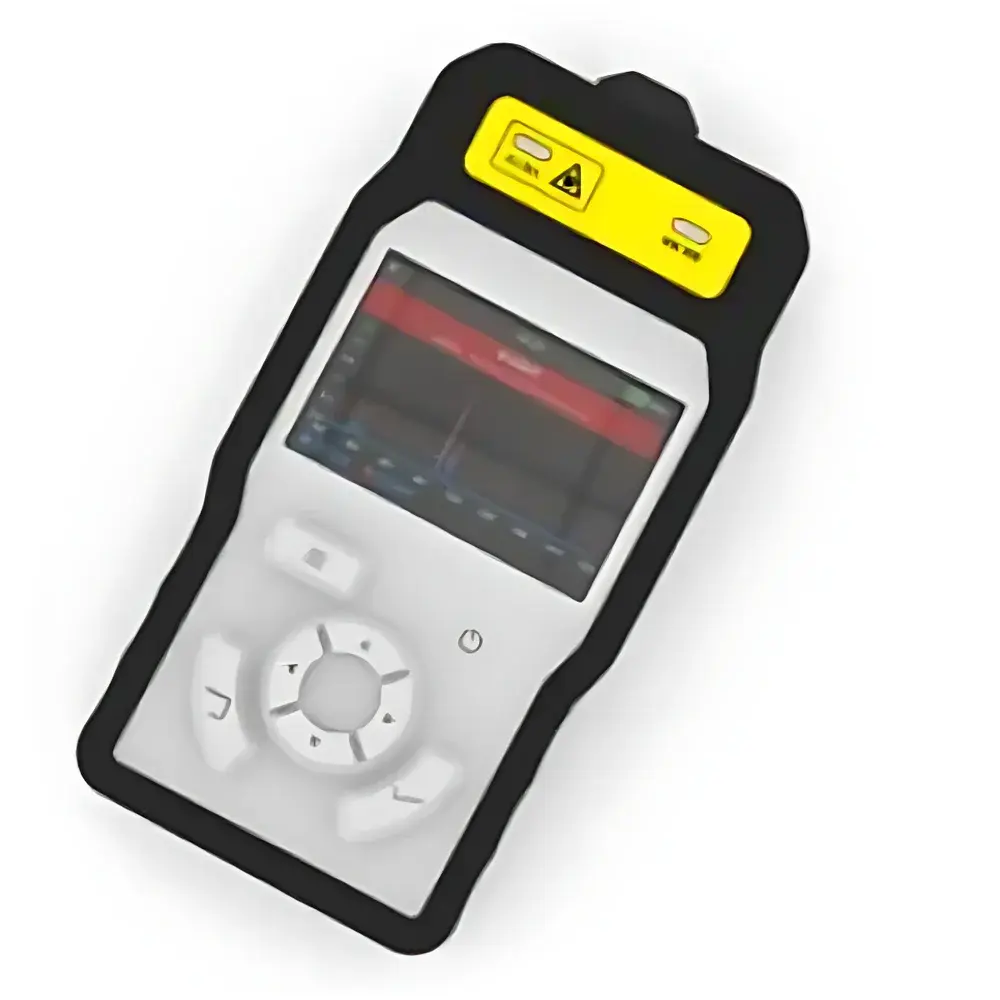
Cloudoptek MP-800S Ruggedized Handheld High-Frequency Area-Scan Raman Spectrometer
| Brand | Cloudoptek |
|---|---|
| Origin | Beijing, China |
| Manufacturer Type | Original Equipment Manufacturer (OEM) |
| Regional Classification | Domestic (PRC) |
| Model | MP-800S |
| Instrument Type | Portable/Handheld Raman Spectrometer |
| Optical Core | Transmission Volume Phase Grating (VPG) + Spatial Direct Coupling + Confocal Architecture |
| Scanning Method | Digital Micromirror Device (DMD)-Driven Area Scan |
| Detection Mode | Surface-Averaged Raman Mapping |
| Spectral Library | >10,000 reference spectra (expandable) |
Overview
The Cloudoptek MP-800S Ruggedized Handheld High-Frequency Area-Scan Raman Spectrometer is an engineered solution for field-deployable molecular identification under operationally demanding conditions. It employs confocal spatial direct coupling with a high-efficiency transmission volume phase grating (VPG) to maximize photon throughput while maintaining spectral resolution suitable for compound discrimination. Unlike conventional point-focused handheld Raman systems, the MP-800S integrates a digital micromirror device (DMD) to dynamically steer the excitation laser across a defined surface region—enabling true area-scan acquisition without mechanical translation. This eliminates localized thermal accumulation at the sample interface, mitigating carbonization, fluorescence quenching, or ignition risk—particularly critical for dark-colored, low-reflectivity, or thermally labile materials such as explosives, dyes, or charred residues. The instrument operates at 785 nm excitation wavelength, balancing fluorescence suppression and detector quantum efficiency, and delivers calibrated Raman shifts from 200 cm⁻¹ to 3200 cm⁻¹ with <4 cm⁻¹ spectral resolution (FWHM).
Key Features
- Ruggedized IP67-rated enclosure compliant with MIL-STD-810G for shock, vibration, dust, and water immersion resistance
- DMD-based non-contact area-scan mode: programmable scan patterns (grid, spiral, line) over user-defined regions up to 10 mm × 10 mm
- Confocal optical architecture with adjustable working distance (3–15 mm) and depth-of-field control for heterogeneous or rough-surface sampling
- Integrated real-time spectral preprocessing: cosmic ray removal, baseline correction (Asymmetric Least Squares), and SNR optimization
- Battery-powered operation: ≥4 hours continuous use on hot-swappable Li-ion packs; supports USB-C PD charging in-field
- On-device spectral matching engine with >10,000 reference spectra—including NATO-standard chemical warfare agent (CWA) libraries, IED precursors, pharmaceutical actives, and illicit drug profiles
Sample Compatibility & Compliance
The MP-800S is validated for direct analysis of solids, powders, gels, and liquids—including opaque, highly pigmented, or thermally sensitive samples unsuitable for conventional focused-beam Raman. Its area-scan capability ensures representative signal averaging across spatially heterogeneous mixtures, reducing false negatives in trace-contamination screening (e.g., nitroaromatic residue on clothing or packaging). The system conforms to ASTM E2529-21 (Standard Guide for Raman Spectroscopy in Forensic Applications) and supports audit-ready data capture per ISO/IEC 17025:2017 requirements for testing laboratories. Raw spectral data are stored in vendor-neutral .spc and .jdx formats; metadata includes GPS coordinates, timestamp, operator ID, ambient temperature/humidity, and instrument calibration status.
Software & Data Management
Cloudoptek SpectraLink™ v3.2 firmware provides embedded spectral acquisition, library search (hit quality index ≥95% threshold), and customizable reporting. Data export supports CSV, PDF, and XML for integration into laboratory information management systems (LIMS) or incident command platforms. Remote firmware updates and spectral library expansions are delivered via encrypted OTA channels. For regulated environments, optional SpectraLink Secure Mode enables 21 CFR Part 11-compliant electronic signatures, role-based access control, and immutable audit trails—including full history of spectral modifications, library version changes, and user authentication events.
Applications
- First-responder chemical threat detection: rapid identification of nerve agents (e.g., VX, sarin), blister agents (e.g., sulfur mustard), and TICs/TACs in urban or industrial settings
- Explosives screening: surface mapping of PETN, RDX, TNT, ammonium nitrate, and peroxide-based IED components on luggage, vehicles, or infrastructure
- Pharmaceutical field verification: counterfeit drug detection via active pharmaceutical ingredient (API) fingerprinting and excipient profiling
- Forensic trace evidence analysis: multi-component mixture deconvolution (e.g., paint chips, ink layers, soil organics) using spectral unmixing algorithms
- Hazardous material (HAZMAT) response: real-time classification of unknown solids/liquids during spill containment or decontamination operations
FAQ
Does the MP-800S require external calibration standards for routine use?
No—factory-calibrated wavelength and intensity references are embedded and auto-verified at power-on. Optional NIST-traceable polystyrene or silicon standards may be used for periodic verification per internal QA protocols.
Can the area-scan mode be configured for quantitative analysis?
Yes—intensity-normalized spectral maps support semi-quantitative distribution modeling when combined with reference spectra acquired under matched optical conditions; full quantification requires matrix-matched calibration curves.
Is spectral data export compatible with third-party chemometric software?
Yes—raw interferogram-free spectra (.spc, .jdx) and metadata-rich .csv exports are fully compatible with MATLAB, Python (scikit-learn, PyMCA), and commercial tools including GRAMS/AI and Unscrambler X.
What safety certifications does the laser subsystem hold?
The 785 nm Class 3B laser complies with IEC 60825-1:2014 and FDA 21 CFR 1040.10; integrated interlock circuitry disables emission if housing integrity is compromised or focus distance falls below 3 mm.
How is spectral library expansion managed in offline operational environments?
Libraries are distributed as signed .clib packages; installation requires local admin privileges and cryptographic signature validation—no internet connection required post-deployment.



