
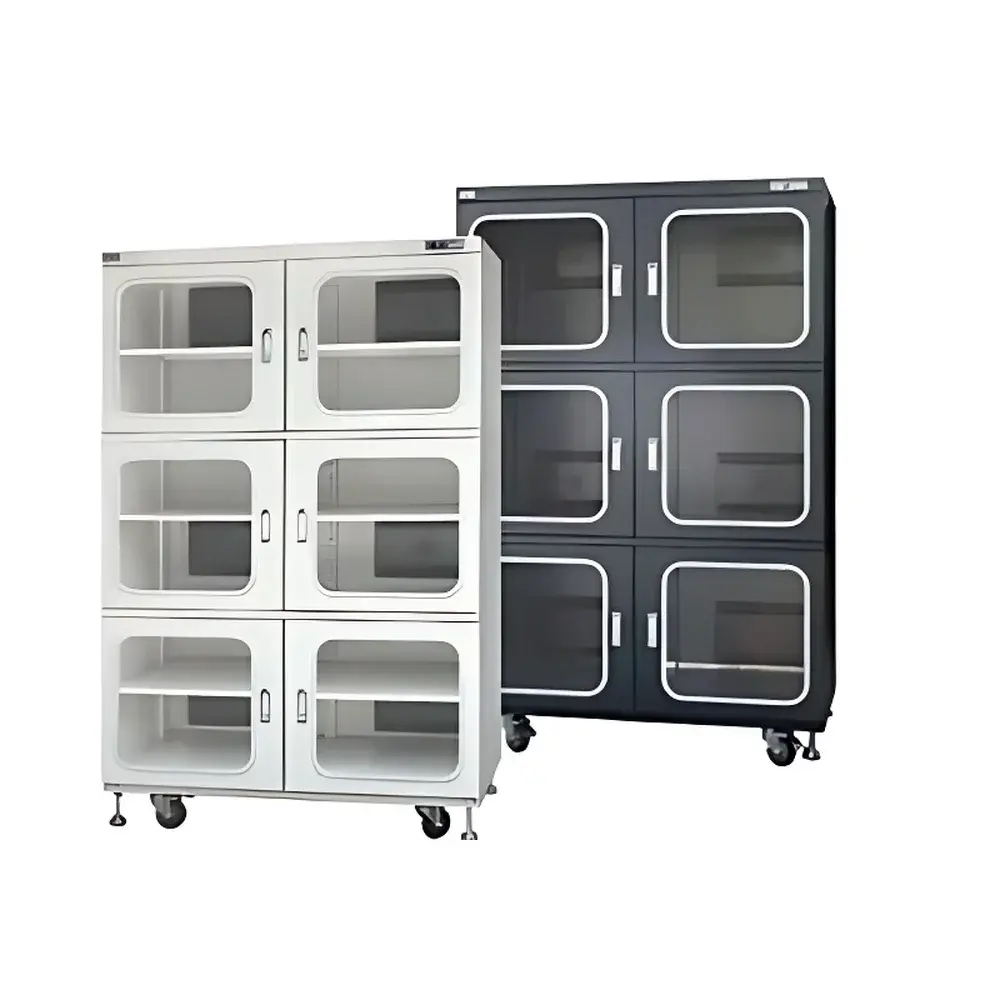
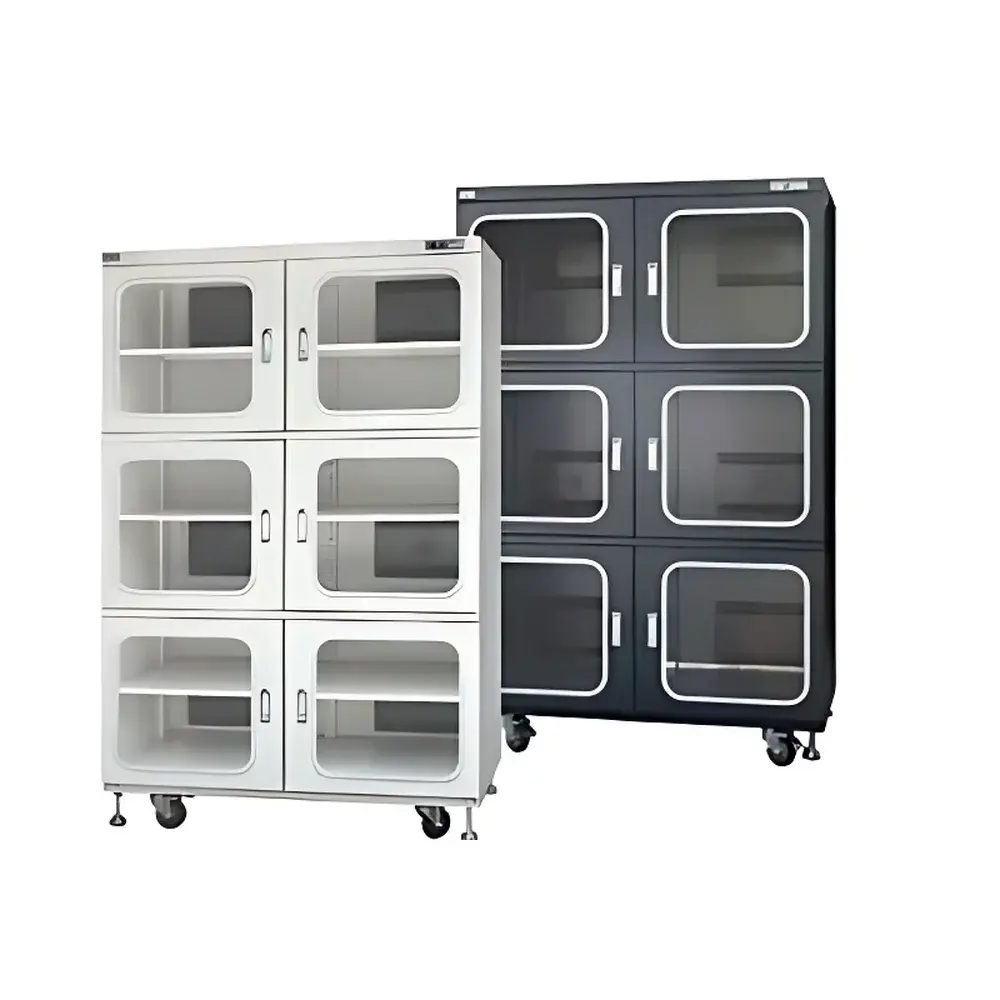
Chu Ding Technology CTA320FD / CTA320D Intelligent Desiccator Cabinet
| Brand | Chu Ding Technology |
|---|---|
| Origin | Shanghai, China |
| Model | CTA320FD / CTA320D |
| Humidity Control Range | 20–60% RH (adjustable) |
| Average Power Consumption | 20 W |
| Max Power | 140 W |
| Anti-Static Option | Yes (CTA320FD), No (CTA320D) |
| Internal Dimensions | 598 × 400 × 1310 mm (W×D×H) |
| Shelf Quantity | 3 adjustable steel shelves |
| Display Accuracy | ±3% RH, ±1°C |
| Sensor | Honeywell OEM humidity & temperature sensors |
| Compliance | RoHS-certified |
| Core Technology | Patented physical desiccant-based moisture removal with intelligent duty-cycle control |
Overview
The Chu Ding Technology CTA320FD and CTA320D are precision-engineered intelligent desiccator cabinets designed for the stable, long-term storage of moisture-sensitive components in electronics manufacturing, semiconductor handling, PCB assembly, and R&D laboratories. Unlike conventional heated drying ovens or passive silica-gel cabinets, these units employ an active, closed-loop desiccation system based on patented physical adsorption technology—co-developed with Canadian engineering partners—using high-efficiency imported desiccant media. The system operates without refrigerants or compressors, eliminating condensation risk and enabling continuous, maintenance-free dehumidification at ambient temperatures. Each cabinet maintains a user-defined relative humidity setpoint (20–60% RH) with high repeatability and minimal drift, critical for JEDEC-compliant dry-packaging workflows and IPC-STD-033B adherence. The architecture integrates dual independent sensing channels (Honeywell OEM RH and temperature sensors), real-time feedback logic, and adaptive duty-cycle modulation to minimize energy use while ensuring consistent chamber stability—even during transient environmental fluctuations.
Key Features
- Robust structural design: 1.0–1.2 mm cold-rolled steel frame with reinforced corner bracing and overlapping door sealing geometry, delivering superior mechanical rigidity and long-term dimensional stability.
- High-integrity enclosure: 3.2 mm tempered safety glass door with anti-tilt hinge mechanism and integrated planar compression latch—meets UL 72 Class 350 security requirements for sensitive material containment.
- Industrial-grade surface finish: 18-stage textured epoxy-polyester powder coating (orange peel texture), providing ISO 12944 C3-level corrosion resistance for laboratory and cleanroom environments.
- Intelligent adaptive control: Microprocessor-driven logic continuously monitors internal RH and automatically adjusts desiccant regeneration cycles—reducing average power draw to 20 W while sustaining target humidity with <±3% RH accuracy.
- Fail-safe passive retention: In the event of power interruption, the desiccant core retains adsorptive capacity; chamber RH rise is limited to ≤10% over 24 hours—ensuring uninterrupted protection for J-STD-020 Level 3+ components.
- RoHS-compliant construction: All internal materials—including housing polymers, gaskets, and circuit boards—certified free of lead, cadmium, mercury, hexavalent chromium, PBB, and PBDE per Directive 2011/65/EU.
Sample Compatibility & Compliance
These cabinets accommodate standard JEDEC trays (330 × 250 mm), 12″ wafer carriers, SMT reels, and bare PCBs up to 300 mm in height. The CTA320FD variant features conductive black epoxy coating (surface resistivity: 10⁴–10⁶ Ω/sq) compliant with ANSI/ESD S20.20 and IEC 61340-5-1 for electrostatic discharge (ESD)-sensitive handling. Units meet ISO 14644-1 Class 8 (100,000) air cleanliness when operated in filtered ambient spaces. Documentation supports GLP/GMP traceability: built-in audit trail logs (time-stamped RH/temperature records), password-protected parameter locking, and optional CSV export via USB interface.
Software & Data Management
While the CTA320 series operates as a standalone instrument, its embedded controller supports firmware-upgradable logic and configurable alarm thresholds (high/low RH, sensor fault, door-open duration). Optional PC connectivity (RS-485 or USB-to-serial adapter) enables integration into LabVantage, Thermo Fisher SampleManager, or custom MES platforms via Modbus RTU protocol. All operational data—including cumulative run time, desiccant cycle count, and deviation history—is stored in non-volatile memory for FDA 21 CFR Part 11–aligned review. Calibration certificates (NIST-traceable RH/temperature verification) are available upon request.
Applications
- Moisture-sensitive device (MSD) storage per J-STD-033D: ICs, BGAs, QFNs, and MEMS packages requiring MSL 2a–6 conditioning.
- Pre-bake staging for conformal coating, underfill, and reflow processes where residual moisture must remain below 0.1 wt%.
- Calibration standard storage: hygrometers, reference humidity generators, and NIST-traceable dew point sensors.
- Pharmaceutical excipient and analytical reference standard preservation—particularly for hygroscopic APIs such as lactose monohydrate or mannitol.
- Archival storage of optical components (lenses, filters, laser diodes) and precision metrology artifacts susceptible to hydrolytic degradation.
FAQ
What humidity range does the CTA320FD support, and how is it controlled?
The CTA320FD maintains 20–60% RH via closed-loop feedback using a Honeywell HCH-1000 sensor and proprietary desiccant regeneration algorithm. Setpoints are adjustable in 1% RH increments with non-volatile memory retention.
Is this unit suitable for storing ESD-sensitive components?
Yes—the CTA320FD model includes a certified anti-static black epoxy finish (10⁴–10⁶ Ω/sq) and grounded chassis design compliant with ANSI/ESD S20.20.
Does the cabinet require consumables or regular desiccant replacement?
No. The core uses regenerable desiccant media with an estimated service life exceeding 10 years under typical lab conditions (25°C, 60% RH ambient). No user-serviceable parts are required.
Can temperature be controlled independently of humidity?
Temperature is monitored but not actively controlled; the unit maintains ambient temperature (–9°C to +99°C display range) while stabilizing RH. For thermostatic drying, a dedicated drying oven is recommended.
How is compliance with regulatory standards documented?
Each unit ships with RoHS Declaration of Conformity and optional IQ/OQ documentation packages. Calibration reports traceable to NIST standards are available through authorized service partners.



