
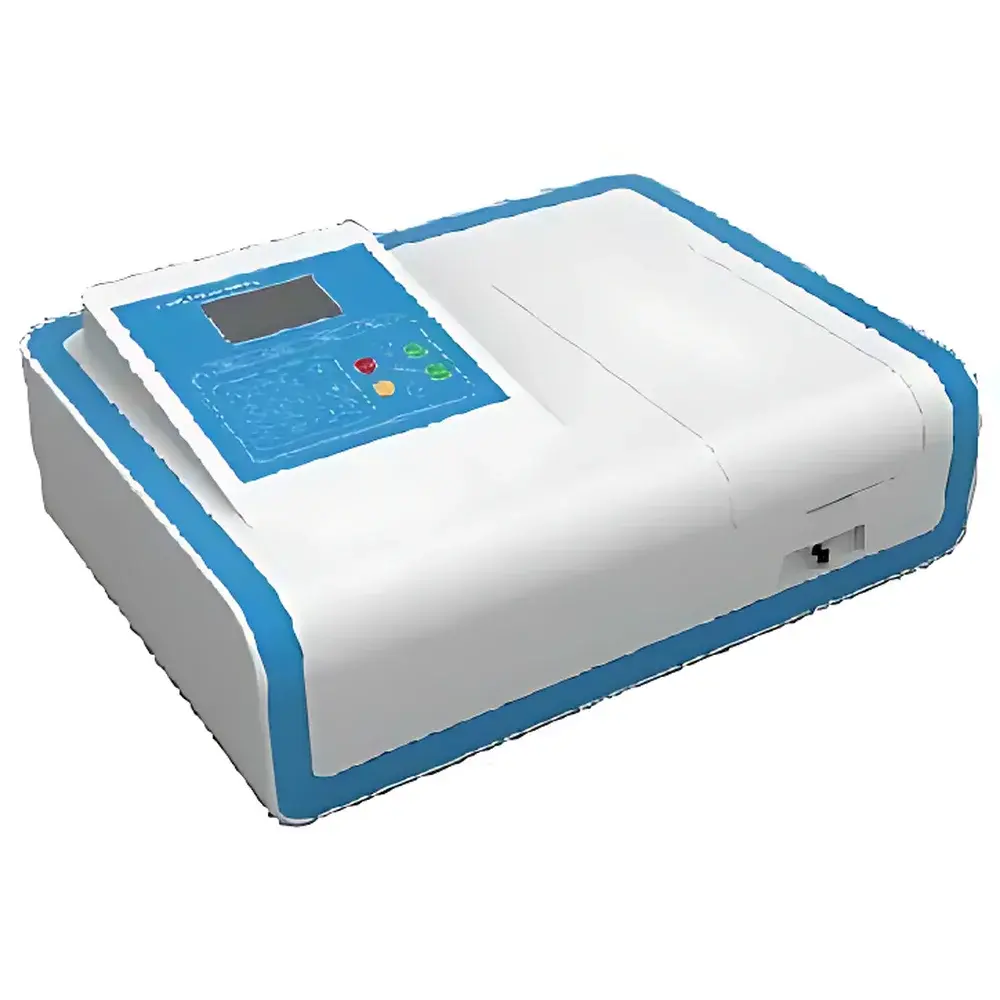
Chu Ding UV756CRT UV-Vis Spectrophotometer
| Brand | Chu Ding |
|---|---|
| Origin | Shanghai, China |
| Model | UV756CRT |
| Wavelength Range | 190–1100 nm |
| Wavelength Accuracy | ±0.5 nm |
| Wavelength Repeatability | 0.2 nm |
| Spectral Bandwidth | 2 nm |
| Photometric Accuracy (Transmittance) | ±0.5% T |
| Photometric Repeatability (Transmittance) | 0.2% T |
| Transmittance Range | 0.0–125% T |
| Absorbance Range | −0.031 to 3.0 A |
| Concentration Display Range | 0–1999 |
| Stray Light | ≤0.05% T at 220 nm and 340 nm |
| Baseline Flatness | ±0.002 A (200–1000 nm) |
| Drift | ±0.001 A/h (at 500 nm, after 2 h warm-up) |
| Noise | ±0.001 A (at 500 nm, after 30 min warm-up) |
| RS232 Interface | Yes |
| Printer Support | Integrated |
| Software Compatibility | PC-based data acquisition and analysis software |
Overview
The Chu Ding UV756CRT is a microprocessor-controlled, single-beam scanning UV-Vis spectrophotometer engineered for routine quantitative analysis and spectral characterization in academic, industrial, and quality control laboratories. Operating on the principle of Beer–Lambert law-based absorbance measurement, the instrument employs a high-efficiency 1200 lines/mm holographic grating and a dual-lamp optical system (deuterium for UV, tungsten-halogen for visible/NIR) to deliver continuous spectral scans across 190–1100 nm. Its fixed 2 nm spectral bandwidth ensures optimal resolution for standard compliance testing while maintaining signal-to-noise performance suitable for low-concentration assays. Designed for reproducible photometric measurements, the UV756CRT meets foundational requirements for method validation under ISO/IEC 17025 and supports traceable calibration using NIST-traceable reference standards.
Key Features
- High-precision wavelength drive mechanism with ±0.5 nm accuracy and 0.2 nm repeatability—enabling reliable peak identification and multi-point calibration.
- Optimized optical path incorporating imported photodetectors and stabilized lamp power supply, delivering baseline flatness of ±0.002 A over 200–1000 nm and photometric noise of ±0.001 A at 500 nm after 30 minutes warm-up.
- Dual-lamp auto-switching system with intelligent timing control minimizes transition artifacts and extends source lifetime—typical deuterium lamp life exceeds 1,000 hours under standard operating conditions.
- Integrated RS232 serial interface enables direct communication with external PCs for automated data logging, report generation, and remote instrument control.
- Onboard printer support and bundled PC software provide full spectral acquisition, kinetic scan, multi-wavelength quantitation, and standard curve fitting (linear, quadratic, cubic, and 4-parameter logistic).
- Modular accessory compatibility—including 1 cm, 5 cm, and 10 cm cuvette holders; variable pathlength cells; fiber-optic probes; and temperature-controlled sample compartments—for method flexibility without hardware modification.
Sample Compatibility & Compliance
The UV756CRT accommodates standard quartz, glass, or plastic cuvettes (up to 10 mm pathlength) and supports liquid, solution-phase samples across pharmaceutical, environmental, food, and biochemical applications. It complies with core photometric performance criteria outlined in ASTM E275, ISO 6059, and USP for spectrophotometric instrumentation. While not inherently 21 CFR Part 11 compliant out-of-the-box, its RS232 interface and audit-ready software output allow integration into validated workflows when paired with appropriate electronic record systems meeting ALCOA+ principles. Routine verification protocols—including wavelength accuracy checks with holmium oxide and didymium filters, photometric linearity assessment via neutral density filters, and stray light verification at 220 nm and 340 nm—are fully supported by the instrument’s calibration routines.
Software & Data Management
The included Windows-compatible software provides comprehensive spectral management capabilities: real-time scanning, overlay of up to 12 spectra, derivative spectroscopy (1st–3rd order), time-scan kinetics (up to 9,999 points), and concentration calculation using stored calibration curves. All data files are saved in ASCII-delimited format (.txt) and CSV, ensuring interoperability with LIMS, Excel, and statistical analysis platforms such as JMP or GraphPad Prism. Audit trail functionality records operator ID, timestamp, parameter changes, and measurement events—facilitating GLP/GMP-aligned documentation when deployed in regulated environments. Firmware updates and method templates can be loaded via RS232 or USB-to-serial adapter.
Applications
The UV756CRT serves as a workhorse instrument for diverse analytical tasks including: quantification of nucleic acids and proteins (e.g., A260/A280 ratio analysis); assay development for enzyme kinetics and inhibitor screening; dissolution testing in pharmaceutical QA/QC; nitrate/nitrite and phosphate determination in environmental water samples; colorimetric assays (e.g., Bradford, Lowry, BCA); purity assessment of organic intermediates; and excipient compatibility studies. Its extended NIR range (up to 1100 nm) also supports basic near-infrared characterization of dyes, pigments, and polymer additives where overtone and combination band analysis is required.
FAQ
What is the difference between the UV756 and UV756CRT models?
The “CRT” suffix denotes integrated cathode-ray tube display capability—allowing direct spectral visualization without a connected PC. Both models share identical optical specifications, but the CRT variant includes an analog oscilloscope-style display for rapid qualitative scanning.
Is the instrument supplied with calibration certificates?
Factory calibration is performed using traceable standards; however, formal ISO/IEC 17025-accredited calibration certificates require third-party service and are available upon request prior to shipment.
Can the UV756CRT perform kinetic measurements?
Yes—the instrument supports time-scan mode with user-defined intervals from 0.1 s to 999 s per point, enabling monitoring of reaction progress, enzymatic activity, or stability studies.
Does it support GLP-compliant data archiving?
While the base software does not include electronic signature or role-based access control, its structured ASCII output and event logging enable implementation within validated LIMS or ELN systems meeting GLP audit requirements.
What maintenance is recommended for long-term photometric stability?
Biannual cleaning of the optical bench with lint-free swabs and spectroscopic-grade solvent, annual lamp replacement (especially deuterium source), and quarterly verification of wavelength and photometric accuracy using certified reference materials are advised.





