
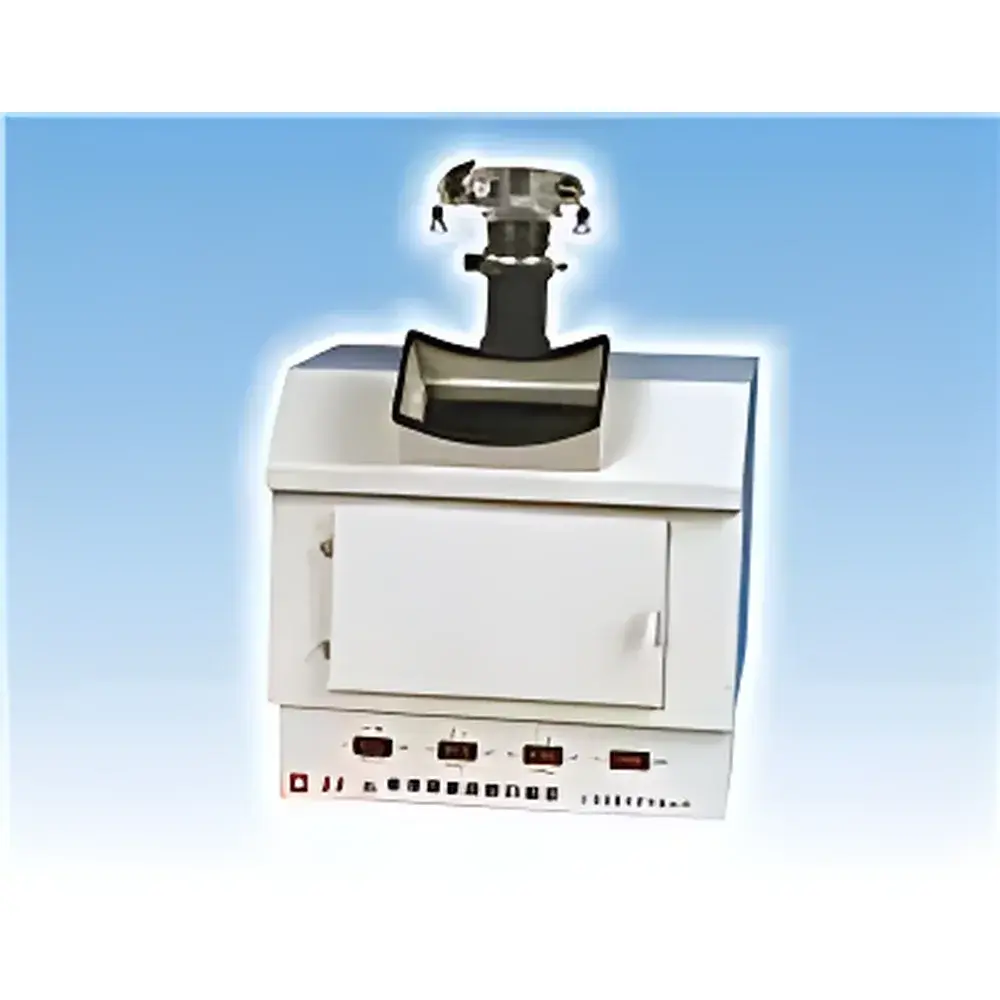
Chu Ding ZF-2 UV Transilluminator and Gel Documentation System
| Brand | Chu Ding |
|---|---|
| Model | ZF-2 |
| Category | UV Transilluminator with Reflective UV Illumination & Integrated Dark Chamber |
| Power Supply | AC 220 V ±10%, 50 Hz |
| Transmitted UV Power | 64 W |
| White Light Illumination Power | 40 W |
| UV Filter Size (Transmittance) | 200 × 150 mm |
| UV Wavelength | 302 nm |
| Chamber Dimensions (L×W×H) | 350 × 260 × 360 mm |
Overview
The Chu Ding ZF-2 UV Transilluminator and Gel Documentation System is an integrated laboratory instrument engineered for nucleic acid visualization, gel documentation, and fluorescence-based analytical imaging in molecular biology workflows. It operates on the principle of ultraviolet-induced fluorescence excitation—specifically at 302 nm—optimized to maximize ethidium bromide (EtBr), SYBR® Safe, and other common nucleic acid stain emission while minimizing photodamage to DNA samples. Unlike conventional transilluminators limited to bottom illumination, the ZF-2 incorporates dual-mode illumination: high-intensity transmitted UV (via a 200 × 150 mm quartz-filtered lamp array) and adjustable reflective UV (mounted on an articulated arm), enabling uniform excitation of both slab gels and surface-bound samples such as TLC plates, paper chromatograms, or enzyme activity gels. Its fully enclosed dark chamber eliminates ambient light interference and integrates a standardized camera mounting interface compatible with DSLR/mirrorless systems equipped with macro lenses and PCR-grade bandpass filters (e.g., 590 nm long-pass). The stainless steel chassis and UV-blocking viewing window (>95% attenuation at 254–365 nm) ensure operator safety and regulatory compliance under IEC 61010-1.
Key Features
- Dual-wavelength-capable optical architecture: Fixed 302 nm transilluminator for high-sensitivity DNA/RNA gel imaging; independently adjustable reflective UV module for top-down fluorescence excitation of non-transparent substrates.
- Integrated safety-certified dark chamber: Eliminates need for dedicated darkrooms; features polycarbonate UV-shielded observation window meeting EN 62471 photobiological safety requirements.
- Precision-engineered illumination geometry: Reflective UV arm allows height and angle adjustment to optimize signal-to-noise ratio across heterogeneous sample surfaces—including native PAGE, zymograms, and thin-layer chromatography plates.
- Standardized imaging interface: Dedicated 1/4″-20 threaded camera mount with alignment reference marks; supports third-party macro lens adapters and filter holders for reproducible documentation under GLP-aligned conditions.
- Thermally stable power management: Separate circuitry for UV transmission (64 W), white-light illumination (40 W), and reflection modules ensures consistent irradiance output without thermal drift during extended exposure sessions.
Sample Compatibility & Compliance
The ZF-2 accommodates standard electrophoretic formats including agarose (0.5–3.0%), polyacrylamide (8–20%), and SDS-PAGE gels up to 150 × 150 mm. It is validated for use with EtBr, GelRed®, SYBR® Gold, and fluorescein-labeled oligonucleotides. For non-gel applications, it supports qualitative analysis of alkaloids, steroids, vitamins (e.g., B2, B12), and enzyme isoforms resolved by native PAGE or IEF—common in pharmaceutical QC per USP Analytical Instrument Qualification guidelines. All electrical components conform to IEC 61010-1:2010 for laboratory equipment safety. UV emission profiles are documented per ISO 15265:2001 for occupational UV exposure assessment. No FDA 21 CFR Part 11 functionality is embedded; however, raw image capture via external cameras supports audit-trail-enabled documentation when paired with compliant LIMS or ELN platforms.
Software & Data Management
The ZF-2 is hardware-only: it does not include proprietary acquisition software or onboard storage. Instead, it is designed for interoperability with industry-standard imaging platforms—including Image Lab™ (Bio-Rad), AlphaView SA (ProteinSimple), and open-source tools like Fiji/ImageJ. Camera trigger synchronization is manual (shutter release cable or timed exposure), supporting exposure bracketing for optimal band contrast. Metadata logging (exposure time, filter type, lamp mode) must be maintained externally per GLP Annex 11 principles. The absence of embedded firmware simplifies 21 CFR Part 11 validation pathways, as system qualification focuses solely on illumination stability (verified via NIST-traceable radiometer calibration) and mechanical repeatability of camera positioning.
Applications
- Visualization and documentation of DNA/RNA fragments post-electrophoresis under standard intercalating dyes.
- Quantitative densitometry of protein bands in Coomassie- or silver-stained gels when used with calibrated white-light illumination.
- TLC plate analysis for pharmaceutical impurity profiling per ICH Q5C guidelines.
- PCR product verification and cloning validation workflows requiring rapid, low-damage UV inspection.
- Enzyme activity assays (e.g., esterase, dehydrogenase zymograms) where substrate cleavage generates fluorescent products.
- Educational laboratory instruction in molecular biology techniques, emphasizing safe UV handling protocols and documentation rigor.
FAQ
Is the ZF-2 suitable for SYBR® Safe staining?
Yes—the 302 nm emission peak aligns closely with SYBR® Safe’s excitation maximum (300 nm), delivering strong signal intensity with reduced mutagenicity risk compared to 254 nm systems.
Can the reflective UV module be used without the dark chamber?
No. The reflective arm is calibrated for use within the chamber environment; operation outside requires certified UV PPE (ANSI Z87.1 goggles, face shield) and controlled access per OSHA 1910.133.
Does the instrument support time-lapse fluorescence imaging?
Not natively—exposure control is manual. However, external intervalometers or programmable DSLR firmware (e.g., Magic Lantern) can enable automated multi-frame capture when mounted correctly.
What maintenance is required for long-term UV output stability?
UV lamps should be replaced every 1,000 hours of cumulative use; quartz filter surfaces require weekly cleaning with ethanol-moistened lint-free wipes to prevent transmission loss.
Is the camera mount compatible with Canon EF-M and Sony E-mount systems?
Yes—via commercially available M42-to-native-mount adapters; mechanical alignment tolerances remain within ±0.15 mm across all supported interfaces.





