
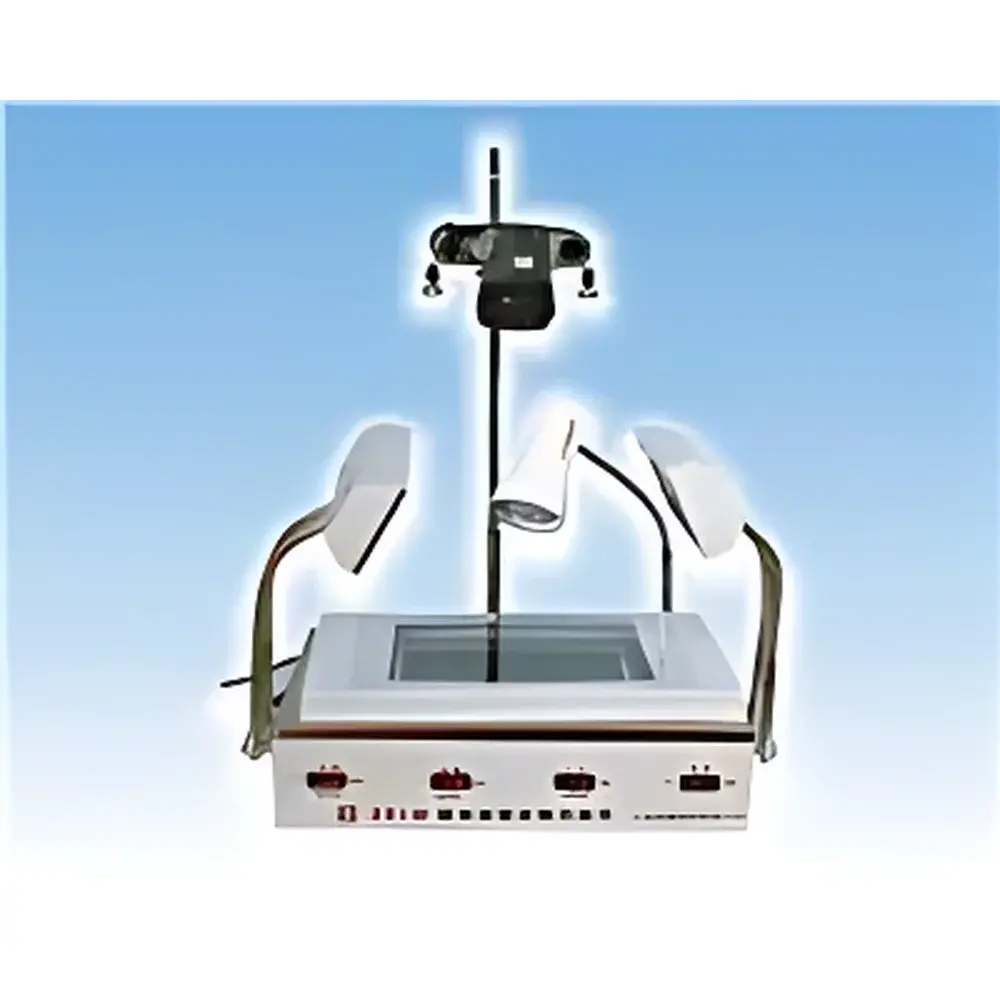
Chu Ding Technology ZF-3 UV Transilluminator and Reflective Gel Documentation System
| Brand | Chu Ding Technology |
|---|---|
| Origin | Shanghai, China |
| Manufacturer Type | Authorized Distributor |
| Product Category | Domestic |
| Model | ZF-3 |
| Price | USD 645 (FOB Shanghai) |
| Input Voltage | AC 220 V ±10%, 50 Hz |
| Transilluminator Power | 48 W (254 nm), 64 W (302 nm/365 nm) |
| Reflector Power | 24 W (dual-channel: 254 nm & 365 nm) |
| Illumination Lamp | 40 W incandescent white light |
| Transmissive UV Filter Size | 200 × 150 mm |
| Reflective UV Filter Size | 200 × 80 mm |
| UV Wavelength Options | 254 nm, 302 nm, 365 nm (transmission) |
Overview
The Chu Ding Technology ZF-3 UV Transilluminator and Reflective Gel Documentation System is a dual-mode analytical instrument engineered for high-sensitivity visualization, qualitative assessment, and photographic documentation of nucleic acid and protein samples resolved by electrophoretic techniques. It operates on the principle of ultraviolet-induced fluorescence: when nucleic acids (e.g., ethidium bromide– or SYBR®-stained DNA/RNA) or fluorescently labeled proteins absorb UV radiation at specific wavelengths, they emit visible light in the orange-red or green spectrum—enabling detection at nanogram-level sensitivities. The ZF-3 integrates both transmissive and reflective UV excitation geometries within a modular, darkroom-compatible platform. Its core design prioritizes analytical flexibility—supporting standard agarose and polyacrylamide gel imaging, thin-layer chromatography (TLC), paper chromatography, and enzyme activity zymography—while minimizing photodamage to biological macromolecules via optional 302 nm illumination, which reduces UV-induced strand breakage compared to 254 nm exposure.
Key Features
- Dual-mode optical architecture: Independent transilluminator (200 × 150 mm active area) and dual-wavelength reflective UV stage (200 × 80 mm) enable simultaneous top-down and bottom-up fluorescence excitation.
- Multi-wavelength UV selection: Four transmission channels—254 nm (high-sensitivity nucleic acid detection), 302 nm (low-damage alternative with balanced sensitivity), 365 nm (reduced background, ideal for SYBR® Safe and long-wave dyes), and visible white light (for sample positioning and focus calibration).
- Reflective UV versatility: Two independent reflector banks—254 nm and 365 nm—optimized for non-transparent substrates including TLC plates, nitrocellulose membranes, and native gels where transillumination is impractical.
- Integrated white-light illumination: 40 W incandescent lamp with adjustable height and angle facilitates precise camera alignment and pre-exposure framing without UV interference.
- Robust mechanical design: Aluminum alloy frame with heat-dissipating ventilation ensures stable operation during extended imaging sessions; all UV filters comply with ISO 9001-certified optical transmission specifications (OD ≥ 4.0 at non-target wavelengths).
Sample Compatibility & Compliance
The ZF-3 accommodates standard electrophoresis formats—including 10 × 10 cm to 20 × 20 cm gels—and supports common fluorescent stains (ethidium bromide, GelRed®, SYBR® Gold, Coomassie Fluorescent Stain) as well as intrinsic fluorophores (e.g., NADH, flavoproteins). It is routinely deployed in academic laboratories, QC units in biopharmaceutical manufacturing, and clinical research settings conducting PCR product verification, restriction digest analysis, and mutational screening. While not FDA-cleared as a diagnostic device, the system adheres to IEC 61010-1 safety standards for laboratory equipment and incorporates interlocked UV shielding to prevent operator exposure—meeting EN 62471 (Photobiological Safety of Lamps) requirements for UV hazard classification. For GLP/GMP-aligned workflows, the instrument supports manual audit trails via logbook documentation; optional external timer integration enables repeatable exposure control compliant with internal SOPs.
Software & Data Management
The ZF-3 is a hardware-only platform designed for seamless integration with third-party imaging systems. It does not include proprietary acquisition software but is fully compatible with industry-standard applications—including ImageLab™ (Bio-Rad), AlphaView SA (ProteinSimple), and open-source tools such as Fiji/ImageJ—when paired with DSLR or scientific CMOS cameras equipped with UV-transmissive lenses and appropriate bandpass filters (e.g., 590 nm long-pass for EtBr, 535 nm for SYBR® Green). All UV channels are manually switched via front-panel toggle switches with LED indicators, ensuring deterministic state control without firmware dependencies. Exposure timing is managed externally—either via camera built-in timers or mechanical shutter triggers—supporting reproducible documentation under defined irradiance conditions per ASTM E2912-13 (Standard Practice for UV Imaging of Nucleic Acids).
Applications
- Visualization and semi-quantitative densitometry of DNA/RNA bands in agarose and denaturing PAGE gels.
- Documentation of restriction fragment length polymorphism (RFLP) and PCR amplification products for publication-grade figures.
- TLC plate analysis for metabolite profiling, antibiotic residue screening, and herbal extract fingerprinting.
- Zymographic detection of matrix metalloproteinases (MMPs) and other proteolytic enzymes using dye-quenched substrates.
- Verification of plasmid integrity, ligation efficiency, and CRISPR-Cas9 editing outcomes via fragment size confirmation.
- Quality control of fluorescently labeled oligonucleotides and aptamers in oligo synthesis facilities.
FAQ
Does the ZF-3 include a built-in camera or imaging software?
No—the ZF-3 is an illumination platform only. Users must supply a DSLR, mirrorless, or scientific camera with UV-capable optics and external triggering capability.
Can the ZF-3 be used safely without the optional dark enclosure?
Yes—but operation requires a light-tight environment (e.g., dedicated darkroom or blackout tent) to prevent ambient light contamination and ensure optimal signal-to-noise ratio during imaging.
What safety certifications apply to the UV sources?
All UV lamps are classified as Risk Group 2 (RG2) per IEC 62471; the unit includes physical UV-blocking acrylic shields and failsafe circuitry that deactivates lamps upon lid opening.
Is 302 nm illumination suitable for SYBR® Safe staining?
Yes—302 nm provides optimal excitation efficiency for SYBR® Safe while significantly reducing DNA photochemical damage relative to 254 nm, supporting downstream cloning and sequencing applications.
How is wavelength selection controlled?
Via discrete front-panel rocker switches with status LEDs; no microprocessor or menu navigation is involved—ensuring reliability and eliminating firmware-related failure modes.




