
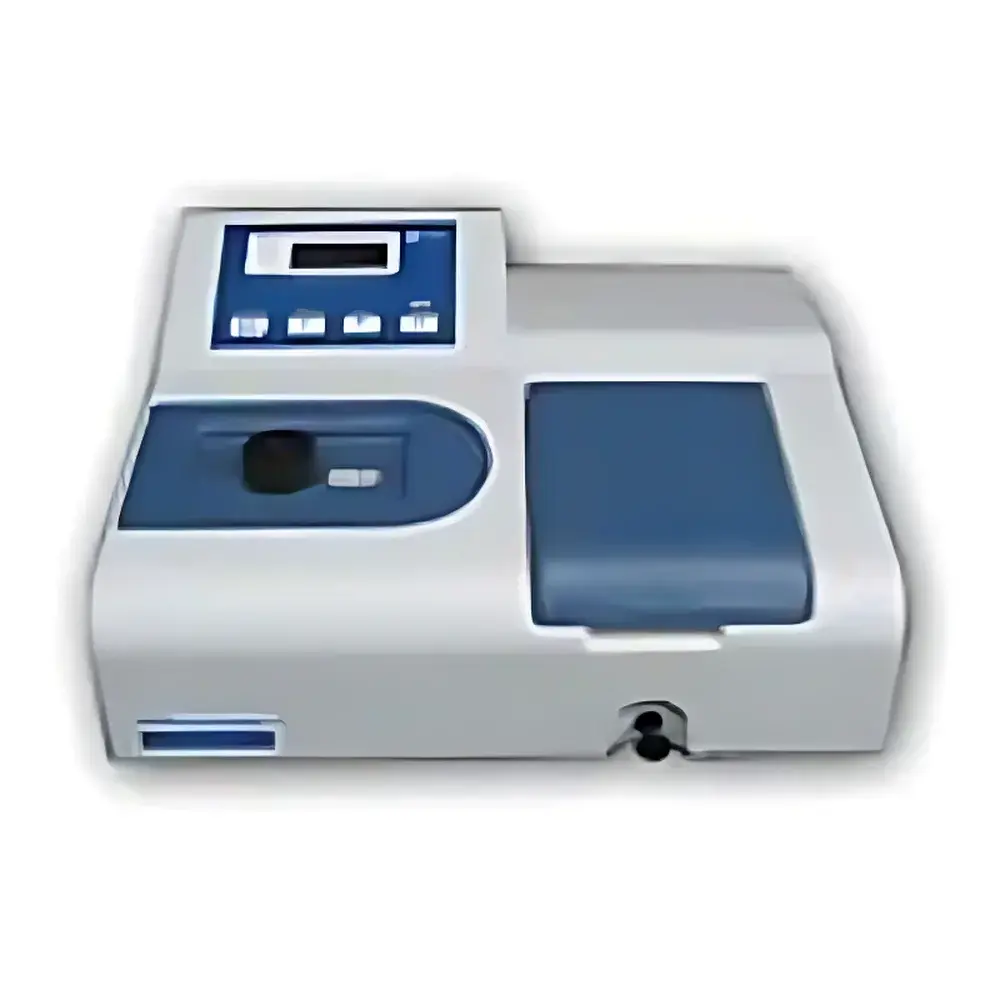
Chu Ding Technology VIS-722N Advanced Visible Spectrophotometer
| Brand | Chu Ding Technology |
|---|---|
| Origin | Shanghai, China |
| Model | VIS-722N |
| Optical System | Achromatic Czerny-Turner with 1200 lines/mm grating |
| Wavelength Range | 320–1020 nm |
| Wavelength Accuracy | ±2 nm |
| Spectral Bandwidth | 4 nm |
| Stray Light | ≤0.05% T at 360 nm |
| Photometric Accuracy | ±0.3% T |
| Photometric Repeatability | ±0.2% T |
| Baseline Drift | ≤0.1% T/h |
| Noise Level | ≤0.2% T |
| Stability | ±0.003 A/h at 500 nm |
| Wavelength Drive | Manual |
| Detector Type | Photodiode Array |
| Light Source | Imported Tungsten Halogen Lamp |
| Net Weight | 8 kg |
| Beam Type | Single-beam |
| Data Output | Optional RS-232 or USB print interface |
| Software Support | None |
Overview
The Chu Ding Technology VIS-722N is a precision-engineered single-beam visible spectrophotometer designed for routine quantitative and qualitative analysis in the 320–1020 nm spectral range. Based on an achromatic Czerny-Turner optical architecture incorporating a 1200 lines/mm holographic grating, the instrument delivers high wavelength fidelity and consistent photometric performance under standard laboratory conditions. Its core measurement principle relies on Beer–Lambert law-based absorbance (A) and transmittance (%T) determination, where sample-induced attenuation of collimated visible light is quantified via a calibrated photodiode array detector. Unlike double-beam systems, the VIS-722N employs a stable tungsten-halogen lamp source and manual wavelength selection—making it especially suitable for fixed-wavelength assays, calibration verification, and teaching laboratories where operational simplicity, mechanical robustness, and cost efficiency are prioritized over automated scanning capability.
Key Features
- Optical design optimized for visible-range accuracy: Achromatic Czerny-Turner monochromator with 1200 L/mm grating ensures minimal chromatic aberration and reproducible spectral resolution.
- High photometric integrity: ±0.3% T photometric accuracy and ±0.2% T repeatability meet baseline requirements for QC testing in regulated environments.
- Low stray light performance: ≤0.05% T at 360 nm supports reliable detection of low-absorbance samples near the UV edge of the visible spectrum.
- Thermally stable tungsten-halogen lamp: Provides consistent radiant output over extended operation cycles, contributing to <0.1% T/h baseline drift.
- Manual wavelength adjustment with vernier scale: Enables precise, tactile positioning across the full 320–1020 nm range without reliance on motorized components—enhancing long-term mechanical reliability.
- Compact, benchtop form factor (8 kg net weight): Designed for space-constrained labs, educational facilities, and field-deployable quality control stations.
Sample Compatibility & Compliance
The VIS-722N accommodates standard 10 mm pathlength cuvettes (glass, quartz, or plastic), supporting liquid-phase analysis of aqueous and organic solutions, suspensions, and colored reagents. It complies with fundamental optical metrology principles defined in ISO 6223 (spectrophotometers — terminology and definitions) and aligns with performance benchmarks referenced in ASTM E275 (Standard Practices for Describing and Measuring Performance of Ultraviolet, Visible, and Near Infrared Spectrophotometers). While not equipped with electronic audit trails or user-access controls, its manual operation and deterministic optical path make it suitable for GLP-compliant workflows where procedural documentation—not software validation—is the primary traceability mechanism. The instrument satisfies essential functional criteria for method validation per USP and EP 2.2.25 in applications involving concentration determination, purity assessment, and kinetic monitoring in non-GMP manufacturing support roles.
Software & Data Management
The VIS-722N operates as a standalone optical instrument with no embedded microprocessor or digital interface firmware. All parameter setting—including transmittance/absorbance mode selection, zeroing, and wavelength adjustment—is performed manually via front-panel controls. Data recording is analog or external: users may connect optional RS-232 or USB-compatible thermal printers for hard-copy output of single-point readings. No proprietary software is supplied; however, measured values (T%, A, or concentration via pre-entered calibration factors) can be logged into third-party spreadsheets or LIMS platforms via manual entry. This architecture eliminates software qualification burdens under FDA 21 CFR Part 11 while preserving full operator control over measurement sequence and environmental context—a key advantage in training, troubleshooting, and method development environments.
Applications
- Pharmaceutical QA/QC: Quantitative assay of dye-labeled excipients, dissolution testing of colored tablets, and colorimetric end-point detection in titration protocols.
- Food & Beverage: Determination of nitrite content in cured meats, anthocyanin concentration in fruit juices, and caramel color intensity (E150) in soft drinks.
- Environmental Monitoring: Measurement of phosphate, silicate, and iron concentrations in surface water using standard APHA-approved colorimetric methods.
- Clinical Chemistry: Hemoglobin estimation via cyanmethemoglobin conversion, bilirubin screening in serum, and uric acid quantification in urine specimens.
- Petrochemical Analysis: Evaluation of lubricant oxidation products and asphaltene content through controlled wavelength absorbance at 400–600 nm.
- Academic Instruction: Teaching spectroscopic fundamentals—including calibration curve construction, Beer’s law verification, and spectral interference analysis—in undergraduate chemistry and biology laboratories.
FAQ
Is the VIS-722N compliant with ISO or ASTM standards?
Yes—the optical performance specifications conform to the general test criteria outlined in ISO 6223 and ASTM E275 for visible-range spectrophotometers, particularly regarding wavelength accuracy, stray light, and photometric repeatability.
Can this instrument be used for UV-range measurements below 320 nm?
No—the VIS-722N is strictly a visible spectrophotometer. Its tungsten-halogen source exhibits negligible output below 320 nm, and the optical coatings are not optimized for UV transmission. For UV–Vis applications, consider the UV752N or UV1900 series.
Does the instrument support automatic wavelength scanning?
No—it features manual wavelength drive only. Scanning functionality requires external integration with stepper-motor controllers and data acquisition hardware, which is outside the scope of factory configuration.
What type of cuvettes are compatible?
Standard 10 mm square-path quartz, glass, or disposable plastic cuvettes may be used. Quartz is recommended for measurements near 320 nm to minimize absorption artifacts.
Is regulatory documentation (e.g., Certificate of Conformance, calibration report) provided?
Each unit ships with a factory calibration certificate verifying wavelength accuracy and photometric linearity at specified reference wavelengths (e.g., 350, 546, and 800 nm), traceable to NIM (National Institute of Metrology, China) standards.






