
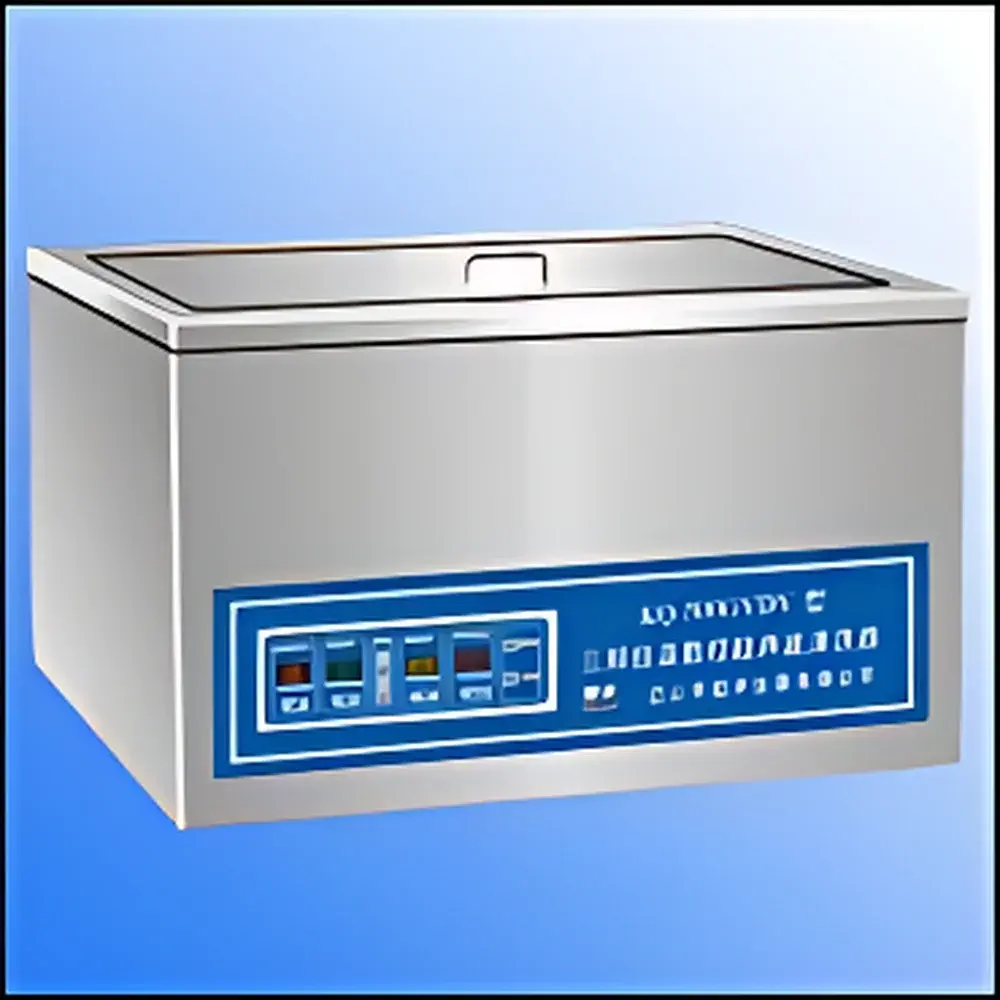
Chu Ding KQ-300GVDV / KQ-500GVDV / KQ-600GVDV Benchtop Dual-Frequency Temperature-Controlled Ultrasonic Cleaner
| Brand | Chu Ding |
|---|---|
| Origin | Shanghai, China |
| Model | KQ-300GVDV / KQ-500GVDV / KQ-600GVDV |
| Tank Dimensions (L×W×H) | 300×240×180 mm (KQ-300GVDV) / 500×300×180 mm (KQ-500GVDV & KQ-600GVDV) |
| Capacity | 13 L (KQ-300GVDV) / 27 L (KQ-500GVDV & KQ-600GVDV) |
| Ultrasonic Frequency | 28 kHz |
| Ultrasonic Power | 300 W / 500 W / 600 W |
| Power Adjustment Range | 40–100% |
| Heating Power | 600 W (KQ-300GVDV) / 1000 W (KQ-500/600GVDV) |
| Cooling Power | 300 W |
| Temperature Control Range | 0–80 °C |
| Timer Range | 1–480 min |
| Construction | Stainless steel tank with argon-welded mesh basket and corrosion-resistant sealing gasket |
Overview
The Chu Ding KQ-GVDV Series represents a class of benchtop dual-frequency temperature-controlled ultrasonic cleaners engineered for precision laboratory cleaning, degassing, emulsification, homogenization, extraction, and cell disruption. Unlike conventional ultrasonic systems where bath temperature rises uncontrollably during prolonged operation—leading to thermal degradation of sensitive samples or inconsistent cavitation intensity—the KQ-GVDV series integrates active heating and thermoelectric cooling modules within a single control architecture. This enables dynamic thermal regulation independent of ultrasonic duty cycle, maintaining solution temperature within ±0.5 °C across extended operational periods (up to 480 minutes). The system operates simultaneously at two discrete frequencies—28 kHz and 45 kHz—with automatic frequency switching logic governed by pre-programmed time intervals (1–999 seconds), allowing users to optimize cavitation energy distribution for diverse contaminant types (e.g., organic residues vs. inorganic particulates) and substrate geometries.
Key Features
- Dual-frequency ultrasonic generation (28 kHz and 45 kHz) with programmable auto-switching intervals for enhanced cleaning efficacy across heterogeneous sample matrices.
- Integrated Peltier-based cooling module (300 W) paired with high-efficiency resistive heating elements (600–1000 W), enabling stable isothermal operation from 0 °C to 80 °C without external chillers.
- Microprocessor-controlled digital interface with non-volatile memory for storing up to 10 user-defined protocols—including frequency selection, power level (40–100%), temperature setpoint, and timer duration.
- Stainless steel (304 grade) ultrasonic tank with argon-welded perforated mesh basket for uniform acoustic coupling and mechanical durability; noise-reducing lid with corrosion-resistant EPDM sealing gasket.
- Drain valve assembly constructed from stainless steel ball valve hardware for reliable, leak-free fluid evacuation post-cycle.
- Real-time digital display of actual bath temperature, set temperature, elapsed time, remaining time, selected frequency, and instantaneous ultrasonic power output.
Sample Compatibility & Compliance
The KQ-GVDV series accommodates a wide range of sample vessels—including glass beakers, quartz cuvettes, metal fixtures, ceramic substrates, and polymer microplates—without compromising acoustic transmission efficiency. Its precisely regulated thermal environment ensures compatibility with thermolabile biological samples (e.g., protein solutions, nucleic acid preparations, primary cell suspensions) and volatile organic solvents (e.g., acetone, isopropanol, ethanol). While not certified for ISO 13485 or FDA 21 CFR Part 11 out-of-the-box, the instrument’s deterministic control logic, parameter logging capability, and reproducible thermal/sonic profiles support GLP-compliant documentation when integrated into validated laboratory workflows. All electrical components conform to IEC 61010-1 safety standards for laboratory equipment.
Software & Data Management
Operation is managed via an embedded 8-bit microcontroller with firmware supporting full parameter recall, real-time monitoring, and error diagnostics (e.g., overtemperature, low-level detection, transducer impedance drift). Though no PC connectivity or proprietary software suite is provided, the unit logs timestamped operational metadata—including start/stop times, temperature deviation history, and frequency transition events—to internal EEPROM. These records may be manually transcribed for audit trail purposes in regulated environments. Optional RS-232 or USB-to-serial adapters can enable basic remote triggering and status polling in custom-developed automation scripts.
Applications
- Removal of polishing compounds, oxides, and flux residues from precision optical components and semiconductor wafers.
- Pre-analytical sample preparation for ICP-MS, HPLC, and GC-MS, including digestion vessel cleaning and solvent degassing to eliminate dissolved gas interference.
- Cell lysis and subcellular fractionation in molecular biology labs, leveraging controlled cavitation to disrupt membranes while preserving enzyme activity.
- Ultrasonic-assisted extraction of phytochemicals, alkaloids, and essential oils under isothermal conditions to prevent thermal decomposition.
- Homogenization of nanoparticle dispersions and colloidal suspensions prior to DLS or TEM analysis.
- De-airing of casting resins, dental impression materials, and composite precursors to eliminate void formation.
FAQ
Does the KQ-GVDV series support continuous operation at elevated temperatures?
Yes—active cooling compensates for ultrasonic energy dissipation, permitting uninterrupted operation at any temperature between 0 °C and 80 °C for up to 480 minutes.
Can the dual-frequency mode be operated manually, or is switching fully automated?
Frequency selection is programmable: users may fix a single frequency or define alternating cycles with durations from 1 to 999 seconds per frequency.
Is the stainless steel tank passivated or electropolished for high-purity applications?
The tank is fabricated from standard 304 stainless steel with mechanical polishing; electropolishing is available as a custom option upon request.
What maintenance is required for long-term reliability?
Routine cleaning of the transducer surface and tank interior with deionized water is recommended; annual inspection of cooling module thermal interface paste and heater element continuity is advised.
Are replacement mesh baskets and lids available as spare parts?
Yes—standard accessories including 304 stainless steel mesh baskets, silicone-sealed lids, and drain valve assemblies are stocked and orderable separately.



