
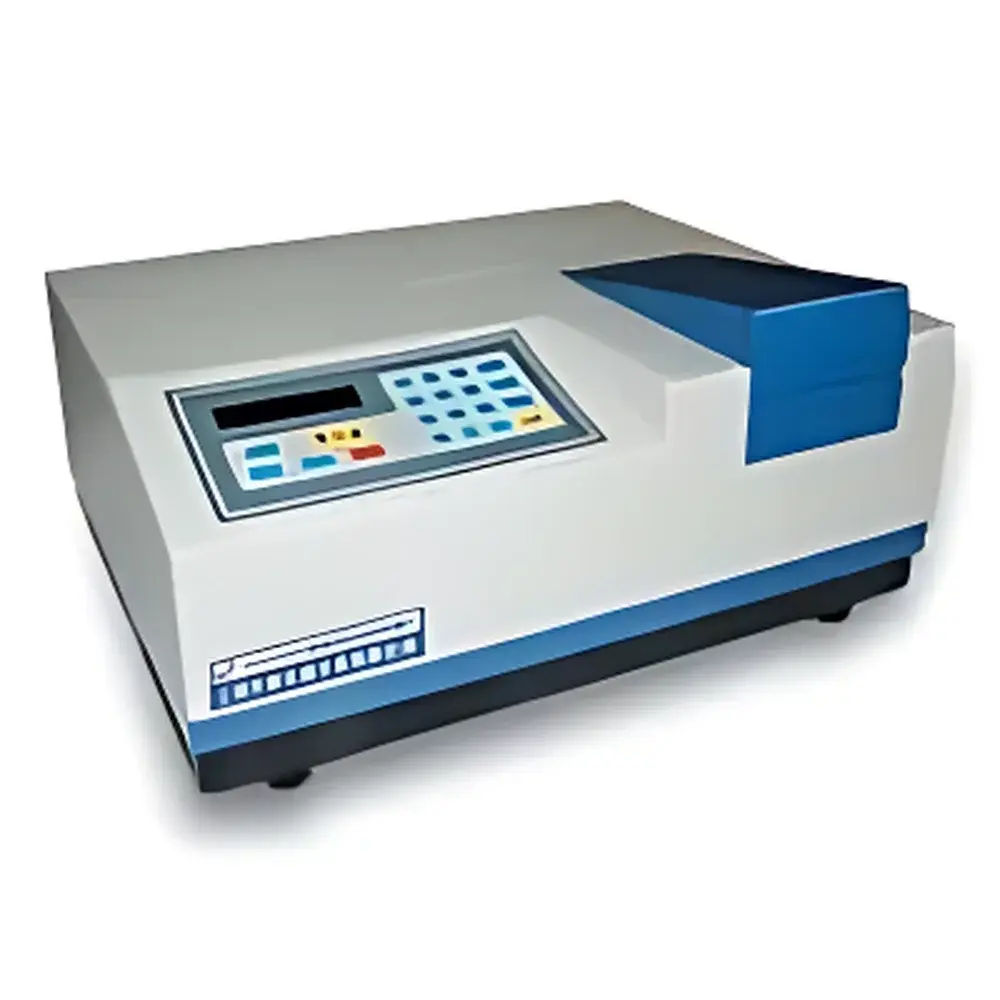
Chu Ding UV757CRT Ultraviolet-Visible Spectrophotometer
| Brand | Chu Ding |
|---|---|
| Origin | Shanghai, China |
| Manufacturer Type | Authorized Distributor |
| Country of Origin | China |
| Model | UV757CRT |
| Price | USD 3,600 (FOB Shanghai) |
| Wavelength Range | 200–1100 nm |
| Light Sources | Imported 12 V/20 W Tungsten-Halogen Lamp & Imported Deuterium Lamp |
| Detector | Imported Photocell |
| Spectral Bandwidth | 3 nm |
| Wavelength Accuracy | ±0.3 nm (auto-calibrated at startup) |
| Wavelength Repeatability | ≤0.2 nm |
| Stray Light | ≤0.15% T (at 220 nm and 340 nm) |
| Transmittance Range | 0.0–200.0% T |
| Absorbance Range | –0.301 to 4.000 A |
| Concentration Readout Range | 0000–9999 (arbitrary units) |
| Transmittance Accuracy | ±0.5% T (verified against NIST-traceable NBS 930D standard filter) |
| Transmittance Repeatability | ≤0.2% T |
| Noise | ≤0.5% T (100% T), ≤0.2% T (0% T) |
| Drift | ≤0.004 A / 30 min |
| Baseline Linearity | ±0.004 A |
| Power Supply | AC 220 V ±22 V, 50 Hz ±1 Hz |
| Dimensions | 520 × 410 × 200 mm (W × D × H) |
Overview
The Chu Ding UV757CRT is a single-beam, scanning ultraviolet-visible (UV-Vis) spectrophotometer engineered for routine quantitative and qualitative analysis in academic laboratories, quality control environments, and industrial R&D settings. It operates on the fundamental principle of Beer–Lambert law-based absorption spectroscopy, measuring the attenuation of monochromatic light as it passes through a sample solution across the spectral range of 200–1100 nm. Its optical architecture integrates a dual-lamp system—comprising an imported deuterium lamp for the UV region (190–350 nm) and a high-stability tungsten-halogen lamp for the visible and near-IR regions (350–1100 nm)—ensuring continuous spectral coverage without manual lamp switching. The instrument employs a fixed-slit monochromator with a 3 nm spectral bandwidth and an imported photocell detector, delivering consistent photometric performance suitable for method validation under ISO/IEC 17025 and GLP-compliant workflows.
Key Features
- Automated eight-position sample holder with programmable cuvette positioning—enabling unattended sequential measurement of up to eight samples or standards
- Pre-aligned, imported deuterium and tungsten-halogen lamps—guaranteeing long-term radiometric stability and minimizing recalibration frequency
- Self-calibrating wavelength verification at power-on—achieving ±0.3 nm accuracy traceable to NIST-standard reference materials
- Low-stray-light optical path design (<0.15% T at critical wavelengths)—enhancing linearity and dynamic range in high-absorbance measurements
- Dual-display interface: 2×20 character LCD on main unit for real-time parameter monitoring and operation status feedback
- Robust mechanical construction with precision-machined optical bench—reducing thermal drift (≤0.004 A/30 min) and supporting stable baseline performance (±0.004 A linearity)
Sample Compatibility & Compliance
The UV757CRT accommodates standard 10 mm square quartz or glass cuvettes (pathlengths from 1 mm to 50 mm via optional holders) and supports liquid, colloidal, and dissolved solid samples in transparent matrices. It complies with core photometric standards including ASTM E275 (describing spectrophotometer terminology and practice), ISO 6059 (water quality—determination of nitrate by UV spectrophotometry), and USP (Spectrophotometry and Light-Scattering). While not FDA 21 CFR Part 11–certified out-of-the-box, its firmware supports audit-trail-ready operation when integrated into validated laboratory information management systems (LIMS) under GxP frameworks. All photometric accuracy specifications are verified using NIST-traceable NBS 930D neutral-density filters per ISO 9001 calibration protocols.
Software & Data Management
The UV757CRT operates in standalone mode via front-panel controls but is fully compatible with optional PC-based acquisition software (Windows 10/11, USB 2.0 interface). This software enables full spectral scanning, kinetic time-course profiling, multi-wavelength quantitation, and derivative spectroscopy. Raw absorbance/transmittance data are exportable in CSV and ASCII formats for downstream statistical analysis in tools such as OriginLab, JMP, or Python-based SciPy pipelines. Software-generated reports include metadata stamps (date/time, operator ID, instrument serial number), calibration history logs, and compliance-ready measurement summaries—facilitating internal QA audits and external accreditation reviews.
Applications
- Quantitative determination of nucleic acids (A260/A280 ratio analysis) and proteins (Bradford/Lowry assays)
- Pharmaceutical assay validation per USP chapters , , and EP 2.2.25
- Environmental water testing—including COD, NO₃⁻, PO₄³⁻, and heavy metal complexation studies
- Food and beverage quality control—e.g., color index evaluation, preservative concentration monitoring (sorbates, benzoates)
- Chemical kinetics studies requiring time-resolved absorbance tracking at user-defined wavelengths
- Educational laboratory instruction in analytical chemistry, physical chemistry, and biochemistry curricula
FAQ
Does the UV757CRT support GLP-compliant data integrity requirements?
Yes—when used with the optional PC software and configured with operator password protection, measurement logging, and electronic signature fields, it supports ALCOA+ principles (Attributable, Legible, Contemporaneous, Original, Accurate) for regulated environments.
Is the instrument capable of performing spectral scanning across the full 200–1100 nm range in a single run?
Yes—the dual-lamp system and automatic lamp selection logic enable seamless scanning without interruption or manual intervention.
What cuvette materials are recommended for UV measurements below 240 nm?
Quartz cuvettes with UV-grade fused silica windows are required for reliable transmission below 240 nm; standard optical glass absorbs strongly in this region.
Can the UV757CRT be integrated into a networked laboratory environment?
While it lacks built-in Ethernet or Wi-Fi, its USB interface allows integration into centralized instrument management platforms via host PC bridging and virtual COM port emulation.
Is factory calibration documentation provided with shipment?
Each unit ships with a Certificate of Conformance and a NIST-traceable wavelength and photometric calibration report signed by the authorized distributor’s metrology lab.




