
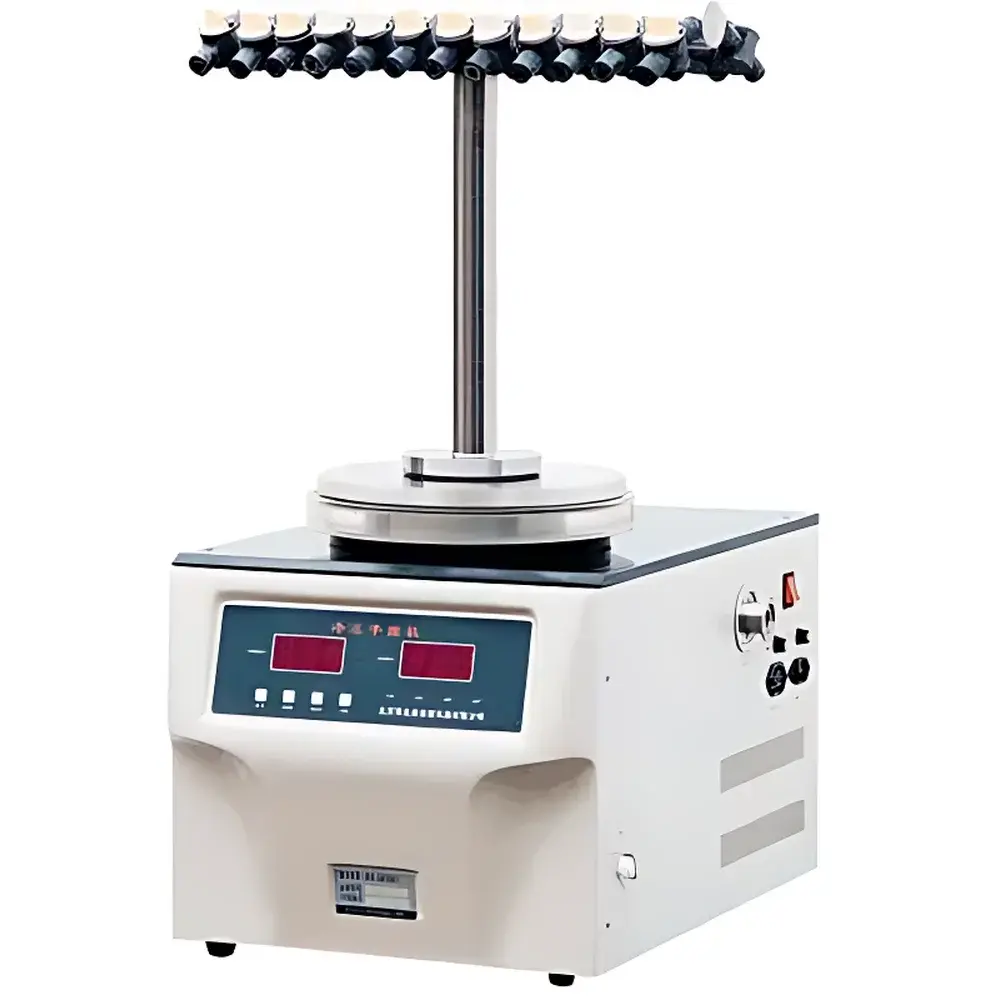
Chu Ding Technology FD-1E-50 T-Shaped Manifold Freeze Dryer
| Brand | Chu Ding Technology |
|---|---|
| Origin | Shanghai, China |
| Model | FD-1E-50 |
| Cold Trap Temperature | ≤ −50 °C |
| Ultimate Vacuum | < 20 Pa |
| Condenser Capacity | 3 kg/24 h |
| Condenser Dimensions | Φ220 × 130 mm |
| Sample Tray Size | Φ200 × 2 mm |
| Manifold Ports | 24 × standard glass tubing ports (for 10–22 mm OD ampoules) |
| Power Supply | 220 V, 50 Hz, 850 W |
| Overall Dimensions | 380 × 600 × 345 mm |
| Weight | ~65 kg |
Overview
The Chu Ding Technology FD-1E-50 T-Shaped Manifold Freeze Dryer is a benchtop lyophilization system engineered for precise, reproducible primary and secondary drying of heat-sensitive biological and pharmaceutical samples under high-vacuum and sub-zero conditions. Based on the physical principle of sublimation—where ice transitions directly from solid to vapor phase without passing through liquid—the FD-1E-50 enables gentle removal of water while preserving structural integrity, bioactivity, and long-term stability of labile compounds including bacterial and fungal cultures, monoclonal antibodies, plasmid DNA, enzymes, and vaccine candidates. Its T-shaped manifold architecture provides independent, simultaneous access to 24 sample positions, each fitted with a dedicated rubber-sealed valve compatible with standard 10–22 mm outer-diameter glass ampoules—making it ideal for microbial strain preservation, reference material banking, and small-batch R&D lyophilization in academic, QC, and early-stage bioprocess laboratories.
Key Features
- Benchtop footprint (380 × 600 × 345 mm) optimized for space-constrained labs; ergonomic front-panel layout with intuitive manual valve operation.
- High-efficiency hermetically sealed refrigeration system with imported compressor delivering stable cold trap temperature ≤ −50 °C—critical for efficient water vapor capture during primary drying.
- Stainless-steel condenser chamber (Φ220 × 130 mm) featuring smooth, coil-free interior surface for easy cleaning, corrosion resistance, and uniform frost distribution.
- Patented baffle-guided airflow design enhances effective condensing area and accelerates ice sublimation kinetics across all 24 manifold ports.
- Integrated pre-freezing capability: samples may be frozen directly in the condenser chamber prior to vacuum application—eliminating need for external ultra-low temperature freezers for many routine applications.
- Dual digital display showing real-time cold trap temperature and chamber pressure (0–100 Pa range, resolution ±1 Pa), enabling process monitoring without external gauges.
- Standardized KF-16 vacuum flange interface compliant with ISO-KF specifications—compatible with common two-stage rotary vane or diaphragm vacuum pumps (e.g., Edwards RV3, Welch 1400).
- Optional inert gas backfilling via imported solenoid-controlled purge valve—supports nitrogen or argon purging to prevent oxidation during sample loading/unloading and final sealing.
Sample Compatibility & Compliance
The FD-1E-50 is validated for use with standard borosilicate glass ampoules (10–22 mm OD), commonly employed in microbiological culture preservation per ATCC and DSMZ guidelines. Its 24-port T-manifold supports parallel processing of diverse sample types—including liquid suspensions, lyophilization-ready formulations, and agar-based microbial inocula—without cross-contamination risk. The system meets fundamental safety and performance criteria aligned with ISO 22042:2017 (freeze-drying equipment — terminology and performance requirements) and supports GLP-compliant documentation when integrated with external data loggers. While not certified for GMP manufacturing, its stainless-steel construction, cleanable surfaces, and traceable vacuum/temperature readouts facilitate audit-readiness for method development, stability studies, and internal quality control workflows.
Software & Data Management
The FD-1E-50 operates as a manually controlled, hardware-focused lyophilizer without embedded PC software or automated cycle programming. All operational parameters—including valve actuation sequence, vacuum pump runtime, and gas backfill timing—are managed via tactile controls and visual indicators. For laboratories requiring electronic recordkeeping, analog outputs (0–5 V or 4–20 mA) for temperature and pressure signals are available upon request, enabling integration with third-party data acquisition systems (e.g., LabVIEW, Delta Tau, or custom SCADA platforms). When used in regulated environments, users may implement supplementary audit trails using timestamped logbooks or external USB data loggers meeting FDA 21 CFR Part 11 requirements for electronic records.
Applications
- Long-term preservation of bacterial, yeast, and fungal strains in ampoule format per CLSI M44-A3 and ISO 11133 standards.
- Rapid drying of small-volume protein solutions, ELISA reagents, and diagnostic calibrators prior to vacuum sealing.
- Preparation of stable lyophilized reference standards for analytical method validation (ICH Q5C, USP <1211>).
- Dehydration of plant extracts, natural product isolates, and enzymatic reaction mixtures where thermal degradation must be avoided.
- Supporting formulation screening studies by enabling comparative drying behavior analysis across excipient blends under identical vacuum and temperature profiles.
FAQ
What ampoule sizes are compatible with the FD-1E-50 manifold?
Standard compatibility covers glass ampoules with outer diameters between 10 mm and 22 mm; custom adapters are available for non-standard dimensions.
Does the unit include a vacuum pump?
No—the FD-1E-50 requires an external vacuum pump (KF-16 flanged, ultimate vacuum ≤ 5 Pa recommended); pump selection guidance is provided in the installation manual.
Can the cold trap be used for pre-freezing samples?
Yes—samples in vials or ampoules may be placed directly onto the chilled condenser surface for freezing prior to manifold connection and vacuum initiation.
Is the system suitable for lyophilizing aqueous solutions containing organic solvents?
Not recommended—this model is designed for aqueous-based systems only; solvents such as ethanol or acetone require specialized condensers with solvent-resistant coatings and lower temperature ratings.
What maintenance is required for long-term reliability?
Routine tasks include vacuum pump oil changes every 200 operating hours, periodic inspection of O-rings and valve seals, and condenser defrosting after each batch to prevent ice buildup affecting thermal efficiency.



