
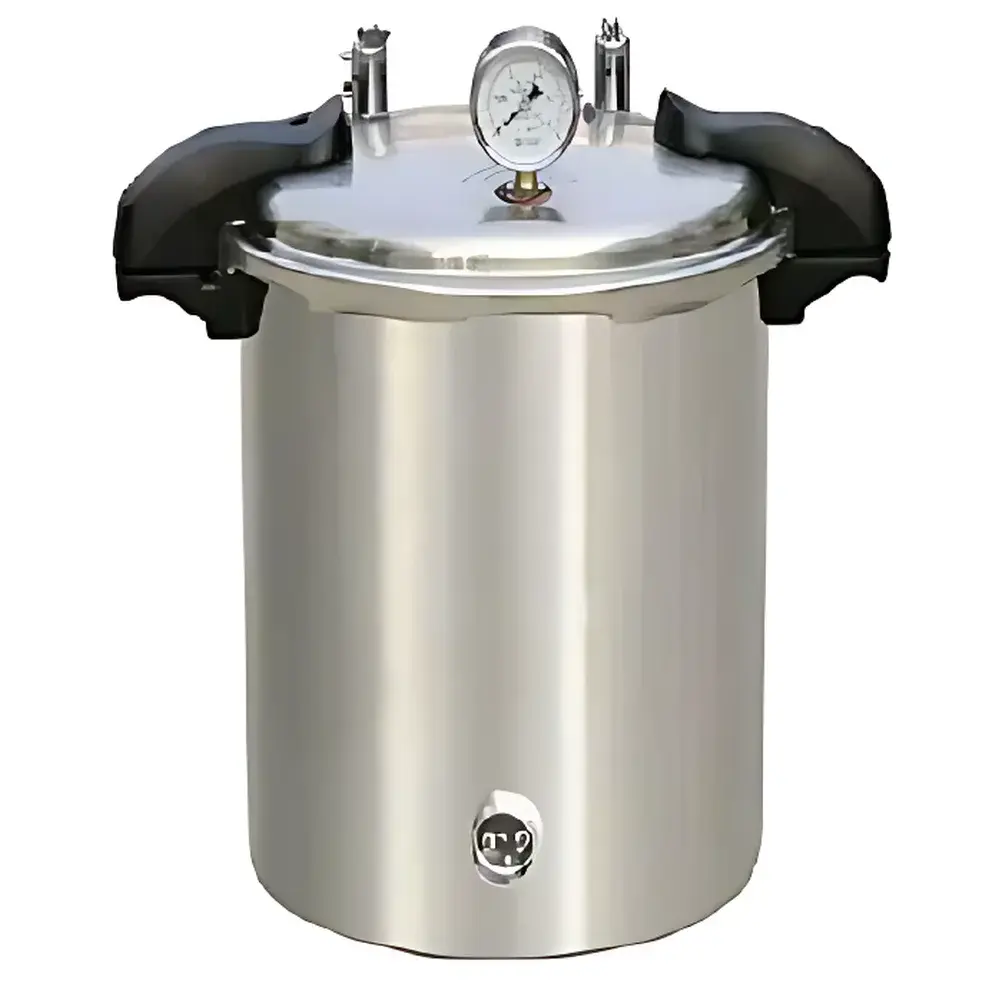
YXQ-SG46-280SA Portable Dual-Fuel (Coal/Electric) Autoclave
| Origin | Shanghai, China |
|---|---|
| Manufacturer Type | Authorized Distributor |
| Origin Category | Domestic (PRC) |
| Model | YXQ-SG46-280SA |
| Chamber Volume | 18 L |
| Rated Operating Temperature | 126 °C |
| Rated Working Pressure | 0.142 MPa |
| Power Rating | 2 kW |
| Voltage/Frequency | 220 V ±10%, 50 Hz ±2% |
| Dimensions (D×H) | 390 mm × 470 mm |
| Construction Material | SUS304 Stainless Steel (Outer Shell & Inner Chamber) |
| Safety Features | Pressure-Actuated Self-Relief Valve, Dual-Scale Pressure Gauge, Auto-Locking Lid Mechanism, Expansion-Type Sealing Ring |
| Heating Mode | Dual-Fuel (Electric or Solid Fuel Compatible) |
| Lid Operation | Lever-Actuated Quick-Opening Mechanism |
Overview
The YXQ-SG46-280SA Portable Dual-Fuel (Coal/Electric) Autoclave is a compact, manually operated steam sterilization system engineered for reliable moist-heat sterilization under saturated steam conditions. It operates on the principle of thermal inactivation via pressurized saturated steam, achieving microbial lethality through time–temperature–pressure integration at 126 °C and 0.142 MPa (equivalent to ~20.6 psi). Designed for field-deployable or resource-constrained laboratory environments—including rural clinics, agricultural extension stations, teaching labs, and mobile pathology units—the unit supports both electric and solid-fuel (e.g., coal, biomass briquettes) heating modes, ensuring operational continuity where stable grid power is unavailable. Its 18 L chamber accommodates standard sterilization loads including wrapped surgical instruments, cotton gauze, glassware, liquid media (with appropriate venting protocols), and tissue processing cassettes—making it functionally complementary to downstream histopathology workflows such as tissue dehydration and embedding. The device complies with fundamental sterilization process requirements outlined in ISO 17665-1:2019 (Sterilization of health care products — Moist heat — Part 1: Requirements for development, validation and routine control), and its pressure/temperature profile aligns with minimum sterilization benchmarks defined in WHO TRS No. 919 Annex 2 and USP for steam sterilization.
Key Features
- True dual-fuel capability: Switchable between 2 kW electric resistance heating and external solid-fuel combustion (e.g., coal or biochar), enabling deployment in off-grid or low-infrastructure settings.
- SUS304 stainless steel construction throughout—both outer jacket and inner chamber—provides long-term resistance to chloride-induced pitting, acidic condensate corrosion, and alkaline cleaning agents commonly used in lab decontamination cycles.
- Integrated safety architecture: Pressure-actuated self-relief valve set at 0.142 MPa ensures passive overpressure protection; auto-locking lid mechanism prevents accidental opening during pressurized operation; expansion-type silicone-reinforced sealing ring maintains consistent steam-tight integrity across repeated thermal cycles.
- Lever-operated quick-opening lid design reduces cycle turnaround time and minimizes operator fatigue during high-frequency use—critical in high-throughput pathology support labs.
- Dual-scale analog pressure gauge (MPa and psi) enables intuitive cross-reference during validation checks and regulatory documentation; calibrated per national metrological standards (JJG 52-2013).
Sample Compatibility & Compliance
The autoclave accommodates porous and non-porous loads up to 18 L volume, including but not limited to: stainless-steel instrument sets, textile dressings, borosilicate glass Petri dishes and pipettes, aqueous nutrient broths (sterilized using slow exhaust mode), and formalin-fixed tissue specimens pre-loaded into stainless steel baskets. Load configuration must follow validated placement patterns to ensure uniform steam penetration and air removal—particularly critical when processing tissue cassettes prior to dehydration. While not certified to EN 13060 or FDA 510(k) as a Class II medical device, the unit meets baseline functional requirements for non-critical and semi-critical item sterilization per CDC Guideline for Disinfection and Sterilization in Healthcare Facilities (2008) and Chinese National Standard GB 8599–2008 (Large Steam Sterilizers). Routine biological indicator testing (e.g., Geobacillus stearothermophilus spore strips) is recommended for process verification.
Software & Data Management
This is a manually controlled, non-programmable autoclave with no embedded microprocessor, digital interface, or data logging capability. All operational parameters—including cycle initiation, timing, pressure monitoring, and exhaust sequencing—are managed by user observation and mechanical controls. As such, it does not support electronic audit trails, user access logs, or 21 CFR Part 11 compliance features. For laboratories requiring traceable sterilization records, integration with external temperature/pressure dataloggers (e.g., compliant with ASTM E2893–22) and manual logbook entries per GLP/GMP Annex 11 principles is advised. Cycle documentation must include date, operator ID, load composition, observed pressure/temperature duration, and BI test results.
Applications
- Pre-sterilization of histological tools (forceps, scalpels, embedding molds) in pathology preparation labs.
- Decontamination of reusable culture media containers and glassware in teaching microbiology laboratories.
- Routine sterilization of veterinary field equipment in agricultural extension services.
- Emergency sterilization of wound-care supplies in remote health posts lacking centralized sterilization infrastructure.
- Validation reference unit for comparative studies assessing alternative sterilization methods (e.g., dry heat vs. steam).
FAQ
Can this autoclave be used for sterilizing liquid media without boil-over?
Yes—when configured with slow exhaust mode and appropriate load volume (≤75% chamber capacity), it safely sterilizes aqueous solutions. Pre-vacuum is not available; therefore, careful loading and venting are essential.
Is the unit suitable for sterilizing wrapped surgical kits?
Yes, provided packaging permits steam penetration (e.g., non-woven wraps or perforated metal containers) and load density allows uniform heat distribution.
Does it meet international regulatory requirements for clinical use?
It satisfies core physical performance criteria per GB 8599–2008 and ISO 17665-1, but lacks CE marking, FDA clearance, or ISO 13485 manufacturing certification—intended for research, educational, or auxiliary clinical support roles.
What maintenance is required to sustain accuracy and safety?
Monthly inspection of the sealing ring for compression set or cracking; quarterly calibration of the pressure gauge against a certified reference standard; annual verification of relief valve set point by qualified technician.
Can third-party validation services be applied?
Yes—qualified sterilization validation providers can perform IQ/OQ/PQ using thermocouple mapping, biological indicators, and pressure transducer correlation per ISO 17665-2.




