
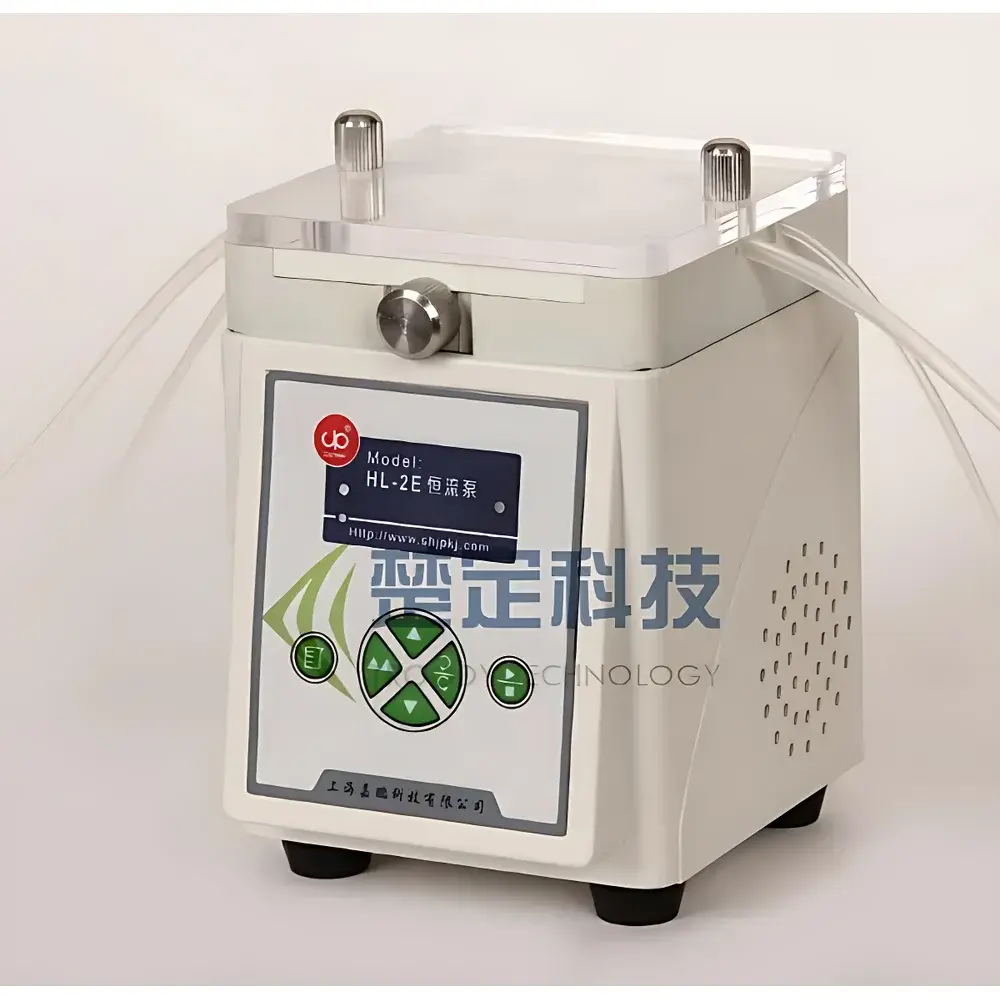
HL-2E Dual-Channel Peristaltic Pump
| Origin | Shanghai, China |
|---|---|
| Manufacturer Type | Authorized Distributor |
| Product Origin | Domestic (China) |
| Model | HL-2E |
| Instrument Type | Peristaltic Pump |
| Flow Rate Range | 0–900 mL/h per channel (2× independent channels) |
| Speed Range | 0–65 rpm (continuous adjustment) |
| Filling Mode Speed Range | 0–60 rpm |
| Maximum Back Pressure | ≥3 kgf/cm² |
| Drive System | Microstepping Stepper Motor with Precision Control Circuitry |
| Interface | Touch-Sensitive Membrane Keypad |
| Noise Level | Low (<45 dB(A) at 1 m) |
Overview
The HL-2E Dual-Channel Peristaltic Pump is an engineered solution for precise, repeatable fluid handling in laboratory and pilot-scale applications requiring independent control of two parallel flow paths. Operating on the principle of positive displacement via roller compression of flexible tubing, this pump delivers consistent volumetric flow without fluid contact with mechanical components—ensuring contamination-free transfer of sensitive reagents, cell suspensions, culture media, or sterile solutions. Its design adheres to core requirements of GLP-compliant workflows where traceability, reproducibility, and tubing-based isolation are critical. The HL-2E is not intended for high-pressure hydraulic systems but is optimized for low-to-moderate back pressure environments typical of gravity-fed filtration, chromatography fraction collection, bioreactor feed lines, and multi-stream reagent dispensing.
Key Features
- Dual independent channels with synchronized or asynchronous speed control—enabling simultaneous but distinct flow profiles for comparative dosing or parallel sample processing.
- Microstepping stepper motor drive with high-resolution细分 circuitry ensures smooth rotation, minimal torque ripple, and stable flow across the full 0–65 rpm range; filling mode operates within a dedicated 0–60 rpm sub-range for enhanced volumetric repeatability during discrete dispensing cycles.
- Touch-sensitive membrane keypad interface provides intuitive access to speed adjustment, direction reversal, start/stop, and preset filling volume entry—eliminating mechanical wear associated with traditional push-button panels.
- Flow rate capability of 0.5–900 mL/h per channel (dependent on tubing ID and pump head configuration), supporting common silicone or PharMed® BPT tubing sizes (e.g., 13#, 14#, 16#, 25#).
- Robust aluminum alloy chassis with vibration-damping feet ensures operational stability during extended unattended runs; noise emission remains below 45 dB(A) at 1 meter—suitable for shared lab environments and cleanroom-adjacent installations.
- Modular pump head design allows rapid tubing replacement and accommodates standard dual-roller configurations compatible with ISO 8536-4 and USP compliant tubing sets.
Sample Compatibility & Compliance
The HL-2E is compatible with a broad range of chemically resistant, USP Class VI-certified tubing materials—including platinum-cured silicone, Pharmed BPT, and Tygon® E-3603—enabling safe handling of aqueous buffers, organic solvents (e.g., ethanol, isopropanol), mild acids/bases, and protein-containing solutions. It meets functional requirements outlined in ASTM D4185 (standard practice for peristaltic pump calibration) and supports audit-ready operation when integrated into validated processes under ISO/IEC 17025 or FDA 21 CFR Part 11 frameworks—provided electronic logging (via optional RS-485 or analog output modules) and user access controls are implemented at the system level.
Software & Data Management
While the HL-2E operates as a standalone instrument with local keypad control, it supports external integration via 0–5 V or 4–20 mA analog input/output interfaces for remote speed modulation and status feedback. Optional TTL-level pulse output enables connection to data acquisition systems for time-stamped flow event logging. When deployed in regulated environments, users may configure external SCADA or LIMS platforms to record pump runtime, total dispensed volume per channel, and operator ID—fulfilling ALCOA+ data integrity principles (Attributable, Legible, Contemporaneous, Original, Accurate) required under GxP guidelines.
Applications
- Automated fraction collection in preparative HPLC and SEC systems.
- Parallel feeding of nutrient media or inducers into multi-vessel microbial fermentation setups.
- Calibration standard delivery in spectrophotometric or ICP-MS sample introduction lines.
- Controlled reagent addition during titration or kinetic assay development.
- Low-shear transfer of shear-sensitive biologics (e.g., viral vectors, exosomes) where diaphragm or piston pumps pose aggregation risks.
- Small-batch sterile filling of vials or syringes under laminar flow hoods using pre-sterilized tubing assemblies.
FAQ
What tubing sizes are supported by the HL-2E pump head?
Standard dual-channel pump heads accept tubing IDs from 0.5 mm to 3.2 mm (e.g., Cole-Parmer Masterflex L/S #13–#25), with optimal performance achieved using wall thicknesses conforming to DIN 73378 or ISO 8536-4 specifications.
Can the HL-2E be used for sterile applications?
Yes—when paired with gamma-irradiated, pyrogen-free tubing and operated under aseptic conditions, the HL-2E supports ISO 5 (Class 100) cleanroom-compatible fluid transfer; tubing must be replaced between batches to maintain sterility assurance.
Is flow calibration traceable to national standards?
The pump itself does not include built-in gravimetric calibration; however, its speed-to-flow relationship can be empirically validated using NIST-traceable balance and timer equipment per ASTM D4185, with documented SOPs enabling regulatory submission.
Does the HL-2E support programmable dispensing sequences?
No—the unit lacks onboard memory or scripting capability; programmable multi-step filling requires integration with external PLC or PC-based control software via analog or digital I/O signals.
What maintenance intervals are recommended?
Roller alignment verification and tubing replacement are advised every 500 operating hours or after 100 autoclave cycles (if applicable); periodic inspection of motor coupling and keypad responsiveness is included in routine GLP equipment checklists.



