
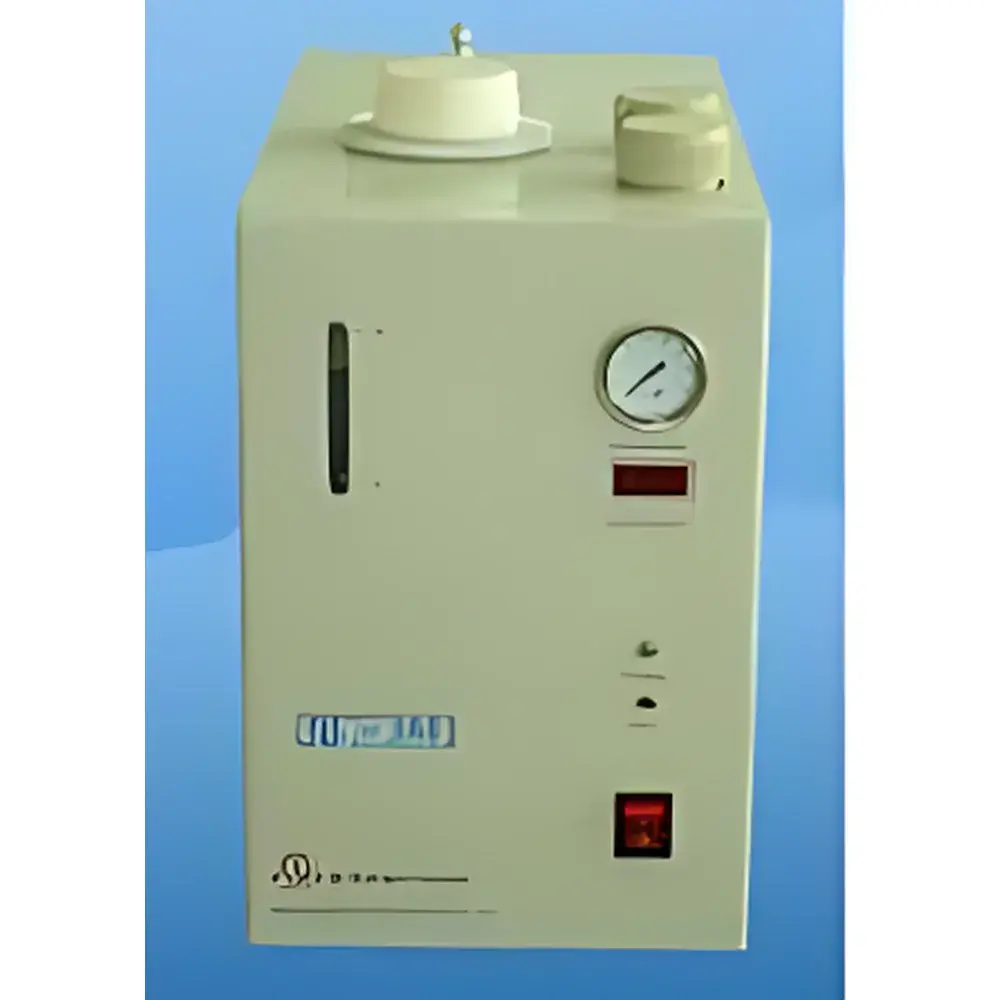
Chu Ding Technology QL-300 SPE-Based High-Purity Hydrogen Generator for GC Applications
| Brand | Chu Ding Technology |
|---|---|
| Origin | Shanghai, China |
| Manufacturer Type | Authorized Distributor |
| Country of Origin | China |
| Model | QL-300 |
| Price | USD 1,200 (FOB Shanghai) |
| Purity | >99.999% H₂ |
| Output Flow | 0–310 mL/min |
| Output Pressure | 0.02–0.4 MPa |
| Power Supply | 220 V ±15%, 50–60 Hz |
| Max. Power Consumption | 150 W |
| Dimensions (W×D×H) | 500 × 270 × 420 mm |
| Water Reservoir Capacity | 3.2 L |
| Water Consumption | 14.46 g/h |
| Feed Water Resistivity Requirement | ≥1 MΩ·cm |
Overview
The Chu Ding Technology QL-300 is a compact, laboratory-grade hydrogen generator engineered specifically for gas chromatography (GC) and analytical chemistry applications requiring continuous, high-purity hydrogen fuel or carrier gas. Unlike traditional alkaline electrolysis systems, the QL-300 employs Solid Polymer Electrolyte (SPE) membrane technology—eliminating the need for caustic KOH or NaOH electrolytes entirely. This design enables on-demand, ultra-pure hydrogen generation directly from deionized water (≥1 MΩ·cm resistivity), ensuring zero chemical carryover, minimal maintenance, and intrinsic operational safety. The core electrochemical cell integrates a composite catalyst–ionomer electrode structure with zero-gap configuration, maximizing proton transfer efficiency and minimizing ohmic losses. Hydrogen is generated via water electrolysis at the anode (2H₂O → 4H⁺ + O₂ + 4e⁻), followed by selective proton conduction through the Nafion™-type PEM to the cathode, where reduction yields high-purity H₂ (4H⁺ + 4e⁻ → 2H₂). Integrated gas–water separation and dual-stage desiccant drying deliver consistent ≥99.999% H₂ purity—meeting ASTM D1945 and ISO 8573-1 Class 1 requirements for instrumental gas supply.
Key Features
- SPE-based electrolysis: No liquid electrolyte required—eliminates corrosion risk, operator exposure hazards, and electrolyte replenishment/maintenance.
- High-efficiency zero-gap catalytic electrodes: Low cell voltage (<1.8 V per cell), reduced thermal load, extended service life, and stable long-term output.
- Intelligent flow & pressure regulation: Microprocessor-controlled proportional valve maintains constant output pressure (0.02–0.4 MPa) and dynamically adjusts flow (0–310 mL/min) in real time to match GC detector or carrier gas demand.
- Integrated safety architecture: Over-pressure shutoff, low-water-level cutoff, over-temperature protection, and automatic system purge upon shutdown.
- Energy-optimized operation: Rated max power draw of only 150 W; water consumption of just 14.46 g/h at full output—significantly lower than conventional alkaline generators.
- Compact footprint (500 × 270 × 420 mm) and modular dry-box design: Fits seamlessly under standard GC workbenches or within instrument cabinets.
Sample Compatibility & Compliance
The QL-300 is validated for use with all major GC platforms—including flame ionization (FID), thermal conductivity (TCD), nitrogen phosphorus (NPD), and electron capture (ECD) detectors—as both fuel gas and carrier gas. It complies with key international standards governing laboratory gas purity and safety: ISO 8573-1:2010 Class 1 (for particulates, moisture, and oil content), ASTM D1945–22 (specifications for hydrogen used in gas analysis), and IEC 61010-1:2012 (safety requirements for electrical equipment for measurement, control, and laboratory use). Its electrolyte-free design supports GLP and GMP environments where auditability of consumables and absence of hazardous chemicals are mandatory. No regulatory filing is required for installation in EU or North American laboratories, as it falls outside the scope of PED 2014/68/EU (pressure equipment) due to its maximum operating pressure of 0.4 MPa (4 bar) and non-steam/non-toxic service classification.
Software & Data Management
While the QL-300 operates as a standalone hardware unit without embedded firmware-based data logging, it features RS-232 serial interface (optional USB-to-serial adapter available) for integration into centralized lab monitoring systems. Status signals—including ready/stable, low-water alarm, over-pressure fault, and temperature warning—are provided as TTL-level digital outputs compatible with PLCs or building management systems. For regulated environments, third-party SCADA or LabVantage interfaces can capture timestamped event logs, enabling 21 CFR Part 11–compliant audit trails when paired with validated software layers. All operational parameters remain fully accessible via front-panel LED indicators and tactile push-button controls—ensuring deterministic behavior independent of network connectivity.
Applications
- Primary hydrogen source for FID and TCD detectors in routine QC/QA GC labs across pharmaceuticals, petrochemicals, food safety, and environmental testing.
- Carrier gas alternative to helium in capillary GC methods where hydrogen’s superior efficiency and speed justify method revalidation.
- On-site, low-risk hydrogen supply for benchtop hydrogenation reactors, fuel cell test stations, and inert atmosphere glove boxes.
- Replacement for high-pressure cylinder systems—reducing logistical overhead, storage compliance burdens (OSHA 1910.101, CGA G-1), and emergency response liabilities.
- Research-grade hydrogen feed for hyphenated techniques including GC–MS and GC–FTIR, where baseline stability and trace-level impurity control are critical.
FAQ
What type of water must be used with the QL-300?
Deionized or double-distilled water with resistivity ≥1 MΩ·cm is mandatory. Tap water, distilled-only water, or water treated solely by reverse osmosis (without final ion-exchange polishing) will cause rapid membrane fouling and irreversible performance loss.
Can the QL-300 supply hydrogen to multiple GC instruments simultaneously?
Yes—provided total combined flow demand remains within 310 mL/min and downstream pressure drop across manifolds/tubing is compensated via calibrated back-pressure regulation. A dedicated stainless-steel distribution panel with individual needle valves and inline particulate filters is recommended.
How often does the desiccant require replacement?
Under typical GC usage (≤200 mL/min, 8 h/day), the integrated silica gel–molecular sieve cartridge lasts 6–9 months. Replacement interval shortens significantly if feed water resistivity falls below specification or ambient humidity exceeds 60% RH.
Is the QL-300 certified for use in explosion-hazard areas (ATEX/IECEx)?
No—the unit is rated for general laboratory use (IP20 enclosure) and is not intrinsically safe. It must be installed outside classified zones per NEC Article 500 and IEC 60079-10-1.
Does the generator produce oxygen as a byproduct—and is venting required?
Yes—oxygen is generated stoichiometrically (1 mol O₂ per 2 mol H₂) and safely discharged through a dedicated exhaust port. Passive venting to ambient lab air is sufficient; no active extraction is needed unless local ventilation codes mandate otherwise.
Related Products





